Most customers check their delivery status at least twice per order. They’re not tracking the truck. They’re checking whether your ETA is still honest.
GPS tracking reports coordinates. Route sequencing does something fundamentally different: it calculates when your driver will actually reach each stop, factoring in service time, dwell time, and the dependency chain connecting every delivery on a multi-stop route.
Accurate ETAs don’t come from a pin on a map. They come from a sequence model with clean inputs, one that accounts for the entire shape of your driver’s day. That’s exactly what CIGO Tracker is built to do.
Key Takeaways
- GPS tracking for delivery trucks reports location. Route sequencing calculates when each stop will be reached.
- One delay ripples through every ETA that follows. GPS cannot model this. Route sequencing can.
- Accurate delivery ETAs need a correct stop order, realistic service time, and live traffic data.
- Inaccurate ETAs drive churn, reattempts, and failed-delivery penalties. The cost adds up fast.
- The gold standard for ETA prediction for the last mile is sequence-based ETAs that update continuously. That’s what route sequencing software delivers.
What Is Route Sequencing?
Route sequencing determines the optimal order in which your driver visits stops on a route, accounting for locations, time windows, service times, vehicle constraints, and live traffic.
The goal is to minimise total route time while maximising the on-time delivery rate.
Distance alone doesn’t drive good sequencing. The shortest path between stops isn’t always the fastest or most time-window-compliant option. More importantly, sequence decisions are compound.
The order you set for your first ten stops directly determines whether your last ten stops are achievable within shift hours.
Get the sequence right, and your ETAs hold. Get it wrong, and early delays cascade through every window that follows.
Route Sequencing vs. Route Optimisation
Route optimisation is the broader process. Route sequencing is the specific component that directly controls ETA for every stop on your route.
| Route Sequencing | Route Optimization | |
| Scope | Stop order on a single route | Full planning across all routes |
| Primary output | Ordered stop list with ETAs | Assigned loads, sequenced routes |
| ETA impact | Direct | Indirect |
When people say “the route is optimised,” they usually mean the sequence has been computed.
The quality of that sequence is what determines ETA reliability. Understanding the difference between logistics and route optimization clarifies where sequencing fits in the broader planning picture.
Route Sequencing vs. GPS Tracking
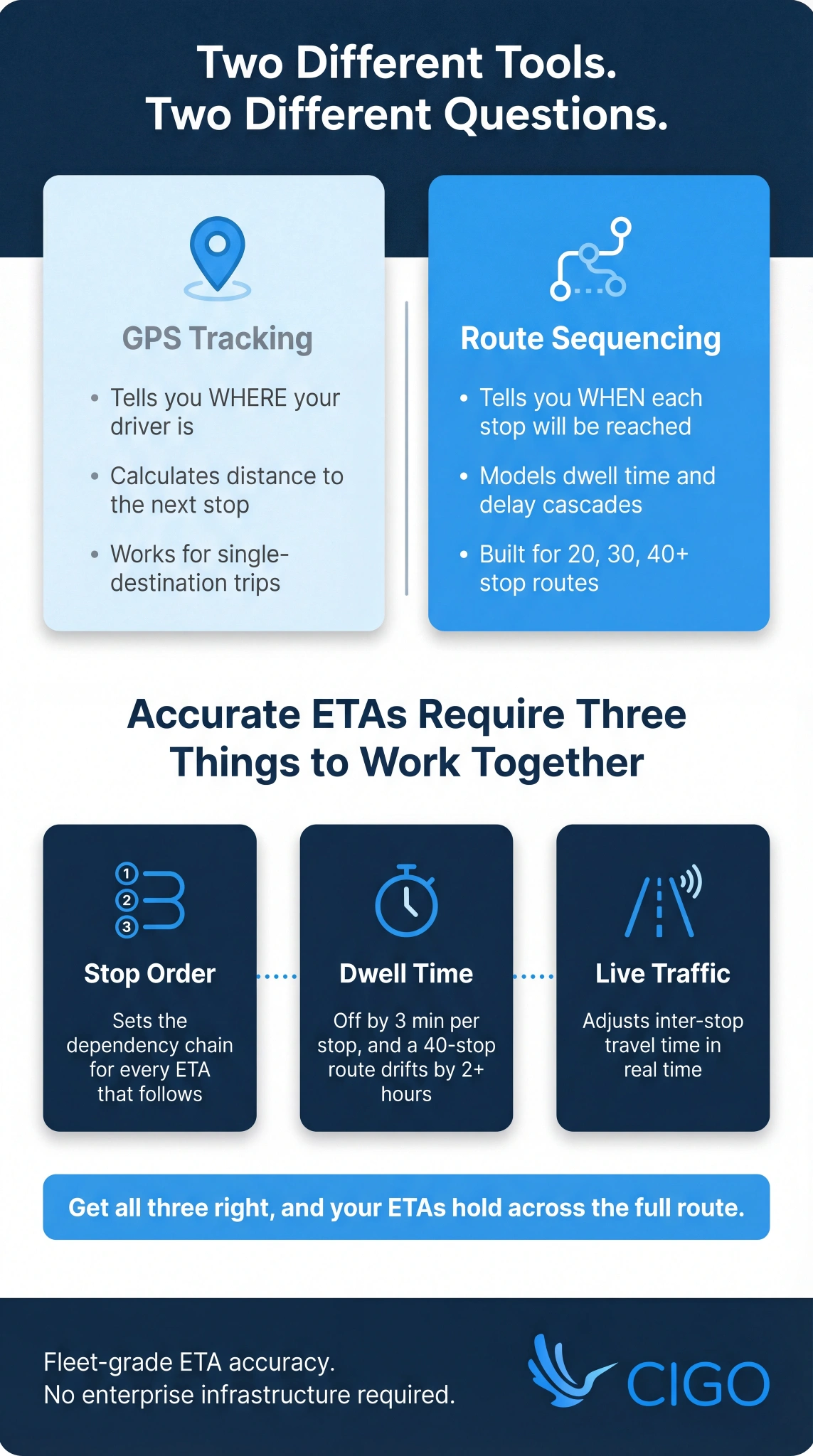
GPS tracking for delivery trucks tells you where your vehicle is right now. Route sequencing tells you where it should be at every point in the day. Those are different things.
- GPS reports live location with no model of service time, stop order, or downstream delay impact
- Route sequencing recalculates when your driver will reach each remaining stop based on current progress and conditions
- GPS feeds sequencing but cannot produce an accurate delivery ETA on its own
Why GPS Tracking Alone Doesn’t Deliver Accurate ETAs
GPS knows your vehicle’s current location and can calculate distance to the next stop.
What it can’t account for is how long your driver will spend there, or how that dwell time shifts every window that follows.
GPS-only ETAs are point-to-point calculations built for a single destination. Last-mile delivery isn’t a single-destination. Reducing late deliveries with GPS tracking only works when live location data pairs with a sequence model that can interpret what position actually means for the rest of your route.
What GPS Can and Cannot Tell You
GPS CAN tell you:
- Your vehicle’s current location
- Distance to the next stop
- Estimated arrival at the next stop based on typical road speed
GPS CANNOT tell you:
- How long your driver will spend at the next stop
- How a delay at stop 5 pushes back every stop that follows
- Whether your current sequence will complete within the shift window
The further out a stop is in your sequence, the less useful a GPS-derived ETA becomes. Uncertainty compounds with every unmodelled dwell event between now and that stop.
The Multi-Stop Problem: Why GPS ETAs Break Down at Scale
On a 40-stop route, a 5-minute dwell overrun per stop accumulates to over three hours of ETA drift by your final stop. GPS recalculates each stop independently, without adjusting for time already lost at earlier stops.
By the time your customers at the end of the route receive a dramatically wrong ETA, it’s already too late to recover.
Research by OpenSend confirms 60% of consumers abandon retailers completely following a late delivery experience. Most of those losses don’t trace back to a bad driver or a traffic incident.
They trace back to a sequence model that couldn’t account for what was actually happening on the route.
How Route Sequencing Produces Accurate ETAs

Route sequencing builds a time model of your entire route. Estimated arrival at each stop, dwell time, estimated departure, and the cumulative impact of any delay are all calculated upfront.
When one stop runs over, the model recalculates ETAs for every stop that follows. The update cascades through your full sequence in real time. GPS tells you where your driver is right now. Sequencing tells you what the rest of your day actually looks like from that point forward.
Stop Order + Service Time + Traffic = Reliable ETA
Three inputs determine whether your ETAs hold or collapse.
- Stop order (sequence) establishes the dependency chain. Each stop’s ETA depends on everything that came before it, so sequence accuracy is non-negotiable.
- Service time (dwell) is the per-stop estimate of how long your driver will spend on site. It’s the single most important input in the model and the most commonly underestimated.
- Live traffic adjusts inter-stop travel time in real time. Important, but secondary to dwell accuracy on dense urban routes where stops are close and service time dominates total route duration.
Get all three right, and your ETAs hold across the full sequence.
How Sequence Changes Cascade Through ETAs
When a stop is added, removed, or reordered, every subsequent ETA on your route must be recalculated. Route sequencing software handles this automatically. Manual and GPS-only approaches do not.
A single 20-minute delay at stop 8 on a 35-stop route pushes every remaining window back by 20 minutes. Your customers at stops 9 through 35 need updated ETAs immediately, not when your driver is already running late and the damage is done.
Predictive ETAs vs. Reactive ETAs
| Reactive ETA | Predictive ETA | |
| What it triggers | After the driver is already running late | Before the driver falls behind |
| Signal source | GPS deviation from the expected position | Dwell time actuals and live traffic earlier in the route |
| Customer experience | Belated notification after damage compounds | Proactive window update before expectations are broken |
| Recovery opportunity | Limited | High |
Sequencing makes the prediction possible. Proactive logistics communication reduces churn and exception costs at scale by making those predictions visible to your customers before they become problems.
The Business Cost of Inaccurate ETAs
Inaccurate ETAs are not just a customer experience problem. They drive measurable operational costs that accumulate every day the sequence model is wrong.
Customer-Facing Costs
Inaccurate ETAs cost more than most fleets realise.
When your ETA window is wrong, customers aren’t home. That triggers a reattempt at full marginal cost, and every one of those reattempts was preventable with a better sequence model.
Inbound calls checking on delivery status are largely a function of ETA unreliability, not curiosity. Poor sequencing directly inflates your support overhead. What customers now expect from delivery sets the bar: tight windows, live updates, and proactive communication are no longer differentiators.
The PwC Retail Monitor found that in the post-pandemic last-mile environment, accuracy now takes priority over speed. Your customers are no longer willing to trade window reliability for faster nominal delivery.
Operational Costs
- Reattempt labour and fuel: Each failed delivery from an inaccurate window is a full-cost second or third attempt that never needed to happen.
- Driver overtime: Late-day route collapses due to dwell-time underestimation are predictable and preventable with better sequencing inputs.
- Dispatcher overhead: Chasing driver ETAs and managing “where’s my delivery?” calls is a direct labour cost of sequencing inaccuracy, not an unavoidable cost of doing business.
How to Build a Route Sequencing Model That Produces Accurate ETAs
Your sequencing model is only as good as its inputs. Most sequencing failures trace back to one or two specific inputs that are wrong or missing.
Build your model in this order: stop order constraints first, then dwell time calibration, traffic integration, and finally predictive ETA logic. Get the sequence right from the ground up, and the ETAs your customers receive will actually hold.
Inputs That Matter Most
- Customer time windows: Hard constraints your sequence must respect. Sequencing around missed windows is the most common cause of late-day route failure.
- Driver shift window: The total time available to complete all stops. Your sequence must fit within this envelope, accounting for all dwell time and travel.
- Stop dependencies: Some stops must be visited before others, such as a pickup before a drop or a morning commercial before an afternoon residential.
- Vehicle and access constraints: Stops requiring specific equipment, access codes, or dock appointments must be sequenced around those availability windows.
Dwell Time: The Variable Most Fleets Underestimate
Dwell time is the per-stop estimate of how long your driver spends making a delivery, capturing proof, and returning to the vehicle.
Most fleets use a single average for every stop. In practice, dwell time varies significantly by stop type: residential versus commercial, parcel versus pallet, easy access versus constrained.
Underestimate by even three to four minutes per stop and you’re looking at over two hours of ETA drift on a 40-stop route. This single input causes more ETA failures than any other variable in your model.
Sequence Constraints That Must Be Enforced
- Time window hard constraints: stops with tight windows, like a 9–10 am commercial receiving dock, must anchor your sequence around them.
- Geographic clustering within time windows: stops that share a window should be clustered to minimise inter-stop drive time within that window.
- End-of-route buffer: the last 10–15% of your route should carry the most flexible windows or longest dwell buffers to absorb cumulative variability.
Keeping Your ETA Model Honest
Your ETA model is only as accurate as its inputs, and those inputs drift over time.
Review dwell time actuals monthly and recalibrate when they deviate from model assumptions by more than 10%. If late-route accuracy degrades consistently, your dwell estimates are too optimistic, not your traffic data.
Track prediction gaps by stop type to pinpoint exactly which assumption needs fixing. That’s a faster fix than rebuilding the model from scratch.
Best-Fit Use Cases

High-Stop-Count Last-Mile Delivery
If your routes regularly hit 20 or more stops, the multi-stop ETA cascade is your biggest accuracy risk.
A 3-minute average dwell error per stop produces 60 minutes of drift by stop 20, and GPS has no mechanism to detect or correct it. Your customers at the end of the route receive dramatically wrong windows long before you can recover.
Sequence-based ETAs are the only reliable model at this scale.
Customer-Facing B2C Delivery With Committed Windows
When you promise a delivery window at booking, ETA accuracy is no longer just an operational metric, it’s a direct commitment to your customer.
Sequence-based predictive ETAs let you update those windows proactively when conditions change, protecting that promise without requiring driver intervention. McKinsey’s research on what US consumers want from e-commerce deliveries shows shoppers rank on-time delivery above speed.
That puts your sequencing model at the centre of retention, not just route performance.
Service and Field Operations
Field service operations, including maintenance, installation, and healthcare delivery, carry longer per-stop dwell times and tighter appointment windows than standard parcel delivery.
A sequencing model built on last-mile parcel defaults will collapse your ETAs at stop 3. Calibrate dwell time assumptions to your actual stop type. For service operations running 30 to 90 minutes per stop, that single adjustment produces more reliable windows than any other change you can make.
Implementation Best Practices
Start with dwell time calibration before anything else. It’s the root cause of most ETA failures and the most direct fix available to you.
Segment dwell time by stop type immediately. Averaging residential and commercial together hides a difference that’s typically 8 to 15 minutes per stop, and that compounds fast across a full route.
Set up cascading ETA notifications before rollout, then track accuracy by stop position weekly for the first three months. Your sequence model and communication layer have to work together, otherwise the business value never reaches your customer.
Common Mistakes to Avoid
- Using a single dwell time average for all stops. It’s the most common and most damaging sequencing input error you’ll encounter, and the easiest to fix with real execution data.
- Treating GPS location updates as ETA updates. Location tells you where your driver is. Your sequence model tells you when they’ll arrive. These are different questions that need different answers.
- Building sequences without time-window hard constraints enforced. A faster sequence that misses a committed window is a failed delivery for your customer, not an optimization.
KPIs to Track After Implementing Sequence-Based ETAs
- ETA accuracy rate: the percentage of your stops completed within the promised window, tracked by stop position to show exactly where your model drifts.
- Reattempt rate: failed deliveries caused by customers missing your promised window. This should decline as your ETA accuracy improves.
- Inbound customer contacts per route: calls and messages asking about delivery status. A direct signal of how much your customers trust your ETAs.
- Driver overtime rate: late-day overtime driven by dwell time underestimation. Calibrate your inputs and this number moves.
- Dwell time variance by stop type: the KPI that drives continuous model improvement. Track it by stop type, not just in aggregate.
These numbers tell you where your model is breaking. Handling delivery delays with transparent playbooks determines whether your customers experience that breakdown as a trust event or a proactive update.
How CIGO Tracker Improves ETA Accuracy Through Route Sequencing
CIGO Tracker gives you the execution data your sequence model actually needs.
Optimized routing builds sequences around your real stop constraints, while real-time delivery tracking lets you spot dwell overruns at early stops before they cascade.
Customer engagement tools push updated ETAs proactively, and last-mile management captures stop-level exceptions so recurring issues feed back into planning rather than landing on your dispatcher as the next fire drill.
Future Trends in ETA Prediction
AI-driven micro-ETA models are moving beyond fixed dwell averages, predicting per-stop service time based on customer history, stop type, time of day, and driver experience.
A 2025 peer-reviewed review of last-mile delivery optimization confirms that integrating AI and machine learning into routing systems directly improves delivery time prediction and reduces time delays. That targets the biggest source of sequencing error you face today.
Dynamic resequencing keeps your model current throughout the day, not just at dispatch. And as customer-driven ETA negotiation becomes standard, your sequence model becomes the engine behind a two-way reliability loop, not just an internal planning tool.
Are You Building Your ETAs or Just Tracking Them?

GPS tracking for delivery trucks tells you where. Route sequencing tells you when. Accurate delivery ETAs come from better inputs, not more tracking layers, and that’s an engineering problem with a solvable root cause.
CIGO Tracker gives you the route sequencing software to build ETA prediction last-mile accuracy from the ground up. Start your free trial or contact us today.
FAQs
What is route sequencing, and why does it matter for delivery ETAs?
Route sequencing determines the stop order on a delivery route and calculates an accurate delivery ETA for each stop. Without it, GPS tracking for delivery trucks cannot model dwell time or sequence dependencies, leading to ETAs that drift as the route progresses.
Why doesn’t GPS tracking alone give accurate delivery ETAs?
GPS tracking for delivery trucks shows location, not timing. It cannot estimate stop service time or the impacts of cascade delays across a multi-stop route. Route sequencing software closes that gap by modelling the full route timeline.
What is dwell time, and why is it so important for route sequencing?
Dwell time is how long your driver spends at each stop. Underestimating it by even three minutes per stop creates over two hours of ETA drift on a 40-stop route. It’s the most common cause of ETA prediction inaccuracy at the last mile.
How do I improve ETA accuracy for my delivery fleet?
Segment your dwell time by stop type, enforce time-window constraints in your route sequencing model, and set up cascading ETA notifications. Better accurate delivery ETA inputs reduce reattempts, overtime, and customer contacts simultaneously.
What KPIs should I track to measure the improvement in ETA accuracy?
Track accurate delivery ETA rate by stop position, reattempt rate, inbound customer contacts per route, driver overtime, and dwell time variance by stop type. These KPIs show whether your route sequencing software is improving over time.