
What is capacity management? It’s the discipline of aligning what your fleet can realistically execute with what you’ve already committed to deliver. This sounds simple in theory but it’s genuinely difficult in practice.
Most overbooking crises don’t start with bad decisions.
They start with fragmented visibility. Dispatch confirms loads without a live picture of driver hours, vehicle availability, or active route capacity. By the time the gap becomes obvious, you’re already rescheduling pickups and burning margin on emergency spot coverage.
That’s exactly where CIGO Tracker comes in, and why the right software changes the outcome entirely.
Key Takeaways
- Capacity management software enforces load limits before commitments are confirmed, not after the damage is done.
- Effective capacity management in the supply chain means “available” is verified against real constraints, not assumed.
- Allocation rules, approval flows, and booking cutoffs reduce spot buys and tender churn across operations.
- Real-time exception handling keeps one truck falling out from becoming a full-day cascade.
- The right capacity management KPIs, utilization, tender acceptance, and cost per load, show exactly where planning breaks down.
What Is Capacity Management?
Capacity management is the practice of measuring, allocating, and protecting available resources so demand never exceeds what your operation can execute.
Most teams understand the concept. Applying it consistently across a live operation is where things break down.
In transportation, that means more than a truck count. It spans driver hours-of-service limits, equipment types, lane availability, dock windows, and lead time requirements by stop. Treat any one as unlimited, and your plans are built on false assumptions.
The consequences are real. According to the U.S. Federal Highway Administration’s freight operations framework, capacity shortfalls directly degrade the predictability and reliability of freight service, making capacity management in supply chain a foundational operational concern, not an afterthought.
Capacity Management in Supply Chain
Capacity management in the supply chain is a chain reaction problem.
When transportation capacity is overbooked, the disruption doesn’t stay contained. It ripples outward. Warehouses hold products they can’t ship. Docks congest because trucks aren’t staged correctly. Customer appointments get missed, and costs compound through demurrage penalties, storage fees, and overtime.
Each team ends up solving a version of the same problem from different constraints.
That’s why cross-team alignment matters: sales promises, order planning, carrier commitments, and customer windows all need to operate from one shared constraint set. Without it, local optimization quietly creates failure everywhere else.
Capacity Management vs. TMS Planning
A common source of confusion: isn’t this what a TMS handles? Not quite. Both tools serve the planning process, but they operate at different stages and answer fundamentally different questions.
| TMS | Capacity Management | |
| When it acts | After loads are created | Before commitment is made |
| Core question | How do we execute this? | Can we commit to this? |
| Primary function | Routing, carrier assignment, rate shopping | Guardrails, allocation rules, demand validation |
| Strength | Optimizing a confirmed day | Preventing an overpromised one |
| Gap it fills | Execution efficiency | Pre-commitment accuracy |
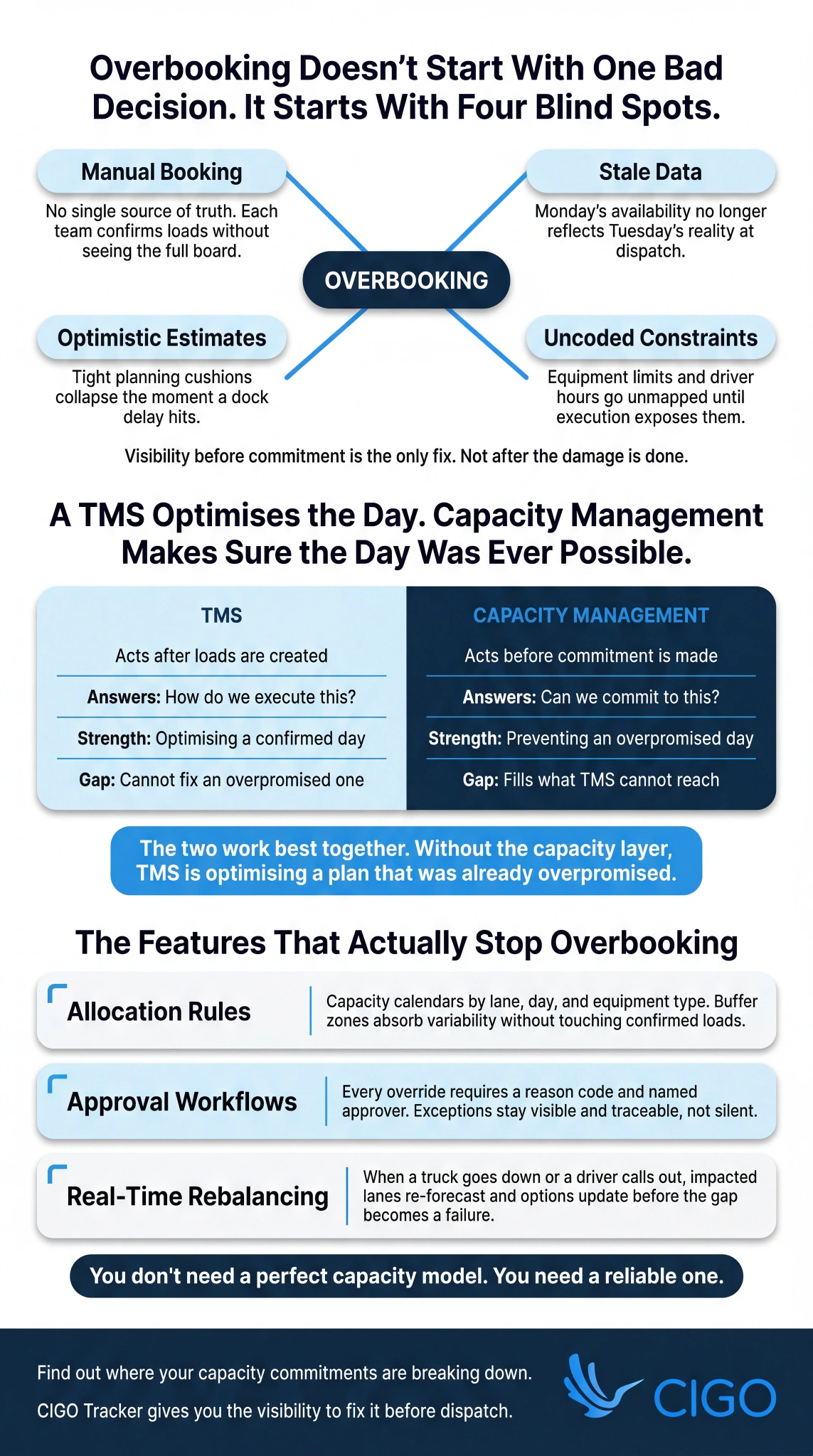
A TMS can execute a well-planned day beautifully. What it cannot do is fix an overpromised one without painful tradeoffs. That’s the gap capacity management fills, and why the two work best together rather than in place of each other.
Why Trucks Get Overbooked

Overbooking rarely happens because of one reckless decision. It usually creeps in through small, reasonable-seeming choices made without full visibility. According to Inbound Logistics, over 40% of sourcing executives report failing to meet demand, largely due to reliance on manually updated platforms that limit operational efficiency.
The root causes tend to follow a familiar pattern:
- Manual booking processes leave no single source of truth, so each team confirms loads without seeing the full board
- Stale availability data means a Monday carrier commitment no longer reflects Tuesday’s reality
- Optimistic service time estimates shrink planning cushions until a dock delay exposes the gap
- Uncoded constraints around equipment limits, driver hours, or lane restrictions get missed entirely until it’s too late
The pattern is predictable, and so is the fix: visibility before commitment, not after.
The Hidden Constraints That Create False Capacity
- Driver and hours-of-service limits shift throughout the week. A driver who was available Monday may be clocking out Thursday based on DOT hours, but if that isn’t tracked against load assignments, the route falls apart late in the week.
- Equipment constraints go deeper than whether you have a truck. Reefer vs. dry, liftgate requirements, cube and weight limits, specialized straps or tie-downs are all factors. Mismatched equipment creates rejections, redelivery costs, and customer service problems.
- Dock and appointment limits are often managed outside the transportation planning tool entirely. Receiving windows close. Check-in rules add time. Detention risk climbs when arrivals bunch up. Left untracked, this daily friction compounds overbooking before anyone notices.
- Lane reality adds another layer. Deadhead distance, seasonal congestion, border delay patterns, and regional traffic all affect how many stops a driver can actually complete in a day. Plans that don’t reflect these patterns are optimistic by design.
The Two Failure Modes
Overbooking shows up in two distinct ways, and understanding both matters because they require different fixes.
The first is oversold capacity; too many loads accepted for the trucks and time available. The solution here belongs at the booking stage, not at dispatch.
The second, and subtler, is misallocated capacity. The total load count looks right, but reefer trucks end up on dry lanes, or heavy freight gets assigned to equipment without the weight rating. Without lane-level visibility, misallocation is easy to miss until a customer call makes it obvious.
How Capacity Management Software Prevents Overbooked Trucks
The core mechanism is straightforward. The software builds a single capacity picture, then blocks conflicts before commitments are made.
Instead of discovering the problem at dispatch, you catch it at booking, when options still exist.
The flow moves from forecast to allocation to booking to execution updates, with discipline enforced at each handoff. Crucially, execution data feeds back into the next planning cycle, so every forecast starts from reality rather than last week’s assumptions.
Forecasting and Capacity Modeling
Effective capacity management starts with demand forecasting at the lane and day level, accounting for seasonality, promotions, and customer patterns. As Inbound Logistics notes, capacity planning requires analyzing historical data and market trends against future demand, not just counting trucks.
Capacity modeling then layers in real constraints, including driver hours, equipment availability, dock windows, and lane lead times. The result is a realistic picture of what the operation can actually execute by day, lane, and equipment type.
Plans built on this foundation hold. Plans built on truck counts rarely do.
Allocation Rules That Stop Overselling
Allocation rules are where capacity management software earns its keep.
Capacity calendars are built by lane, equipment type, and day, each with defined booking limits. Buffer zones, typically the last 10 to 20% of capacity, absorb variability without touching confirmed loads.
When a lane hits its threshold, new requests queue for review or trigger an escalation path. That visibility matters because approval workflows make overrides intentional rather than silent.
Every override and approval gets logged through the delivery dispatch software, which is ultimately what separates a managed exception from a margin leak nobody can trace.
Tendering and Coverage Guardrails
Carrier commitments should live inside the capacity plan, not in a spreadsheet only two people know how to read. According to FreightWaves’ tender rejection research, rejection rates rise sharply when commitment tracking isn’t embedded in the planning process, forcing freight onto a costlier spot market.
When acceptance rates drop or carriers show signs of pulling back, early warning alerts give you time to cover before a route becomes a same-day emergency.
Automated escalation paths, whether rerouting the tender, activating a backup carrier, or flagging for planner review, mean the response is structured rather than improvised. That’s the difference between a recoverable disruption and a missed delivery.
Real-Time Rebalancing When Capacity Changes
Even well-built plans break. A truck goes down, a driver calls out, a dock backs up. What separates good capacity management from fragile capacity management is what happens next.
The software should let you re-forecast, re-allocate, and rebook without duplicating work across teams. Everyone sees the same updated picture, so planners can act while options still exist. That shared real-time supply chain visibility is ultimately what contains the ripple before it becomes a full-day failure.
Key Features to Look For in Capacity Management Software
Not every platform that claims capacity management actually delivers it. The features that matter most depend on where your overbooking comes from, so match accordingly.
- Capacity calendars by lane, day, and equipment type with configurable buffer zones
- Constraint modeling covering driver hours, equipment specs, and dock windows
- Scenario planning tools to stress-test volume spikes or truck losses in advance
- Carrier commitment tracking connected to daily planning, not a separate spreadsheet
- Booking workflows with caps, approval paths, and documented audit trails
- TMS or WMS integrations that keep capacity in sync with the order stream
- Alert logic for overload risk, late tendering, and dock conflicts
- Utilization and tender acceptance reporting so the model improves over time
What Data You Need to Get Value Quickly
Capacity management software is only as good as the data feeding it.
Start with shipment history by lane and day, including actual service times, not assumptions. From there, layer in real driver and equipment availability, dock calendars, and carrier commitment history.
If contracts live in spreadsheets or email threads, that’s a data quality problem to solve before launch. Finally, pull recent exception reasons and service outcomes. They reveal where your planning assumptions are most detached from reality, and where the model needs to be tightest first.
Keep It Practical
The fastest path to value isn’t a perfect model on day one. Start by identifying the 20% of lanes or customers driving 80% of your overload events, then put tight guardrails there first.
From there, assign a single owner responsible for keeping availability data current.
Without that accountability, data drifts and the plan becomes a historical document rather than a live guide. Teams handling multi-stop route planning alongside these constraints will feel that they drift fastest, which is exactly why the data discipline matters most at the execution layer.
Use Cases: Where Capacity Management Pays Off Fast

Shippers and Private Fleets
For shippers running their own fleet, overbooking typically surfaces as missed pickup windows and expensive spot coverage. Accepting a load the fleet can’t support means disappointing the customer, paying spot premium, or both.
Tight capacity calendars and booking cutoffs change that. Your team commits confidently, spot buys drop, and margin stops eroding on loads that should have been profitable. Pairing that with strong route optimization for last-mile delivery means capacity commitments translate directly into executable plans rather than aspirational ones.
3PLs and Brokerages
For 3PLs, the core risk is selling the same capacity twice across different accounts.
Without a single authoritative view of what’s already allocated, account managers commit based on assumptions rather than reality.
Capacity management software solves that with a shared allocation view and standardized approval workflows. Exceptions get escalated before they become silent margin leaks.
That visibility only holds, though, when the plan is connected to live order streams through solid integrations for 3PLs and retailers, where client demand and available capacity are always speaking the same language.
Carriers and Dedicated Operations
For carriers running dedicated lanes, the challenge is keeping utilization high without breaking service commitments.
That balance gets harder mid-week when driver hours and equipment availability start shifting.
Capacity management software lets you see those shifts before they become service failures, balancing lanes and driver hours proactively rather than reactively. Teams that also invest in driver performance and fleet optimization find that tight utilization and reliable service stop being trade-offs and start reinforcing each other.
KPIs to Track After Rollout
Rolling out capacity management software without tracking outcomes means the guardrail is up but nobody is checking if vehicles still go over the edge.
- Overbooking rate and override frequency: if overrides are climbing, caps need tightening or approval culture needs attention
- Tender acceptance and time-to-cover: improving both directly reduces spot market exposure
- Utilization by lane, day, and equipment: high averages masking low valleys still cost money
- On-time pickup and delivery: the most direct signal that capacity commitments are credible
- Spot buy rate and cost per load: according to FreightWaves’ Outbound Tender Rejection Index, rising rejection rates are a leading indicator of spot rate increases, making this metric one of the earliest signals that committed capacity is underperforming
- Detention and dwell time: trucks sitting longer than planned usually means dock assumptions aren’t reflected in scheduling
Taken together, these metrics tell you where the system is holding and, more importantly, where it isn’t.
Implementation Best Practices
Resist the temptation to configure everything at once. Start narrow by defining equipment limits, lane restrictions, and dock hours first, since these inputs are what make the model accurate.
Without them, the software just enforces the same flawed assumptions you were already working with.
From there, build a simple capacity calendar for your highest-volume lanes, then add nuance after the first pilot cycle. Teams that have already worked through the questions to ask before integrating delivery software tend to move through this stage faster, because the integration decisions are already mapped before go-live.
Common Rollout Mistakes to Avoid
- Modeling capacity as truck count only. A truck busy from 7 AM to 4 PM cannot run a 2 PM pickup. Time is a constraint, and leaving it out of the model means the software is solving a simpler problem than the one you actually have.
- Letting overrides go unaccountable. Without a reason code and named approver, exceptions quietly become the norm rather than staying exceptions.
- Skipping change management. Capacity management software changes how commitments get made. If teams don’t understand why the process changed, they will route around it and the tool takes the blame.
How CIGO Tracker Helps Keep Capacity Commitments Credible
CIGO Tracker is built around execution data that tells you whether capacity assumptions are holding up.
Through delivery tracking and logistics optimization, planners get live signals before risk becomes a service failure. SOC 2-compliant security keeps that data protected at every layer, while the built-in Planner connects forecasts directly to execution.
Proof capture and exception reason codes then close the feedback loop, so overbooking patterns become visible and addressable rather than repeating cycle after cycle.
Is Your Capacity Plan Defensible Enough to Commit To?

Good teams overbook when they’re working from incomplete information, not because they’re careless. Capacity management closes that gap before it becomes a service failure.
Document your real constraints, set caps on high-risk lanes, enforce exception workflows, and review outcomes weekly. You don’t need a perfect model; you need a reliable one.
CIGO Tracker is built to help you get there. Start your free trial or contact us today.
FAQs
What is capacity management in supply chain, and why does it matter?
Capacity management in supply chain is the process of measuring, allocating, and protecting available resources including trucks, drivers, dock time, and lane availability, so demand never exceeds what you can execute. Without it, operations run on assumptions, leading to overcommitments, service failures, and compounding costs.
How does capacity management software prevent overbooked trucks in practice?
Capacity management software enforces booking limits before conflicts reach dispatch. It checks each load request against available capacity, triggers approval workflows when caps are hit, and logs every override. The result is a plan that stays connected to what’s actually executable.
What is the difference between capacity management software and a TMS?
A TMS optimizes loads after they’re created. Capacity management software operates earlier, answering whether a load is committable in the first place. Together they complement each other, but without the capacity layer, a TMS is optimizing a plan that was already overpromised.
What data do you need before implementing capacity management?
You need shipment history by lane, current fleet availability, dock calendars, and carrier commitment data. The most common gap is data quality, not data volume. Clean up service time actuals and carrier acceptance history first, then start with your highest-volume problem lanes.
How long does it take to see results after rollout?
Most operations see measurable improvement within four to six weeks on overbooking rate, override frequency, and spot buy costs. Results depend more on data quality and change management than configuration. A focused pilot scope with clear KPIs consistently delivers faster, more durable gains.