
Most fleets don’t fail because of bad routing. They fail because they accepted more work than they could realistically complete.
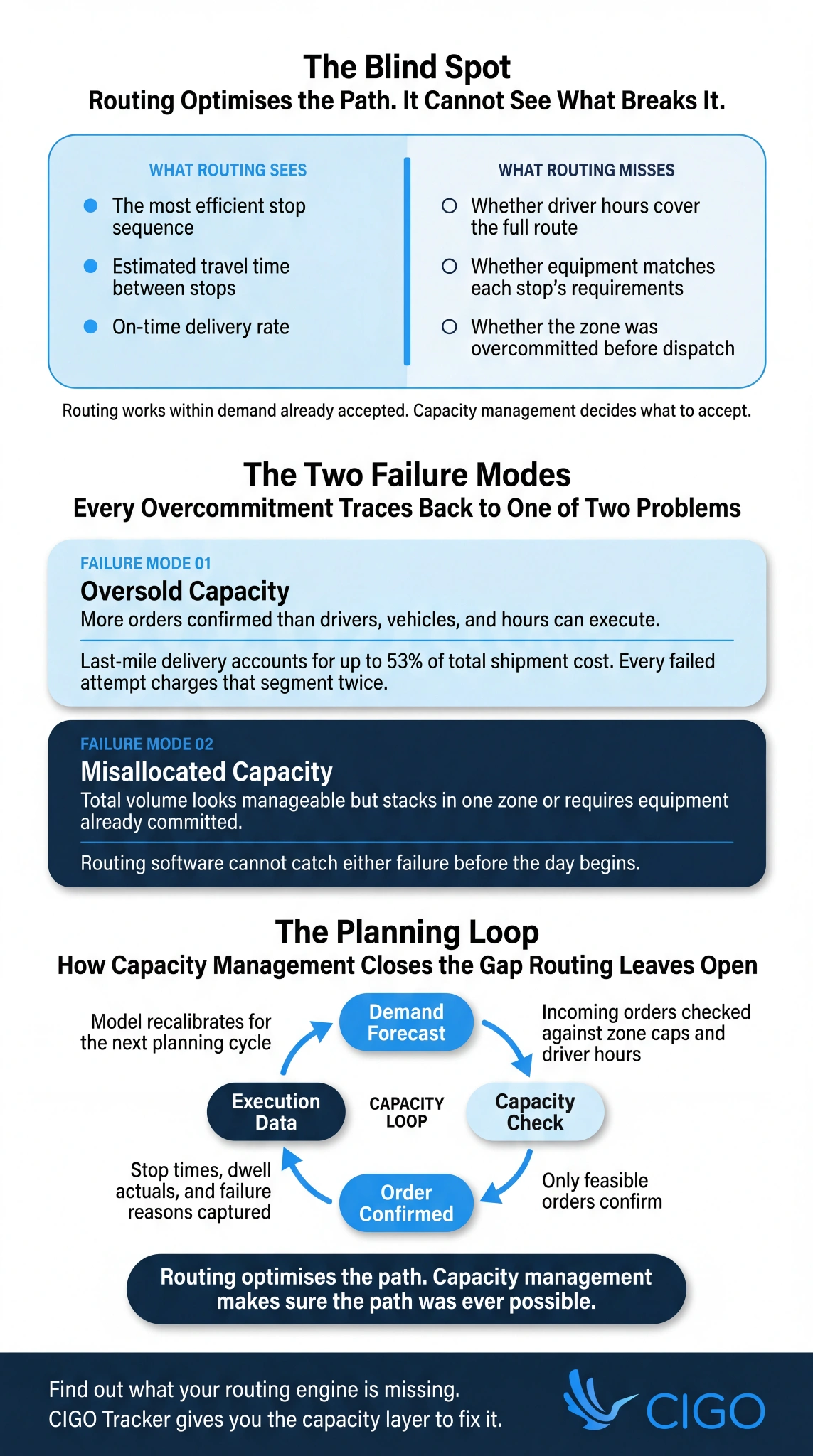
Routing software finds the most efficient path through existing demand, but it cannot evaluate whether that demand should have been accepted in the first place. That gap is exactly where delivery capacity management becomes critical.
CIGO Tracker is built around this principle. Capacity management matches incoming orders to real available resources before commitments lock in, so planners stop patching avoidable failures and start executing a plan that was feasible from the beginning.
Key Takeaways
- Delivery capacity management matches incoming orders to available drivers, vehicles, and time windows before anything is confirmed.
- Route optimisation improves execution of deliveries already booked; it controls how many you should accept.
- Capacities in supply chain management include vehicle weight, cube, driver hours, equipment type, and dwell time, not just truck count.
- Routing alone as a capacity check leads to structural overcommitment: inflated ETAs, failed delivery attempts, and recovery costs that erode margin.
- The right software closes the loop by enforcing booking limits, alerting to risk early, and returning execution data to the planning model.
What Is Delivery Capacity Management?
Delivery capacity management is the process of measuring, allocating, and protecting delivery capacity so accepted demand never exceeds what the fleet can reliably execute.
It sits between demand forecasting and route building, translating incoming orders into resource requirements and confirming coverage before any commitment locks in.
That sequence matters because routing cannot fix what overbooking already broke.
If you cannot state how many stops your fleet can handle tomorrow by zone and vehicle type, you are managing the consequences of a missing plan, not the plan itself.
Capacity Management vs Route Optimization
Route optimization answers one question: what is the most efficient sequence for stops already on the plan? Capacity management answers an earlier, more consequential one: should those stops have been accepted at all?
That distinction matters in practice. Route optimization cannot detect that a zone is overcommitted or that driver hours run short before the last stop.
Capacity management catches those problems at booking, before execution inherits them. Both tools are necessary. But only one prevents the failure the other cannot fix.
Capacities in Supply Chain Management: Delivery Edition
Supply chain capacity thinking maps directly onto last-mile operations, and the constraints are more specific than most planners account for.
Every working model needs to cover vehicle cubic volume, payload weight, and hours-of-service. FMCSA regulations cap property-carrying drivers at 11 driving hours within a 14-hour on-duty window, a hard limit that directly shapes how much a route can realistically hold.
Beyond that, dock receiving limits, dwell time per stop type, and equipment-specific constraints like liftgate availability all affect true capacity. Ignore any one of them and the plan is built on a number that does not exist.
Capacity Management vs Dispatch
The two functions operate at different points in the day, and keeping them separate is what makes both work.
Capacity management prevents overcommitment before the plan is set. Dispatch management then handles what the plan could not predict:
- Breakdowns and vehicle failures
- Last-minute customer changes
- Traffic anomalies mid-route
When capacity is managed upstream, dispatchers handle genuine exceptions rather than firefighting predictable overloads. That distinction is what separates a controlled operation from a reactive one.
Why Routing Alone Is Not Enough
Route optimization works within the demand it receives. It never questions whether that demand should have been accepted, and that distinction is where most last-mile failures actually begin.
When a routed plan becomes proof of capacity, the operation is confusing path efficiency with resource adequacy. According to SupplyChainBrain, over 61% of logistics companies identify last-mile delivery as their supply chain’s most inefficient process.
Routing software cannot solve that. Capacity management can.
Routing Limitations That Create Delivery Failures
These are planning failures, not routing ones:
- Stop vs time: Routing fills routes; capacity planning confirms drivers can complete them within shift hours.
- Load blind spots: Route optimisers ignore weight and cube. Capacity planning enforces those limits.
- Window stacking: Tight windows on one zone create under-capacity that routing cannot detect.
- Equipment mismatches: A liftgate job without available equipment is a capacity failure.
- No forward view: Routing is same-day; capacity planning looks ahead to prevent tomorrow’s crisis.
The Two Capacity Failure Modes
Every overcommitment traces back to one of two distinct problems, and confusing them makes both harder to fix.
Oversold capacity means more orders were confirmed than the fleet can realistically execute.
Inbound Logistics reports that last-mile delivery accounts for up to 53% of total shipment cost, meaning each failed attempt doesn’t just disappoint a customer. It adds a second charge on the most expensive segment in the chain.
Misallocated capacity is subtler: the total order volume looks manageable, but too much of it lands in the same zone or requires equipment that is already fully committed. Routing software cannot catch either failure before the day begins.
Hidden Constraints That Create False Capacity
- Driver hours: Compliance requirements and mid-week call-outs shrink available shift time, turning a feasible plan into an overcommitted one before the first stop is reached.
- Equipment constraints: Assigning a liftgate job to a standard vehicle or a temperature-sensitive load to an unrefrigerated truck produces a route that cannot be completed, regardless of how well it was optimised.
- Dwell-time underestimates: Optimistic stop times inflate route capacity on paper and create late-day cascades in the field that dispatch cannot recover from.
How Delivery Capacity Management Prevents Overcommitment

Delivery capacity management creates a single capacity picture across drivers, vehicles, zones, and time slots, blocking overcommitments before any order is confirmed. Demand forecasts feed directly into allocation rules, and real-time rebalancing keeps the plan current as conditions change.
Demand Forecasting and Capacity Modelling
Effective forecasting breaks demand down by zone, day, and stop type rather than total volume alone. That distinction matters because aggregated volume hides the constraints that actually break plans.
Separating confirmed orders from likely ones prevents the model from inflating available slots prematurely. Zone-level capacity calendars then make those slots visible and enforceable, while cube and weight caps per vehicle push load constraints to booking rather than the loading dock.
Allocation Rules and Real-Time Rebalancing
Allocation rules convert planning policy into enforceable defaults:
- Capacity calendars by zone, day, and equipment type with configurable buffers that prevent overselling.
- Approval workflows that make above-cap requests deliberate rather than accidental.
When a driver calls out or a vehicle goes offline, impacted zones re-forecast and ETAs update immediately. That execution data feeds back into the model, which is precisely why automated planning outperforms manual methods at scale, turning field reality into better rules rather than repeated errors.
Real-Time Rebalancing When Capacity Changes
Capacity does not stay fixed once the day begins.
Driver call-outs, vehicle breakdowns, and closed appointment windows all reduce what the plan can deliver, and the operation needs to respond before those gaps become failures.
When conditions shift, impacted zones re-forecast automatically, open slots reallocate, and customer ETAs update without duplicating effort across teams. Stop times, failure reasons, and dwell actuals then feed back into the model, so tomorrow’s plan reflects what actually happened rather than what was assumed.
Key Features to Look For in Capacity Management Software
When evaluating these platforms, prioritise these capabilities:
- Zone and day capacity calendars with configurable buffers and booking caps enforced at order intake.
- Constraint modelling: driver hours, equipment type, stop-count limits, dwell time, and cube/weight caps.
- Demand forecasting by zone and stop type with manual overrides for known promotional or seasonal spikes.
- Scenario planning: test volume spikes and equipment outages before the day begins.
- Alerts for overcommitment risk, driver-hours warnings, and equipment mismatches while options still exist.
- Reporting that ties capacity planning inputs to on-time performance, cost per stop, and reattempt rates.
What Data You Need to Get Value Fast
Start with what the model actually needs: historical order volume by zone, real dwell-time assumptions by stop type, current fleet availability by vehicle spec, and prior exception reasons.
Optimistic estimates hide false headroom and repeat the same planning errors. Fleet manager KPIs pinpoints the operational metrics most directly tied to where that data has the greatest impact.
Keep the Model Honest
A capacity model is only as accurate as the assumptions behind it. Use dwell-time ranges and buffers rather than single best-case estimates, and track planning overrides so the model learns where rules consistently break down.
Start with the 20 percent of zones generating 80 percent of overcommitment events. Fixing the highest-failure areas first proves the concept before expanding fleet-wide.
Where Delivery Capacity Management Pays Off Fast
Last-Mile Delivery Fleets
This discipline shifts the failure point from execution, where recovery is expensive, to planning, where it is cheap to fix. Only feasible orders get confirmed, reattempt costs drop, and routes built on realistic assumptions hold up under the conditions drivers actually encounter.
Private Fleets and Dedicated Operations
Without zone-level caps, private fleets only discover overcommitment after drivers are already running late and rescheduling options have closed.
Applying zone-level capacity balancing before routes are built prevents that entirely, reducing overtime and eliminating the empty repositioning that follows when demand was never properly distributed.
3PLs Managing Multiple Clients
For 3PLs, silent double-booking across accounts is a structural risk, not an occasional oversight. Shared caps and approval workflows catch it before routes are ever built. Without that layer, even the best approach to multi-client route optimisation fails because the commitments feeding those routes were already undeliverable before planning began.
High-Volume B2C and E-Commerce
Peak seasons do not create capacity problems. They reveal ones that already existed. Zone-level signals that open and close booking slots before promises reach customers mean service failures are prevented at the source, rather than managed as complaints after the fact.
Implementation Best Practices
Define constraints before building any capacity calendar: equipment types, zone stop limits, shift rules, and dwell-time assumptions.
From there, pilot by zone with clear KPI targets before expanding fleet-wide.
Build a weekly rhythm of demand review, capacity confirmation, and exception flagging. Treat override approvals as non-negotiable: every above-cap decision must be visible and traceable, or it quietly recreates the spreadsheet problem you set out to solve.
Common Mistakes to Avoid
- Treating capacity as vehicle count only, ignoring driver hours, equipment constraints, and realistic stop dwell time.
- Unlimited overrides without accountability: every override should require a reason code and leave an auditable record.
- Measuring on-time delivery without reattempt rate or cost per stop, which hides the real downstream cost of planning failures.
- Skipping change management and blaming the software when planners revert to manual workarounds after rollout.
KPIs to Track After Rollout
Track planning quality, not just execution outcomes.
McKinsey’s research on delivery precision confirms that on-time, in-full delivery directly affects both customer retention and cost structure, making these capacity-specific KPIs essential:
- Overcommitment rate: percentage of days where accepted orders exceeded available capacity by zone and equipment type.
- On-time delivery vs committed windows at zone and route level, not fleet average, which masks zone-level failures.
- Reattempt rate and top failure reasons tied to capacity or scheduling decisions so root causes are visible.
- Cost per stop trending week over week after capacity rules are enforced.
- Driver overtime hours linked to capacity overruns so planning errors carry a visible labour cost.
How CIGO Tracker Supports Delivery Capacity Management
CIGO Tracker tightens planning assumptions by feeding real execution data directly back into the capacity model.
Delivery tracking and logistics optimization work together at the planning layer, while capacity management and customer engagement tools ensure planners act on alerts before failures develop, proof of delivery closes every exception, and customers stay informed throughout without adding to dispatcher workload.
Future Trends in Delivery Capacity Management
Delivery capacity management is moving toward predictive capability, and the market behind that shift reflects the urgency. Grand View Research values the last-mile delivery market at USD 132.71 billion in 2022, projecting growth to USD 258.68 billion by 2030.
That growth will bring AI-driven stop-time modelling using zone-level historical dwell data, and dynamic booking slots that open and close as capacity is consumed, much like airline seat management.
Operations that build governance frameworks now will absorb these capabilities fastest.
Is Your Routing Engine Hiding a Capacity Problem?
Routing optimises the path. Capacity management determines whether the path was ever possible. Treating one as a substitute is where margin leaks quietly.
Audit your overcommitment rate, map the constraints your routing engine ignores, and pilot zone-level caps on your highest-failure zones. CIGO Tracker gives your team the capacity visibility and planning tools to make that shift.
Start a free trial or contact the team today.
FAQs
What is delivery capacity management, and how is it different from route optimisation?
Delivery capacity management matches incoming orders to available drivers, vehicles, and time windows before commitments are confirmed. Route optimization sequences those orders after booking. Capacity management decides what to accept; route optimization determines how to execute it.
What does “capacities in supply chain management” mean for last-mile delivery?
Capacities in supply chain management include vehicle weight, cubic volume, driver hours-of-service, dock windows, and dwell time per stop. In last-mile delivery, ignoring any single constraint inflates paper capacity and creates delivery failures that routing software cannot prevent.
Why does routing alone fail to prevent overbooked deliveries?
Route optimisation works within demand already accepted. It cannot evaluate whether driver hours, equipment availability, or zone capacity support that demand. Overbooking happens before the route is built; routing software only runs after the commitment is already made.
What data do you need to implement delivery capacity management?
Start with historical order volume by zone, current fleet and equipment availability, real dwell-time assumptions by stop type, and failure reasons from prior routes. That foundation lets the capacity model reflect operational reality rather than optimistic planning assumptions.
What KPIs should I track to measure delivery capacity management effectiveness?
Track overcommitment rate by zone, on-time delivery versus committed windows, reattempt rate, cost per stop trends, driver overtime hours, and override frequency. Together these confirm whether the capacity model is reducing planning errors or simply documenting them.