Foresight AI
One late stop can trigger missed windows, angry calls, and credits you never budgeted for. Your customer only remembers whether the ETA felt honest.
Inside the operation, split visibility is usually the culprit: drivers, dispatch, and support each work from different signals. When WISMO spikes, you spend labor reconciling stories instead of saving the route.
Delivery tracking software closes the gap by turning every order into a shared record with live status, ETA updates, and proof. It gives you one source of information, so customers and teams stay aligned when plans change. See how it works with CIGO Tracker.
Key Takeaways
- Self-serve tracking plus proactive alerts reduces WISMO by answering customers before they reach out.
- Real-time delivery tracking keeps ETA windows credible, so fewer deliveries fail due to surprises at the door.
- Live route health and an exception queue help dispatch fix issues while there is still time to recover the route.
- Proof of delivery software cuts disputes by enforcing complete, stop-level evidence every time.
- Clean reporting turns execution data into action: repeat failure zones, high dwell stops, and coaching targets.
What is Delivery Tracking Software?
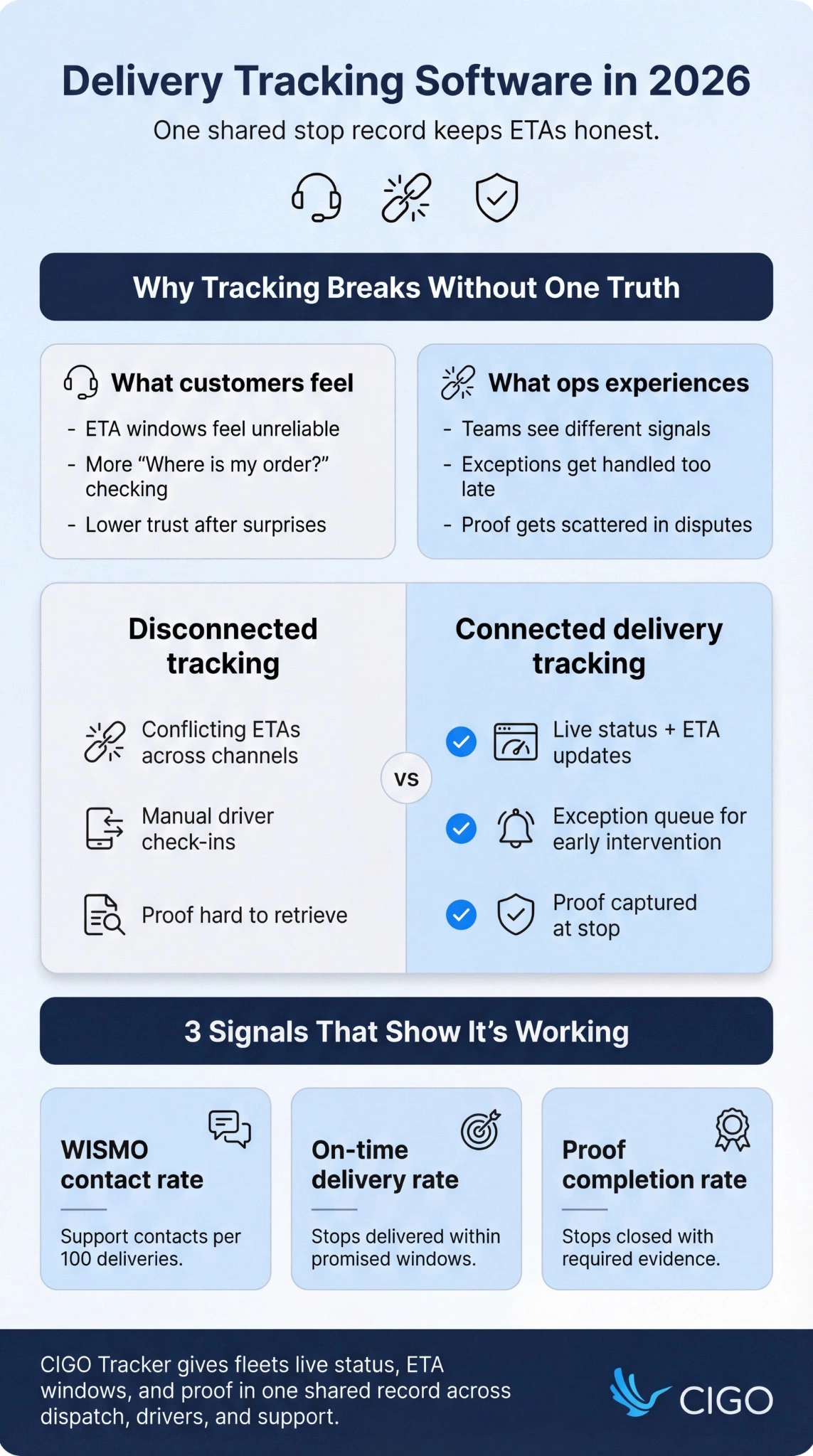
Delivery tracking software is a platform that monitors order and stop progress in real time and shares status updates across your teams and customers. It creates real-time delivery tracking you can trust, because everyone is looking at the same stop events, not different screenshots, which is what lets teams implement real-time tracking without juggling disconnected updates
That shared view matters because logistics breaks down at handoffs, where information gets lost and decisions slow down.
As reported in the McKinsey handover analysis, digitizing those handovers reduces waste by replacing blind transfers with integrated workflows and clear signals.
In practical terms, it replaces spreadsheet status checks, phone-call updates, and scattered tracking links that disagree. It also fits between route planning, dispatch operations, driver workflows, and customer communication, while keeping proof of delivery software evidence tied to each stop.
Elements of a Modern Delivery Tracking Experience
Modern delivery tracking ties together customer updates, ops control, driver execution, and reliable evidence.
Customer view
A branded tracking page that shows a live ETA window, order status, and a simple place to add instructions, powered by white-label delivery tracking so the experience stays on your brand and not a third-party portal.
From there, SMS and email alerts keep the customer in sync when the window shifts, so they don’t feel the need to check in.
If the customer does need help, the tracking view carries the order context into support, which keeps the handoff smooth and stops the customer from repeating the same story.
Ops view
A live map with route health signals, an exception queue, SLA flags, and quick dispatcher actions like rescheduling, reassignment, and customer contact logs.
Driver view
A stop list that matches reality, navigation, consistent status codes, required fields, and enforced proof rules. No guessing about what evidence is required at that stop.
Evidence layer
Timestamps, GPS markers, photos, signatures, notes, and scan events that bind to the stop record. This is where proof of delivery software stops being a feature and becomes dispute prevention.
Why Delivery Visibility Is Essential in 2026
Delivery volume in 2026 exposes every weak link.
One late stop can ripple into missed windows, reattempts, support contacts, credits, and claims, especially when customers are watching the clock.
In an Elsevier delay prediction review, researchers note that better delay prediction often comes from combining enterprise data with logistics signals, yet practical deployment still lags. Delivery tracking software closes that operational gap by turning live events into decisions while the route is still recoverable.
Support also needs the same truth dispatch sees, and proof has to be consistent. Shared visibility keeps teams aligned, so recurring issues surface before they become weekly surprises.
What changed since earlier tracking tools
Earlier tracking tools were built for internal reassurance, so a dot on a map was enough.
The shift came when delivery started to behave like an appointment customers actively manage, which raised expectations for proactive updates, clearer reasons, and ETA windows that stay credible.
Research shows why the bar moved.
In a McKinsey & Company consumer delivery survey, shoppers prioritize cost, reliability, and flexibility more than pure speed, so tracking had to become an experience layer that supports choices and trust.
Cost pressure also pushed teams to look deeper. DHL’s last-mile cost analysis shows that the final leg can swallow a disproportionate share of total shipping spend, which is why analytics on dwell time, reattempt rates, and failure hotspots becomes non-negotiable.
Challenges with Manual or Disconnected Tracking
Manual tracking creates conflicting ETAs, slow execution response, and missing proof, which fuels WISMO, reattempts, and costly disputes daily everywhere, and the delivery tracking consequences tend to show up the same way across teams
- Conflicting ETAs across channels, so customers stop trusting updates and support ends up translating confusion.
- Reactive exception handling, because dispatch hears about issues too late through alerts, calls, or last-minute escalations.
- Scattered proof of delivery, so disputes become a document scavenger hunt instead of a fast, clean resolution.
- Delayed reporting, which masks repeat failure zones and allows the same problems to recur week after week.
- No consistent handoff between ops, drivers, and support, so each team works from partial context.
Benefits of Delivery Tracking Software for Fleet and Ops Teams
Connected delivery tracking turns real-time delivery tracking into action, not noise.
As reported in an MIT CTL visibility report, visibility helps reduce exceptions and the costly work that follows, while also enabling long-term service improvements.
- Fewer WISMO contacts, since customers self-serve updates and get proactive alerts that match the route, showing how delivery notifications reduce WISMO calls before support ever gets pulled in
- Higher on-time performance, because dispatch sees risk early and can intervene with options still open.
- Fewer failed deliveries and reattempts, using clearer instructions, access notes, and “arriving soon” prompts.
- Faster exception resolution, since ops works from one live stop record instead of driver check-ins.
- Stronger accountability, with consistent status codes and clearer fleet delivery visibility across teams.
- Cleaner disputes and claims, because proof of delivery software evidence stays tied to the stop.
Operational Impact of Better Tracking Data
Better tracking data changes how the day runs.
Dispatch sees the route timeline and health signals in one view, so they spend less time calling drivers and more time fixing exceptions while the route can still recover.
Those same stop events make coaching concrete. You can spot repeat patterns like long dwell, missed scans, and incomplete proof, then target the specific stops or zones. Leadership gains a cleaner cost per stop picture, linking reattempts and route variability to process gaps they can measure and improve.
Key Features to Look for in Delivery Tracking Software (2026 Checklist)
Prioritize features that keep fleet delivery visibility accurate, actionable, and auditable daily.
These basics protect margin when routes drift and disputes appear, and modern delivery tracking features are a good gut-check for what belongs on a 2026 shortlist
- Live map, route progress, and health indicators
- Dynamic ETA engine using traffic and service-time patterns
- Branded tracking page with SMS and email alerts
- Proof of delivery software with photo, signature, and scans
- Exception workflows with reason codes, reschedule, and contact logs
- Role-based access, audit logs, retention, and reporting exports
How Delivery Tracking Improves Customer Experience Throughout the Journey
Customer experience improves when tracking answers the same core question at the moments customers care about most: Before delivery, during delivery, and after delivery.
Before delivery, the customer wants confirmation and a clear way to add instructions, so the driver does not arrive blind.
Research published by the peer-reviewed journal Mathematics links satisfaction to accurate status information and flexible last-mile options, which makes consistent updates part of the service, not decoration.
During delivery, real-time delivery tracking keeps the ETA window honest as conditions change, so customers understand what is happening. After delivery, proof of delivery software keeps the record complete, which speeds up support and reduces disputes.
Scenario: Turning Uncertainty into Confidence
A customer expects a delivery between 2:00 pm and 4:00 pm, but traffic pushes the route behind schedule.
The tracking page refreshes the ETA window to 3:00 pm to 5:00 pm and explains the delay, so the customer updates instructions instead of calling support.
Dispatch sees the risk early and shifts one nearby stop to another driver to protect the SLA.
At the door, the driver captures the required photo and signature, so the record is complete. What matters is what you avoid. No WISMO spike, no dispute, and no scramble across teams.
Delivery Tracking in B2B Logistics: Beyond DTC Use Cases
B2B delivery is structured, not casual. You are delivering into someone else’s operation, so you often need an appointment time, a specific dock, and a receiver who can sign. In that environment, live map vs ETA notifications is a practical choice, because receivers need either a dependable arrival window to stage dock time or a real-time approach signal to avoid a missed handoff.
If any of those pieces are missing, the stop can fail even when the driver arrives on time.
Each stop also plays by different rules. One location wants a signature and pallet count, another wants photos, and a job site might require check-in with security. On multi-stop routes, those differences stack up fast.
Contractors make this harder because they do not work from your habits. Delivery tracking creates one consistent workflow, so every driver captures the same proof and the same failure reasons. That consistency protects you when a customer disputes a delivery or challenges a charge.
Implementation Best Practices for Delivery Tracking Software
A rollout succeeds when you standardize the basics before you scale. You want every team to work from the same playbook, so the data stays clean and the customer experience stays consistent.
- Define status codes and failure reasons before rollout, so drivers, dispatch, and support speak one language.
- Clean up addresses and delivery instructions, since ETA accuracy and first-attempt success depend on good inputs.
- Pilot on a small set of routes, and tie success to KPIs like on-time rate, proof completion, and reattempts.
- Give support the same live view dispatch uses, so your status truth stays consistent across every channel.
Tracking KPIs to Monitor Post-Implementation
After rollout, KPIs show whether tracking is improving service or only creating noise. Use them to spot drift early, coach consistently, and prove progress to leadership.
- On-time delivery rate and ETA accuracy
- WISMO contact rate by channel and customer segment
- Failed delivery and reattempt rate tied to failure reasons
- Stop dwell time and time-on-stop variability
- Proof completion rate and dispute rate
- Time to resolution for exceptions and claims
Getting the Most Out of CIGO Tracker’s Delivery Tracking Capabilities
CIGO Tracker works best when every team sees the same stop record. With Delivery Tracking, dispatch and support share live ETAs, stop status, and proof in one view.
Add Customer Engagement to send branded updates, collect instructions, and reduce WISMO without extra calls. Protect access with Platform Security, so roles, logs, and retention stay controlled as you scale. When routing changes mid-day, your plan and execution stay connected, so exceptions do not break the story.
You get one place to review performance, so coaching and planning follow facts, not guesswork.
Creating a Competitive Advantage with Real-Time Delivery Visibility
Real-time delivery visibility turns delivery into a trust moment, not a guessing game.
When customers see a window and an update when it shifts, they often stay calmer and they stay loyal. It also sets expectations for support and keeps conversations short.
Cost drops too without adding more headcount. Fewer status calls hit support, dispatch works exceptions earlier, and proof stays ready for disputes. Proactive service lifts customer metrics like NPS and CSAT, according to a Gartner proactive service survey.
In B2B, SLA reporting helps you win renewals and bids.
Future Trends in Delivery Tracking Software
Predictive ETAs will keep improving as fleets learn real service-time patterns from stop history, scans, and live route conditions.
As the signal gets cleaner, tracking systems will shift from reporting delays to recommending the best recovery move, so dispatch can protect windows before the route falls behind.
Customer preference controls will mature too, with channel choice, quiet hours, and reusable instruction templates becoming standard. Security expectations will tighten as more roles touch delivery data, so access, logging, and retention have to be intentional and provable, which aligns well with NIST security controls.
Delivery Tracking Software Improves Visibility
Are your routes telling one story across dispatch, drivers, support, and customers, or three different ones?
Delivery tracking software improves visibility, proof, and performance by keeping status, ETA windows, and proof of delivery in one consistent workflow. When every channel pulls from the same record, teams spend less time reconciling updates and more time preventing exceptions before they escalate.
Start with a simple audit of where trust breaks. Look for inconsistent ETAs, missing proof, slow exception response, and repeat failure reasons.
CIGO Tracker can help you close those gaps with live tracking, customer updates, and secure proof workflows, so performance shows up in your KPIs. Ready to see it on real routes? book a demo.
FAQs
What is delivery tracking software and who should use it?
Delivery tracking software turns every stop into a shared record with status, ETA windows, and proof. Use it if missed windows, chargebacks, or WISMO cost you time on multi-stop routes where fleet delivery visibility matters.
How does delivery tracking software cut WISMO calls?
WISMO drops when customers can self-serve progress, see an accurate window, and get proactive delay messages. Delivery tracking software supports the same view, so real-time delivery tracking replaces phone updates and guesswork.
How do you measure ETA accuracy after rollout?
Measure ETA accuracy by comparing promised windows to actual arrival and completion times, segmented by route and stop type. Delivery tracking software should report accuracy bands and show why drift occurred using stop events.
What proof of delivery features matter most in disputes?
Disputes resolve faster when evidence is complete and tied to the stop. Look for proof of delivery software with timestamp, GPS validation, photos, signature when required, item scans, and exception notes you can retrieve instantly.
What should a fleet team prepare before implementation?
Prepare a shared status language and proof rules, clean addresses and instructions, and set ownership for exceptions. Define roles, permissions, and audit logs early so delivery tracking software scales without leaks or confusion.