Foresight AI
A perfect route can still lose money at the receiving door. One missing case or incomplete proof of delivery, and you’re negotiating credits instead of driving sales.
In 2026, direct store delivery software has to lock in store truth. That means enforced stop statuses, required proof capture, and exceptions that mirror real store conditions, so every outcome is defensible.
With CIGO Tracker, you get live route visibility and stop-level evidence that speeds invoicing, returns, and closeout. So in this guide, we walk through the full DSD workflow, the features and KPIs that protect margin, and a rollout plan you can run with confidence.
Key Takeaways
- DSD software standardizes store execution, so every step lands in one shared record.
- Proof of delivery software turns delivery outcomes into defensible evidence, not back-and-forth debates.
- Live route visibility gives supervisors the context to correct issues while the route is still active.
- Faster closeout happens when invoicing, returns, and reason codes are consistent and tied to what was captured at the stop.
- Route accounting software reporting surfaces patterns by store, route, day, and driver, so coaching stays targeted and measurable.
What Is Direct Store Delivery Software?
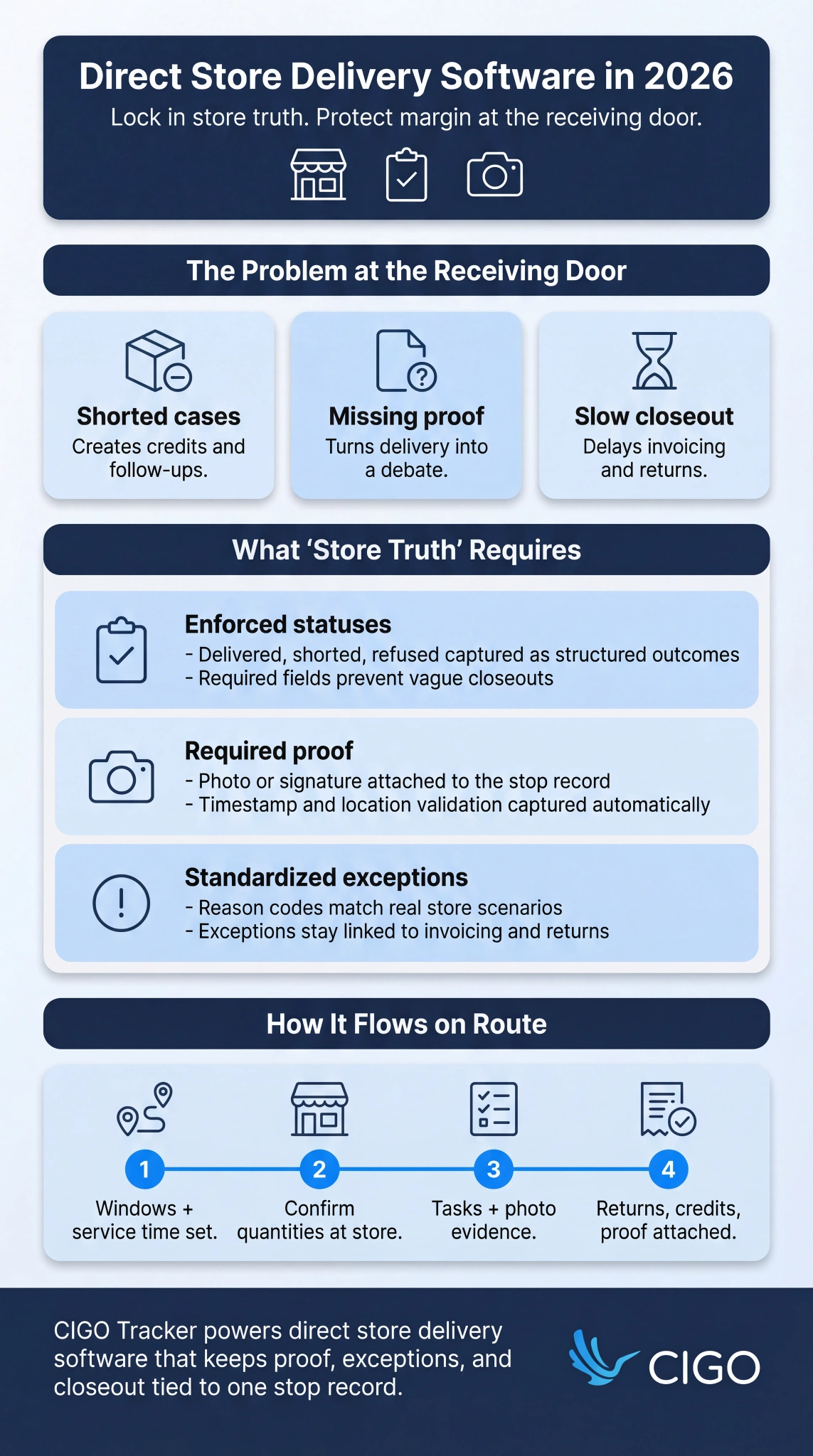
Direct store delivery software manages store delivery execution and the documentation that closes the loop. It standardizes what happens at each stop, so delivered, shorted, refused, or returned is captured as a structured outcome, not a debate.
That framing matches how SAP describes direct store delivery as a store-facing process where goods are delivered directly from a supplier or distributor, which is why the stop record matters as much as the route plan.
Distributors, brands, and route teams rely on it because store windows, receiving rules, and shelf tasks punish ambiguity.
With proof of delivery software and route accounting software workflows connected, it replaces paper invoices, manual logs, scattered proof, and delayed reconciliation, so your operation can scale with fewer disputes.
What It Typically Includes
DSD software works because it connects route execution to the records your back office depends on.
With direct store delivery software, you are planning stops, defining what must be captured at each stop, and also how that data becomes a clean financial outcome you can trust.
Here is what that usually includes:
- Route planning and dispatch that respects store windows, service times, and stop instructions.
- “Driver mobile workflow that enforces required fields, status updates, and at-stop steps, supported by dispatch driver app features.
- Proof capture through proof of delivery software functions like signature, photos, timestamps, and location validation.
- Invoicing, returns, credits, and closeout support that ties financial documents to stop outcomes, including reason codes and documentation.
- Reporting by store, route, driver, and exception type so you can coach the operation, not just react to fires.
How DSD Works in 2026
DSD in 2026 is driven by verifiable records. Every stop needs a record your finance team can pull in seconds, and modern delivery tracking features are what makes that record usable while the route is still active.
Shipping and receiving best practices from GS1 centers on one thing: confirm, then record. DSD is that discipline in motion. When you treat the store as the checkpoint, each route becomes a set workflow: pre-route planning, on-site check-in, shelf work, and closeout.
Each state captures proof and exceptions in the moment, with proof rules that are hard to bypass.
With stop truth locked, your route accounting software can invoice, process returns, and reconcile without loose notes. Disputes drop, closeout speeds up, and the workflow stops relying on memory.
Pre-route
You plan stops with realistic service times, store windows, and route scheduling software that keeps sequences workable when the day gets tight. You confirm load details and set expectations for what must be captured at each store, including proof rules, exceptions allowed, and merch tasks.
At-store
The driver checks in, confirms quantities, and captures proof in a structured way that matches your dispute and chargeback reality. If something is shorted, refused, or delayed, the exception is logged with a standardized reason that your back office can use without translation.
Shelf work
Merchandising tasks show up as checklists that can require photo evidence and electronic proof of delivery, notes, and confirmation fields. You move from “we think it got done” to “we can verify it got done,” which protects shelf space and improves coaching.
Closeout
Returns, credits, and adjustments are captured with documentation at the stop, tied to a reason code, and sent to the back office with the proof attached.
This is where route accounting software stops being a back-office scramble and becomes a structured outcome of consistent field execution.
Research by S Wibbeling on electronic proof of delivery at the point of delivery highlights how digital capture at the doorstep is designed to reduce friction and improve downstream process reliability.
DSD vs Standard Last Mile Delivery
| Dimension | Standard last mile delivery | DSD delivery to retail stores |
| Primary success measure | Delivered on time | Delivered and compliant at the store |
| Stop complexity | Drop-off is usually the core action | Receiving rules, store windows, shelf tasks, and confirmations add steps |
| Evidence expectations | Basic confirmation is often enough | Proof must stand up to disputes and audits |
| Exceptions | Logged loosely or handled ad hoc | Standardized reasons, required fields, and clear reschedule paths |
| Risk profile | Late delivery drives complaints | Credits, disputes, chargebacks, and lost shelf space drive margin loss |
| Operational focus | Route efficiency and ETA accuracy | Store execution + documentation + closeout discipline |
| What “good” software enforces | Status updates and tracking | Proof capture, required fields, exception structure, and closeout-ready records. |
Common DSD Pain Points
Most DSD problems do not start as big failures. They start as small gaps at the store, and those gaps compound into credits, delays, and missed shelf opportunities.
Once the stop record is incomplete, every team downstream is forced to guess.
Here are the issues that show up most often:
- Shorted or wrong items disputes because the stop record lacks clean confirmation, photos, or exception context.
- Slow credits and returns processing because returns are captured inconsistently and finance cannot reconcile quickly.
- Missed merchandising actions and weak photo evidence that lead to shelf drift and lost visibility at the point of sale.
- Route variability that breaks planning assumptions, since service time and exceptions are not tracked in a way supervisors can act on.
Taken together, the pattern stays consistent. Store truth is missing, or store truth is hard to retrieve when it matters most.
Benefits of Direct Store Delivery Software
Direct store delivery software boosts margin when store actions become closeout-ready records. Disputes drop because shortages and refusals are captured consistently.
Benefits show up fast. You also get coaching clarity because patterns show up by store and driver.
- Higher order accuracy with enforced confirmations and exceptions.
- Faster invoicing and closeout with proof of delivery software attached.
- Cleaner returns and credits using reason codes and photos.
- Better shelf compliance with task checklists and verified images.
- More predictable stop times through route accounting software links.
In regulated categories, structured capture carries even more weight.
The U.S. Food and Drug Administration explains that FSMA Section 204’s Food Traceability rule is designed to support faster identification and removal of potentially contaminated food, which raises the value of clean, retrievable event records tied to shipments and receiving.
Must-Have Features
If you are evaluating direct store delivery software in 2026, these are the capabilities that protect you from credits, disputes, and slow closeout.
Route planning with store windows and service times
You want realistic planning that reflects store windows and stop service times, and retail delivery software route planning is the baseline for building routes that hold up under real receiving conditions
Driver app with fast status updates and required fields
The app should make the right thing easy, with enforced required fields where disputes typically begin.
Proof of delivery software
Look for photo, signature, timestamps, and GPS validation that are tied to the stop record.
If you need a standard lens, GS1 publishes delivery management standards for identifying logistic units and capturing shipment and receiving information consistently.
Exceptions that match real store scenarios
You want standardized failure reasons, reschedule support, notes, and proof rules that adapt by store type.
Returns and credits capture
Returns should be captured at the stop with reason codes, quantities, and documentation attached.
Reporting dashboards and exports
Dashboards should segment by store, route, day-of-week, exception type, and proof completion so supervisors can coach with precision.
Security and governance
Roles, permissions, audit logs, and retention controls protect your evidence and reduce internal process risk.
Proof Standards to Set Early
Proof standards work best when they remove ambiguity at the stop, since clarity drives consistency.
In week one, define what acceptable proof looks like by store type, so every driver captures the same evidence in the same way and your operation stops relying on personal judgment.
Those proof rules work even better when they sit alongside exception reasons that match real store scenarios, which keeps drivers from inventing categories under pressure. Add a simple retrieval path for support and account teams, because proof only protects you when it can be found fast and shared with confidence, especially during disputes.
KPIs That Matter in DSD
If you only track on-time arrival, you miss where profit leaks, and the top 10 last mile KPIs map cleanly into store-level proof, disputes, and closeout performance
- On-time arrival rate still matters, especially for strict receiving windows.
- Stop completion time and dwell time reveal where process friction lives, by store and by driver.
- Proof completion rate tells you whether your audit trail is strong enough to defend disputes.
- Dispute rate and time to resolution show the cost of weak evidence and inconsistent exception handling.
- Returns and credits volume by reason exposes training gaps, store-specific patterns, and product issues.
- Route consistency across days helps you separate real variability from workflow inconsistency.
For many teams, the KPI that changes behavior fastest is proof completion rate, since it forces stop discipline and improves downstream billing confidence.
How to Choose Direct Store Delivery Software
Choose direct store delivery software by starting with your route model, since delivery-only, pre-sell, van sales, and hybrid teams close out differently.
From there, pressure-test proof and settlement.
The TechTarget SCM modules guide notes that proof of delivery capabilities support shipping confirmation through customer payment collection, so your demo should prove required fields, exception reasons, returns, and route accounting all stay linked at the stop.
Look for reporting that surfaces drivers by store and permissions that protect evidence from edits.
Common DSD Pain Points
Ask vendors to walk you through scenarios that expose their weak spots.
- A shortage dispute with proof retrievalwhere you locate the stop, open proof, and export it for a customer conversation.
- A return and credit captured at the stop with reason codes, photos, and a clear back-office trail.
- A merchandising task with photo verification where the task is required, not optional, and missing evidence blocks completion.
- A day-of route change where updates show up for dispatch and supervisors without breaking stop evidence and closeout reporting.
Implementation Playbook
Implementation works when you lock standards before you touch configuration, so the field and finance teams stay aligned.
Once definitions are stable, rollout becomes repeatable across routes, and logistics optimization ROI thinking helps you lock baselines and prove impact as you scale
- Define statuses, proof rules, exception reasons, and task standards with supervisors and finance.
- Clean customer and product data, especially windows, instructions, and unit-of-measure rules.
- Pilot with KPI targets like proof completion, dispute rate, and time to close out.
- Roll out by route group, using weekly reviews to coach disputes, proof gaps, and stop-time variance.
How CIGO Tracker Supports DSD Outcomes
With CIGO Tracker, you manage DSD outcomes at the stop, where credits and disputes begin across every route.
Use real-time delivery tracking visibility to see live status and exceptions before they escalate.
Plan routes around store windows with optimized routing for reliable plans, and keep closeout clean with enforced proof and reason codes. Protect sensitive evidence with security and compliance controls, while customer engagement tools for updates keep receivers informed.
Together, these layers turn store execution into defensible records and faster reconciliation, so supervisors coach from facts instead of guesswork.
Choose the Right Direct Store Delivery Software for You
When you choose well, improvements show up in a predictable order.
Accuracy tightens. Proof gets stronger. Closeout speeds up. Shelf compliance becomes measurable, and supervisors coach with real stop context instead of guesswork.
To pressure-test your shortlist, structure demos around the moments that create credits: dispute defense, returns capture, merchandising verification, and day-of change handling.
You will learn quickly which platforms hold up under real store conditions.
If you want to see how CIGO supports that workflow without adding friction, contact us to map it to your route model and store requirements.
FAQs
What is direct store delivery software, and who needs it?
Direct store delivery software runs store-stop execution and creates a retrievable record for billing and support. Teams with store windows, returns, or shelf tasks rely on dsd software to prevent credits and disputes.
Which features reduce DSD disputes and chargebacks fastest?
Disputes fall fastest when proof is enforced and exceptions are standardized. Proof of delivery software should require signatures, photos, timestamps, and GPS. Clear reason codes make shortages and refusals defensible and easy to resolve.
How should returns and credits work inside DSD software?
Returns should be captured at the stop with reason codes, quantities, and required photos. When route accounting software links returns to invoices and outcomes, finance reconciles faster and credits stop turning into a backlog.
What KPIs should route supervisors review weekly?
Review proof completion rate, dwell time, exception rate by reason, dispute rate, and time to resolution. DSD software dashboards should be segmented by store and driver, so coaching targets the stops creating repeated variance.
What does a realistic rollout timeline look like for a mid-sized DSD team?
Rollout starts with standards, then clean data, then a pilot with KPI targets. Scale by route group with weekly reviews. Proof of delivery software rules and route accounting software closeout must be stable before expansion.