
Amazon began as a bookstore, yet it built a delivery engine that reshaped what speed and certainty mean at the doorstep. Prime’s 2005 debut turned two-day shipping into a baseline expectation and raised the bar for everyone else.
Customers now assume tight windows, live ETAs, and proof of delivery that appears quickly and clearly. That mindset extends to B2B, healthcare, foodservice, and field service.
The good news is that you do not need Amazon-scale infrastructure to compete on the experience layer. With CIGO Tracker, you can meet modern logistics industry standards using fleet management performance metrics that keep service visible, measurable, and trustworthy.
Key Takeaways
- Amazon reset logistics industry standards for speed, visibility, and reliability.
- Customers expect accurate ETAs, proactive updates, and instant proof of delivery.
- Many teams now treat Amazon-style fleet management performance metrics as the baseline.
- You can compete by upgrading the experience layer with integrated routing, tracking, and driver tools.
- CIGO Tracker helps you meet Amazon-grade expectations without rebuilding your tech stack.
Amazon’s Impact on the Logistics Industry
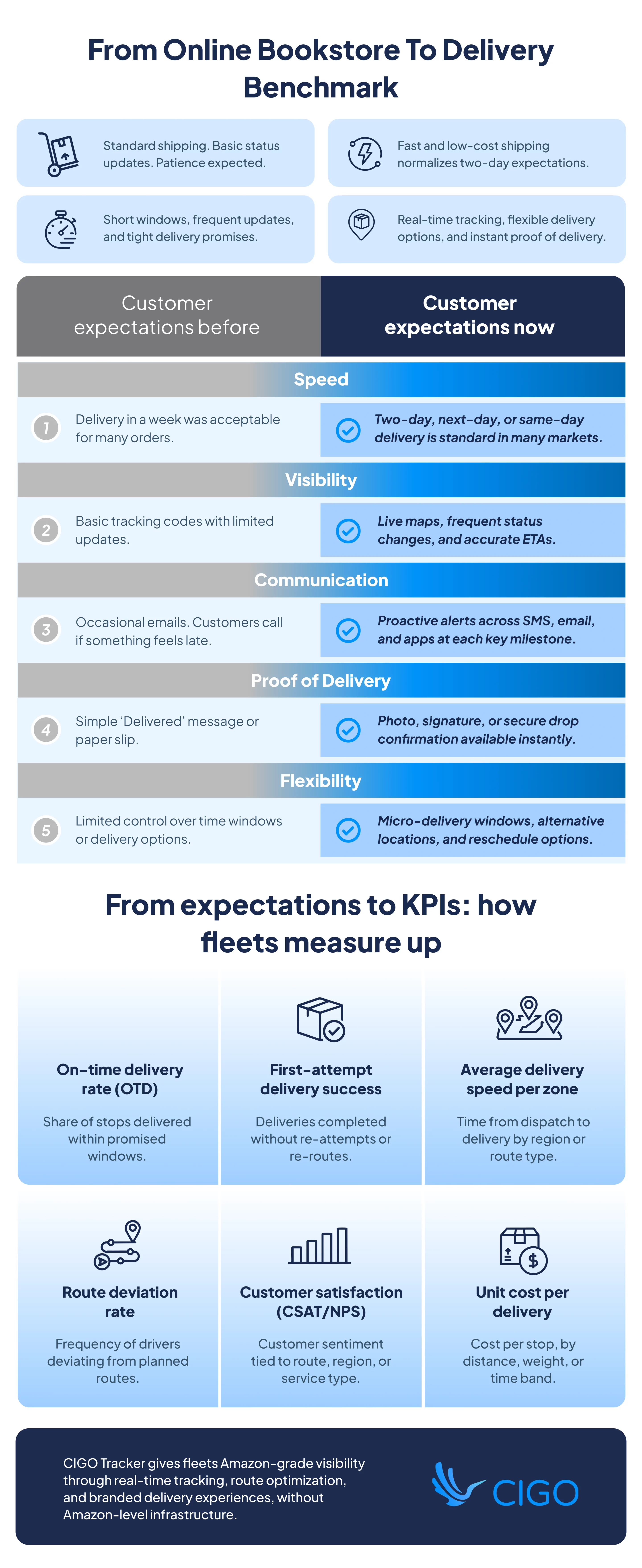
Prime’s promise and massive network investments turned Amazon into the logistics powerhouse that defined the benchmark.
From Marketplace to Logistics Powerhouse
Prime was a promise, yet a promise can’t scale without muscle behind it.
Amazon built that muscle through years of investment across fulfillment, linehaul, sortation, and last-mile capacity. The outcome was shorter lead times and a delivery experience that Amazon could shape end to end.
A major inflection point came with Fulfillment by Amazon (FBA) in 2006, which let independent sellers tap into the same fast, reliable network. As reported by Amazon, improving delivery performance also fueled growth among independent sellers.
This widened the gap between ad hoc shipping and a managed, consistency-driven service.
That level of ownership explains how new benchmarks emerge. When one brand sets tight internal SLAs and delivers them at scale, the market begins to treat that experience as the minimum.
Amazon Prime and the Age of “Fast & Free”
Prime turned shipping speed into a loyalty feature and made convenience feel like part of the product. Two-way delivery became the baseline, and same-day options tightened expectations in dense markets.
According to research published by Harvard, Prime’s early model shifted consumer and competitor assumptions about acceptable delivery time.
The ripple effect still shapes how you are judged today. Even if you never touch Amazon’s network, your customers still compare your ETAs, updates, and proof of delivery to the smoothest experience they know.
Changing Logistics Industry Standards
The Amazon Effect is not a race to two-day shipping. It is the expectation that delivery should feel visible, controlled, and low-risk at every step.
You are judged on the experience, not your warehouse footprint. These logistics industry standards now show up across retail, B2B, healthcare, foodservice, and field service.
What customers now treat as normal:
- Real-time tracking with accurate ETAs.
- Tight delivery windows with clear communication.
- Instant proof of delivery, photo or signature.
- Simple rescheduling and preference-based options.
- Fast exception updates when plans shift.
These New Standards Now Include
| New standard | What customers experience | What ops team gain |
| Real-time tracking with accurate ETAs | Confidence and fewer “where is my order” moments. | Fewer escalations and clearer exception visibility. |
| Delivery window reliability | Predictable handoffs that fit real schedules. | Better route planning and service consistency. |
| Instant proof of delivery (photo/signature) | Quick confirmation and reduced disputes. | Stronger compliance and faster issue resolution. |
| Multi-channel updates (SMS/email/app) | Updates in the channel that they actually notice. | Higher engagement and fewer missed deliveries. |
| Flexible scheduling options | A sense of control over the last mile. | Improved success rates and better delivery density. |
Performance Metrics Inspired by Amazon’s Model
Amazon’s delivery culture shows how measurement becomes behavior.
When the organization rewards precision, speed, and exception control, the customer feels it. Today, many fleet management performance metrics used by regional carriers, 3PLs, and private fleets mirror this same logic.
Must-Track KPIs to Compete
| KPI | What it measures | Why it matters | How to operationalize |
| On-time delivery rate (OTD) | Deliveries within the promised window | Core trust signal | Segment by lane, zone, customer, driver |
| Initial-attempt success | Delivered on the first try | Cuts, rework, and cost | Track by address type and time-off-day |
| Avg delivery speed per zone | Time to complete stops in each area | Sets realistic SLAs | Compare urban vs suburban vs rural |
| Route deviation rate | Off-plan distance or time | Flags planning and driver issues | Set tolerance bands and review outliers |
| Planned vs actual route time | Schedule accuracy | Improves ETA reliability | Use variance to refine future routing |
| CSAT/NPS per route | Customer sentiment tied to routes | Shows experience quality | Link survey triggers to delivery events |
| Unit cost per delivery | Cost per stop by distance/weight/time | Protects margin | Monitor alongside OTD to balance speed and cost |
The Importance of Real-Time Visibility
Real-time visibility now sits at the center of the delivery promise. Customers want to see movement, not guesswork, and a reliable ETA keeps trust intact.
As reported by an MDPI study, last-mile delivery quality and satisfaction shape the broader online retail experience.
Amazon’s Map Tracking and delivery alerts helped normalize this instinct so that silence can feel like a delay even on a good day. This is the new baseline for modern fleets. CIGO Tracker supports this expectation with real-time GPS, automatic ETA recalculations, and dashboards surfacing exceptions early, so you can act before customers escalate.
Why Static Planning ≠ Visibility
A static route plan gives you a sensible baseline, yet the real world rarely stays still. Traffic spikes, stops get added, recipients reschedule, and a tidy plan quickly turns into guesswork.
When you rely only on that original map, you see yesterday’s logic trying to survive today’s chaos.
Real-time GPS and dynamic ETA updates replace assumptions with live operational truth.
You can spot drift early, adjust sequencing, and communicate changes with confidence. The shift protects on-time performance and reduces avoidable check-in calls by keeping your team and your customers aligned on what is actually happening.
Amazon’s Technology Advantages (and How to Compete Without Them)

Amazon’s edge rests on a technology scale most fleets can’t replicate. Robotics, orchestration software, and network design tighten speed and consistency across the delivery chain.
As reported by Investopedia, Amazon has deployed over 1 million warehouse robots, showing how automation supports its delivery promises. You do not need that capital intensity to meet rising expectations. You can compete by improving the experience layer with real-time visibility, smart routing, and rapid proof of delivery.
CIGO Tracker helps you add these capabilities around your existing stack so the service stays modern and dependable.
Lessons from Amazon’s Delivery Playbook
Amazon’s delivery playbook works because its habits reinforce each other. It treats speed, visibility, and execution as one system you can tune daily.
What you can borrow without Amazon-scale infrastructure:
- Design routes for real conditions, using live sequencing and exception awareness.
- Communicate early across SMS, email, and in-app updates to prevent anxiety.
- Automate status and ETA changes so consistency does not depend on memory.
- Equip drivers with mobile workflows for scans, photos, and signatures to reduce errors.
Key Takeaways From Amazon’s Operational Model
Amazon’s operational model is a loop of measurement, response, and ownership. It looks simple on paper, yet it scales because each habit reinforces the one before it.
- Measure every handoff, scan, and ETA, so you know where performance drifts on real routes.
- Log exceptions in a structured way, so delays become patterns you can fix, not surprises you absorb.
- Own the customer experience end to end, even when partners deliver, so accountability stays clear.
Adopt these habits and your service feels deliberate, not improvised.
How CIGO Tracker Helps Logistics Providers Compete
CIGO Tracker delivers Amazon-grade experiences with modular tools that fit your existing operations.
Feature Highlights That Match Amazon-Grade Experiences
We help you meet expectations by focusing on the experience layer your customers feel every day. Our platform combines real-time visibility, dynamic route intelligence, and customer-facing updates to deliver speed with control, not chaos. We fit around the tools you already use.
With our Optimized Routing and Delivery Tracking, we use real-time data and traffic signals to auto-generate precise ETAs, maintain reliable time windows, and surface exceptions early for dispatchers.
We also bring performance insights into one view so you can connect each route to cost, speed, and service gaps.
Our Customer Engagement tools extend that clarity to recipients through branded tracking and proactive notifications, reducing missed deliveries and protecting trust. You get Amazon-like confidence without Amazon-like infrastructure.
Adapting Fleet Management KPIs to Modern Standards
Performance-based contracts are raising the pressure on proof, not promises. You need Fleet management performance metrics that demonstrate to clients you can consistently meet modern logistics industry standards, even when routes, volumes, and conditions shift.
What this KPI upgrade should focus on:
- Tie OTD, ETA accuracy, and initial-attempt success to specific customer segments.
- Track variance for planned vs actual route time to explain delays with clarity.
- Benchmark cost per delivery alongside service quality so speed stays profitable.
- Build weekly exception trends that show what you fixed, not only what failed.
Example KPIs You Can Set in CIGO Tracker
These KPIs work best when you connect service promises to route reality and review them as one system.
- Aim for 95% on-time delivery by route type to keep windows credible.
- Hold route deviation under 3% to protect planning discipline and driver focus.
- Keep CSAT above 80, tying dips to specific zones and driver clusters.
- Track delivery density per shift to improve efficiency while preserving service quality.
- Set tight caps on missed-ETA escalation responses so exceptions get resolved early, not amplified.
Avoiding Common Mistakes When Competing with Amazon
Trying to outrun Amazon with manual hustle and optimistic planning is a trap. It drains planners, pushes drivers into firefighting, and still leaves customers with shaky ETAs that feel improvised.
Another misstep is treating speed as the only headline. Customers also want clarity and control, so silence can feel like failure even when the van is moving.
Without proactive updates, your support team ends up translating uncertainty into apologies.
Siloed tools create the third problem. According to the AlixPartners survey, U.S. e-shoppers expected delivery in about 3.5 days in 2024, and 92% said free shipping influences purchase decisions. When routing, tracking, and messaging live together, leaders can trust the metric story and fix the few levers that actually move service.
What Smart Logistics Leaders Do Instead
Smart logistics leaders compete on experience by building a connected system, not a patchwork.
- They choose software that unifies routing, real-time tracking, customer messaging, and proof of delivery so each update reflects the same operational truth.
- These leaders set KPIs that mirror customer promises, tying on-time performance and ETA accuracy to contract outcomes and renewal conversations.
- They also use fleet data to coach drivers, refine zones, and adjust service windows, making improvement continuous and visible across teams.
- Asides from the above, they review exceptions weekly, identify repeat causes, and automate fixes to prevent the same delay from happening again tomorrow.
A New Standard for Fleet Excellence
Competing in a post-Amazon market means building a delivery system that feels fast, precise, and transparent on ordinary days, not only in peak season. Customers notice when speed lacks discipline or when visibility slows once the van leaves the depot. This balance defines the new standard.
Scale pressure is also rising. The Census report notes that U.S. e-commerce sales grew 5.3% year over year in Q2 2025 and accounted for about 16.3% of total retail sales.
That growth raises the stakes for fleets looking to expand without sacrificing service quality.
When you connect smart routing, live status, and tight exception workflows, you can add regions and partners while maintaining credible ETAs and customer confidence.
Are your delivery promises built for the Amazon era?

Amazon helped normalize the idea that speed and visibility are part of the customer’s rights, not optional perks. Prime accelerated that shift, and the broader network behind it made those expectations feel realistic at scale.
You don’t need Amazon’s footprint to deliver an Amazon-grade experience. You need reliable real-time visibility, integrated execution, and fleet management performance metrics that keep performance honest, explainable, and improving week by week.
This is where we can help. With delivery tracking, we provide live ETAs, proof-of-delivery workflows, and exception clarity that meet modern logistics industry standards. If you want to benchmark your gaps and build a practical upgrade path, contact us and we’ll help you map the fastest route to a stronger, calmer last mile.
FAQs
How did Amazon change delivery expectations across industries?
Amazon made speed, visibility, and easy proof of delivery feel normal. That shifted logistics industry standards toward tighter windows and clearer communication across retail and B2B. You may not compete directly with Amazon, yet your customers still compare your ETAs and updates to what they see elsewhere, so consistency becomes part of your brand promise.
Which KPIs matter most when you’re benchmarking service quality?
Start with on-time delivery, ETA accuracy, and initial-attempt success. These fleet management performance metrics indicate whether your planning and communication align with customer expectations. Add route deviation and cost per delivery to keep service and margin aligned. A small, well-tracked set beats a long list you rarely review.
Can mid-sized fleets meet Amazon-level expectations?
You can meet modern logistics industry standards by upgrading the experience layer instead of copying Amazon’s infrastructure. Use integrated tools to connect routing, real-time tracking, and proof of delivery. Fleet management performance metrics will show where small changes like better exception alerts or smarter sequencing improve performance fastest.
Why is real-time tracking considered a baseline now?
Real-time tracking turns expected delivery into visible progress. That helps logistics industry standards feel credible because customers can see changes as routes shift. Pair live location with dynamic ETAs and proactive messages so teams act early and recipients stay informed. This reduces support calls and improves the success rate of initial attempts.
How should you set targets for performance-based contracts?
Choose targets that reflect your service promises and route reality. For example, set OTD goals by route type, define a tight deviation tolerance, and track weekly exception themes. These logistics industry standards become easier to defend when fleet management performance metrics tie each improvement to customer outcomes and contract performance.