
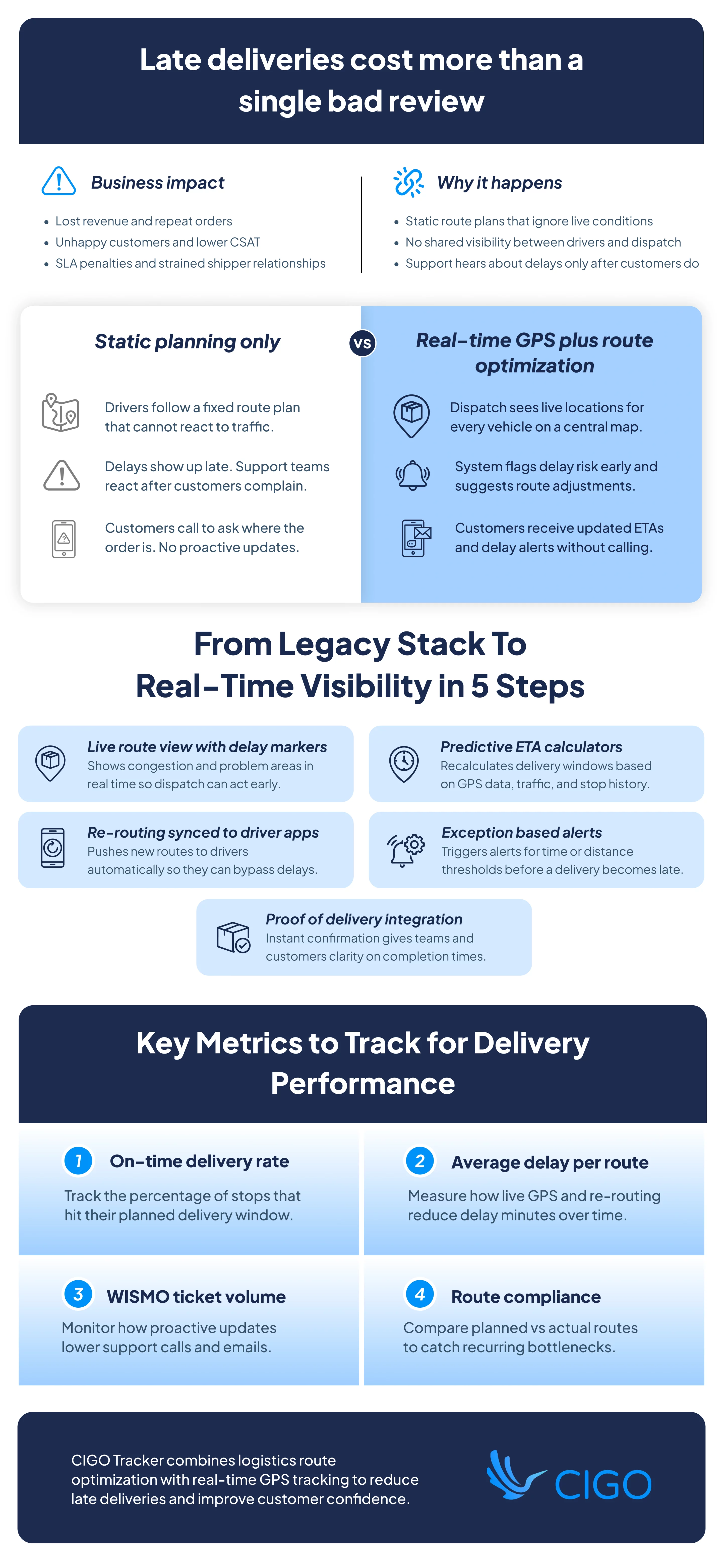
Late deliveries are a silent tax on your operation. They trigger WISMO spikes, strain SLAs, and push your dispatch team into firefighting mode.
The real problem is rarely a single driver or a random traffic jam. It is the gap between static plans and live reality. Without continuous location signals, ETAs drift, priorities clash, and small disruptions cascade across multi-stop routes.
Pair logistics route optimization with real-time GPS, and you gain a practical early-warning system. You spot any risks building, adjust routes, and update customers before trust erodes. CIGO Tracker brings these pieces together into a single, clear, fleet-wide view.
Key Takeaways
- Real-time GPS tracking gives you the visibility to reduce late deliveries before they snowball into escalations.
- Platforms that combine logistics route optimization with live location data help you run smarter dispatch decisions and adapt routes during the day.
- The best fleet GPS tracking software integrates with your existing tools rather than requiring an expensive rebuild.
- Accurate ETAs, exception alerts, and shared visibility lower internal stress and improve customer confidence.
- CIGO Tracker connects optimization and tracking at the workflow level, so you can risk, act, and communicate in one coordinated rhythm.
Late Deliveries: The Hidden Cost for Logistics Operators
Late deliveries rarely affect just one stop on a multi-stop route. One delay can ripple into overtime, extra callbacks, and tough SLA conversations.
Over weeks, that friction can quietly weaken shipper confidence and repeat volume.
That creeping pressure shows up in WISMO. When customers cannot see accurate progress, uncertainty turns into calls, chats, and emails that compete with your dispatch priorities.
Shopify defines WISMO as the “Where is my order?” question that grows when visibility and communication lag.
Real-time GPS linked with logistics route optimization closes that gap. You get early signals, adjust sequences, and refresh ETAs while there is still room to recover the day. Customers feel informed, support load stays lighter, and on-time performance becomes a managed outcome.
Common Root Causes of Late Deliveries
Traffic is the loudest culprit, yet late deliveries often stem from planning gaps and communication friction. Congestion still matters, especially during peak days. INRIX estimates U.S. drivers lost an average of 43 hours to traffic in 2024, a hidden drain that can squeeze tight delivery windows and destabilize multi-stop routes.
The operational roots you can control usually include:
- Static plans that ignore mid-day orders, cancellations, and changing time windows.
- Thin location updates that delay ETA recalculation and hide route drift.
- Dispatch, driver, and support teams are working off different versions of the day.
When these factors stack up, small disruptions can cascade into missed stops across multi-stop routes. Linking real-time GPS with logistics route optimization helps you detect risk early and keep everyone aligned on priorities.
How Real-Time GPS Tracking Solves the Visibility Gap
Real-time GPS changes the way you see a delivery day. Instead of guessing progress using periodic pings, you get a live operational picture that reflects traffic shifts, stop delays, and route drift as they happen.
That clarity gives your team time to act while the schedule is still recoverable.
With that visibility, dispatch can flag risks earlier, refresh ETAs, and coordinate with drivers using a single source of information. Customer service stays aligned, too, which helps you reduce panicked status questions and focus on the exceptions that truly need human judgment.
A 2024 study on tracking and tracing applications in Logistics 4.0 notes that real-time data supports better coordination across logistics operations. It reinforces why live GPS works best when paired with dynamic routing logic.
Benefits of Real-Time vs. Static GPS Data
| Dimension | Static GPS data | Real-time GPS data | Why it matters for late deliveries |
| Data cadence | Periodic location pings with gaps between updates | Continuous or near-continuous location stream | Those gap windows often hide the exact moment a route starts slipping. |
| ETA accuracy | ETAs age quickly when traffic, stop duration, or sequence changes | ETAs refresh as conditions evolve | You protect time windows using current reality, not morning assumptions. |
| Alert timing | Alerts tend to trigger after the deviation is already material | Alerts can trigger earlier with tighter thresholds | You gain workable options, not last-second improvisation. |
| Rerouting readiness | Limited signal confidence for safe mid-shift changes | Strong trigger for dynamic routing decisions | Routes stay resilient across multi-stop sequencing and priority shifts |
| Operational visibility | Harder to pinpoint where delays begin | Clear view of the delay origin and propagation | You can fix the right bottleneck instead of guessing. |
| Cross-team alignment | Dispatch, drivers, and support can operate on mismatched status views | A shared, live source of truth across teams | Fewer handoff errors and fewer compounding route-level delays |
| Customer experience | Visibility feels stale, driving more status anxiety | Proactive updates are easier and more accurate | WISMO pressure drops when customers see believable progress |
| Performance analysis | Post-shift diagnosis is limited by missing timeline detail | Richer movement and stop-level data for review | You can refine routing rules and training using evidence, not intuition. |
Role of Route Optimization in Preventing Late Deliveries
GPS gives you visibility. Route optimization turns that visibility into control.
Live location tells you where the fleet is. Optimization decides how to protect the day when reality shifts. It builds stop sequences that respect time windows, service priorities, vehicle limits, and hour-changing road patterns, guided by logistics optimization principles that maintain consistent decisions across the shift.
This matters because late deliveries rarely begin with a single big failure. They start with small timing leaks that compound across multi-stop routes. With dynamic routing, your platform can re-score risk, adjust sequences, and push updated directions to drivers while dispatch stays focused on high-impact exceptions.
You gain cleaner ETAs, fewer manual plan rebuilds, and a steadier service rhythm. Over time, that discipline makes on-time performance a designed outcome instead of a daily hope.
Features That Support Better Logistics Route Optimization
Strong logistics route optimization relies on features that keep your plan accurate as conditions change throughout the day.
- Time-window logic and priority rules reorder stops when risk rises, protecting medical, grocery, or contract-critical deliveries.
- GPS-driven dynamic rerouting recalculates sequences to avoid congestion, accidents, or last-minute add-ons, reducing snowball delays on multi-stop routes.
- Constraint-aware planning aligns vehicle types, capacities, access limitations, and customer preferences to help drivers avoid impossible assignments and wasted miles.
What to Look for in the Best Fleet GPS Tracking Software
The best fleet GPS tracking software should function as an execution layer, not a passive map.
You want clarity that helps you protect time windows across the whole day. Integration-friendly design matters because you shouldn’t have to replace your TMS or WMS to achieve live visibility, especially if your broader strategy already includes strong optimization solutions that support dynamic decision-making across routes.
- Live maps with filters for route, driver, status, and risk flags.
- Real-time ETA recalculation tied to traffic and stop-level delays.
- Exception alerts you can tune by time, distance, and customer priority.
- Driver apps that sync reliably with mixed hardware and BYOD setups.
Integration Considerations
Integration decides if a GPS platform becomes a quick win or a stalled project.
The best fleet Global Positioning System (GPS) tracking software should integrate with your Transportation Management System (TMS), Warehouse Management System (WMS), or dispatch workflows via clean APIs and clear data mapping.
Look for low-friction onboarding that works with existing devices to avoid forced hardware swaps. A phased rollout lets you validate ETA accuracy, alert quality, and dispatcher adoption on a small route group before you expand across regions.
You also want role-based access and audit trails, especially if multiple carriers share the same ecosystem.
Why Static Route Planning Isn’t Enough

Once-a-day route planning gives you a neat schedule at 7 a.m., but not dependable performance by mid-afternoon.
The moment traffic spikes, a customer tightens a time window, or a high-priority stop is added, the plan starts drifting away from reality. Dispatchers end up patching schedules via phone calls and gut checks rather than relying on a smarter route-algorithm that can adapt to shifting conditions.
Static routes also ignore the feedback loop that real-time GPS can provide.
Without live signals, the system cannot re-sequence stops, recalculate ETAs, or warn you early enough to protect multi-stop performance. Small disruptions stack into late deliveries, and by the time you notice, your options are already shrinking. Dynamic planning keeps your day flexible, measurable, and far less stressful.
5 Real-Time Features That Directly Reduce Late Deliveries
This is the core capability stack that separates reactive tracking tools from prevention-focused platforms.
1. Live Route View with Delay Markers
A live route view puts the whole day into focus, showing you where delay risk is growing before it starts infecting every stop on the run.
Instead of guessing which driver is slipping, you see the pressure points on a single map.
With delay markers and congestion overlays, dispatch can prioritize the right intervention, send a quick reroute, or adjust a time window while there is still room to recover. That speed upgrades your team’s decision quality and keeps multi-stop routes stable, even when traffic or service times wobble.
2. Predictive ETA Calculators
Static GPS updates can leave you working with an outdated picture. A ping every few minutes might look harmless, yet it can mask a critical detour or stop delay that knocks your whole sequence off rhythm.
Predictive ETA calculators close that gap by blending live GPS and traffic signals into continuously refreshed arrival windows. Recent research shows that integrating predictive ETAs into truck scheduling supports better operational decisions when conditions shift.
You keep dispatch aligned with drivers, and your customer updates remain credible rather than optimistic.
3. Re-Routing Logic with Driver App Sync
Rerouting only works when the driver’s screen updates as fast as the plan changes in real time.
Without app sync, a dispatcher may se a fixed problem while the driver unknowingly follows the old sequence.
- Automatic route pushes to the driver app with clear turn-by-turn guidance.
- Read receipt or confirmation so dispatch knows the new plan is acknowledged.
- Offline-safe caching and quick resync to handle poor coverage without losing the updated sequence
4. Exception-Based Alerts (Before It’s Too Late)
Exception-based alerts work best when they give you time to choose.Instead of waiting for a missed window, you set risk thresholds tied to time-to-stop, distance-to-window, route deviation, or unexpected dwell time.
With that early signal, dispatch can reroute, re-sequence, or notify the customer while the delivery is still salvageable. The alerts become a rhythm for the day, keeping human attention centered on the few events that truly threaten on-time performance.
5. Proof of Delivery Integration
Proof of delivery integration turns “delivered” into a verified, time-stamped reality.
- Capture a signature, photo, or scan tied to the stop and GPS point.
- Auto-save POD to the order record so support can close disputes fast.
- Feed POD timestamps into route reports to spot delay patterns tied to access issues, dwell time, or sequence choice.
With POD aligned to live tracking, you strengthen daily accountability and sharpen future routes.
How CIGO Tracker Combines Route Optimization + Real-Time GPS Data
With CIGO Tracker, we combine route logic and live visibility so you can manage the day as it unfolds. Our platform pairs Optimized Routing with Delivery Tracking, helping you compare planned versus actual movement and refresh ETAs when conditions shift. That unified view surfaces delay risk early.
Our Route Planner lets dispatchers create, change, and optimize daily trips in real time, keeping drivers and support aligned.
We designed these tools to integrate with your stack, so you don’t have to replace your systems. You reduce manual check-ins, protect time windows, and keep customers informed with confidence.
Key Metrics to Track for Delivery Performance
Metrics keep your improvement story grounded, showing where GPS visibility and logistics route optimization are truly working. Track leading indicators to intervene before service slips, using last-mile KPIs that reveal both service risk and process gaps.
- On-time delivery rate by route and time window.
- Alert engagement and response speed across dispatch and drivers.
- Average delay minutes by region and shift.
- Customer tickets tied to missed or drifting ETAs.
- Planned versus actual route adherence to surface training gaps.
Best Practices for Deploying Real-Time GPS Tracking
Deploy real-time GPS with a disciplined rollout to prove value before scaling. It keeps everyone focused on fewer late stops and gives you a clear lens for comparing route software options once you see what your operation truly needs.
- Start with routes where lateness and escalations are frequent.
- Validate coverage and location accuracy across your delivery zones.
- Train dispatchers to read live maps with clear thresholds.
- Coach drivers on app sync, status updates, and reroute acceptance.
- Review alert noise weekly and tighten time-window rules.
Common Mistakes to Avoid
Real-time GPS can feel like a cure-all, yet the wrong setup can leave you chasing dots without improving on-time performance. The goal is not more data, it is better decisions.
Avoid these common traps:
- Treating GPS as visibility only, without logistics route optimization to re-sequence stops when risk rises.
- Setting alerts that never trigger customer updates, which keeps WISMO pressure high and weakens delivery transparency when timelines shift.
- Skipping driver onboarding on app sync and status habits, which erodes data quality fast.
- Choosing black-box tools that hide routing logic and weaken dispatcher trust.
Tight governance, clear thresholds, and shared workflows keep the system working for you.
Future-Proofing Your Fleet with Dynamic Routing + GPS Visibility
Your network never holds still. Seasonal surges, new service areas, and shifting compliance expectations keep testing the same static playbook, and the mistakes you avoid today can return tomorrow in a new shape.
Future-proofing means choosing tools that stay transparent, configurable, and easy to scale without turning your operation into a black box.
Dynamic routing paired with real-time GPS gives you that flexibility. You can adjust sequences mid-shift, protect time windows, and cut wasted miles without ripping out your stack, especially when you apply AI routing.
Why CIGO Tracker is the Best Fleet GPS Tracking Software for Avoiding Late Deliveries
CIGO Tracker helps you prevent late deliveries with live visibility and configurable alerts, so you can act before a small delay becomes a route-wide problem.
Our platform brings real-time visibility and logistics route optimization into a single operational layer, so dispatch sees risk early, and drivers stay aligned with the live plan.
With our Customer Engagement tools, you can send branded updates and predictive ETAs that reduce WISMO pressure. API Integrations and Last Mile workflows support mixed fleets and existing systems so that you can roll out quickly without disruption. You also get clearer planned-versus-actual insights that make coaching and route tuning simpler each week.
Turn Late Delivery Risk Into a Managed System
Late deliveries are not inevitable, even when your network is complex and your day changes mid-route. With real-time GPS visibility and smart routing logic, you can spot risks early, protect time windows, and keep ETAs credible across multi-stop routes.
That shift turns last-mile performance into a system you can manage, measure, and improve, not a daily gamble that drains support time and customer patience. If you want a clearer path to fewer late stops and stronger trust, our Live tracking and optimization workflows help you see what is happening, decide faster, and act with less friction.
If you’d like to see how this could work across your routes, contact our team to book a demo or a tailored walkthrough.
FAQs
What is logistics route optimization, and why does it cut late deliveries?
Logistics route optimization is the process of sequencing stops and selecting paths that protect time windows, capacity, and service priorities. It reduces late deliveries by preventing small timing leaks from compounding across multi-stop routes. Peer-reviewed research on last-mile optimization highlights how data-driven routing improves reliability, cost control, and customer outcomes.
How does real-time GPS make logistics route optimization stronger?
Logistics route optimization works best when it is fed live signals, not morning assumptions. Real-time GPS reveals route drift, unexpected dwell time, and traffic shifts early enough for you to intervene.
What should I prioritize when choosing the Best fleet GPS tracking software?
The Best fleet GPS tracking software should give you live maps, reliable ETA recalculation, and configurable exception alerts. You also want a strong driver app sync, so dispatch and drivers share a single version of the day.
Look for tools that connect GPS signals to operational decisions, not just visibility, which aligns with modern last-mile tech trends.
Can the Best fleet GPS tracking software work with my current TMS or WMS?
Yes, and it should. The best fleet GPS tracking software typically offers APIs or lightweight integrations that let you add real-time visibility without forcing you to replace core systems. This matters when you need faster deployment and less disruption. Integration-oriented fleet platforms emphasize pulling GPS data into existing dispatch and enterprise workflows.
How do I reduce WISMO using Logistics route optimization and the Best fleet GPS tracking software?
WISMO stands for “Where Is My Order?” and spikes when customers lack credible status and ETAs. Logistics route optimization keeps stop sequences resilient, while GPS tracking software keeps ETAs up to date and provides timely alerts.
Together, you can send proactive updates that reduce anxiety and protect SLAs across busy multi-stop days.