
Most fleet failures don’t start at dispatch. They start the moment an order is confirmed without checking whether the capacity to fulfil it actually exists.
By 7 a.m., the route plan looks clean. By 10 a.m., three late orders have landed after the last driver left the depot, and dispatch is fielding calls it cannot resolve.
That is truck overbooking. The fix is not faster routing or better dispatch. It is a planning layer that enforces real limits at the moment orders are confirmed. CIGO Tracker is built around exactly that.
Key Takeaways
- Truck overbooking occurs when confirmed orders exceed the fleet’s real delivery capacity in driver hours, vehicle count, stop limits, or equipment type.
- Real-time capacity planning closes the booking window before overcommitment happens, not after the route is already broken.
- Planning software enforces limits at order confirmation, turning a reactive problem into a proactive one.
- The biggest savings from stopping overbooking come from eliminating reattempts, overtime, and last-minute spot-labour costs.
- KPIs to prove impact: overcommitment rate, reattempt rate, cost per stop, overtime hours, and override frequency.
What Is Truck Overbooking, and Why Does It Keep Happening?
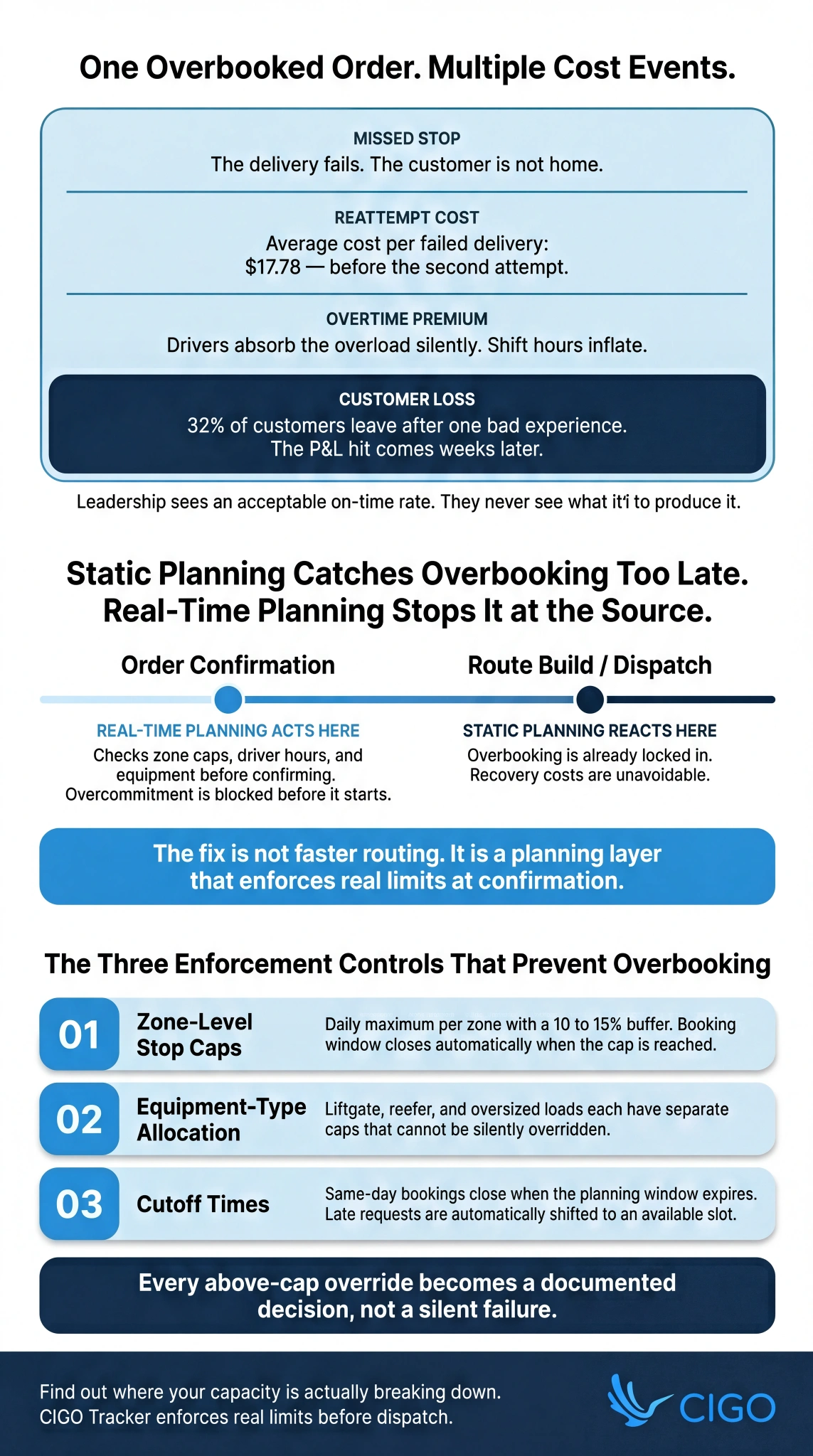
Overbooking means more stops, volume, or service windows are confirmed than available drivers, vehicles, and hours can realistically execute within the day.
What makes it persistent is that it is rarely a deliberate decision. No single system shows the planner what capacity is already committed before a new order is accepted. Orders keep sliding in unchecked until the route build finally reveals a plan the fleet was never equipped to run.
How Overbooking Happens Without Anyone Noticing
Orders arrive from multiple channels simultaneously: website, phone, EDI, and field sales.
Each gets confirmed before anyone has verified available capacity, because no single system enforces a check at that moment.
By the time the route plan is built, the overbooking is already locked in. The gap then gets absorbed invisibly through:
- Overtime hours drivers and dispatchers never formally flag
- Stop triage that quietly deprioritises lower-margin deliveries
- Reattempt loops that inflate cost per stop without explanation
- Leadership sees an acceptable on-time rate. They never see what it actually costs to produce it.
The True Cost of Overbooking (Beyond the Missed Stop)
A failed delivery is never just a missed stop. It is a cost event with multiple layers, and most operations only account for the first one.
Loqate puts the average cost per failed delivery to a retailer at $17.20, before the reattempt. Add overtime premium, spot coverage, and SLA penalties on top of that, and a single bad planning day compounds quickly across the entire week.
What makes it worse is the delayed damage. PwC’s customer experience research found that 32% of customers leave a brand after just one bad experience, meaning the revenue loss follows weeks or months later.
The financial impact of missed deliveries rarely appears on the same week’s P&L as the planning failure that caused it, which is precisely why overbooking stays invisible for so long and why fixing it at the planning layer, before orders are confirmed, is the only intervention that actually stops the cycle.
What Is Real-Time Capacity Planning?
Real-time capacity planning is the live management of available delivery resources, covering drivers, vehicles, stop slots, and time windows. Unlike static planning, limits update continuously as orders confirm, drivers call out, and vehicles go offline.
A figure set the night before is already outdated by the time the shift starts. Accepting orders against stale capacity creates the exact overbooking problem planning is supposed to prevent in the first place.
Real-Time vs. Static Capacity Planning
| Static Planning | Real-Time Planning | |
| When limits are set | Once per planning cycle | Continuously updated |
| When overbooking is caught | At route build or dispatch | Blocked at order confirmation |
| Response to zone capacity | Route collapses under overload | Booking window closes automatically |
| Planning outcome | Reacts to overcommitment | Prevents it entirely |
How Real-Time Capacity Planning Stops Overbooking

A shared capacity model sits between order intake and route build, checking every incoming order against three constraints before confirmation:
- Zone capacity: available stop slots by area and time window
- Driver hours: remaining shift time against the order’s service requirements
- Equipment type: matching load requirements to available vehicles
Orders within limits confirm immediately. Orders above limits are held, rerouted, or escalated for planner approval, producing a route plan fully executable before the build even starts.
Live Capacity Visibility Across Drivers, Vehicles, and Zones
A capacity dashboard shows utilisation by zone, vehicle type, and driver, updating continuously as orders are confirmed. Planners see which zones are approaching their risk threshold before the booking window closes, giving them time to act rather than react.
Order intake teams benefit directly too. They can see available slots without calling dispatch, which removes a communication bottleneck that slows confirmation times.
Real-time supply chain visibility shifts overcommitment from a dispatch-level firefight into a planning-level advantage, caught before it ever has the chance to cascade.
Booking Caps and Cutoffs That Enforce Real Limits
Three configurable controls work together to keep acceptance within what the fleet can actually execute:
- Zone-level stop caps: set a daily maximum per zone, with a 10–15% buffer reserved for variability
- Equipment-type caps: give liftgate runs, reefer loads, and oversized items separate allocation limits that cannot be overridden silently
- Cutoff times: close same-day bookings when the planning window expires, automatically shifting late requests to an available slot instead of compressing them into an already-full route
Automatic Alerts Before Overcommitment Is Locked In
Alerts fire at three points, each designed to surface risk while planners still have room to act.
Zone-level threshold warnings trigger at 80 percent of a stop cap, giving both planners and order intake teams lead time to redirect volume before a zone fills.
From there, equipment availability warnings activate when a requested vehicle type is already fully committed. Driver-hours warnings then flag any stop that would push a driver into overtime or an hours-of-service violation, before the route is ever locked.
Exception Handling Without Manual Firefighting
When capacity is genuinely full, the system routes the exception automatically rather than dropping it on a planner’s desk. It has three paths available: hold the order for an available slot, escalate it for planner approval, or redirect it to an alternative zone or vehicle type.
Each option keeps volume moving without requiring manual intervention.
Above-cap overrides still require an approval step. Every overbooking becomes a deliberate, documented decision rather than a silent failure.
Better still, that override tracking feeds directly back into capacity model calibration. The system sharpens with every exception it processes.
Key Features to Look For in Capacity Planning Software

Evaluating delivery planning software for fleet teams on these criteria separates genuine fleet capacity management from a relabelled scheduling tool:
- Real-time capacity dashboard: live view of driver, vehicle, and zone utilisation across the full planning horizon
- Zone and day stop caps: configurable buffers with hard and soft enforcement modes
- Equipment-type allocation rules: separate caps for liftgate, reefer, and oversized loads
- Order intake integration: capacity checks happen at confirmation, not at route build
- Alert and notification system: threshold warnings, at-capacity flags, and driver-hours proximity alerts
- Override workflow: above-cap requests require documented approval and are logged for auditing
- Reporting: overcommitment rate, override frequency, reattempt correlation, and cost-per-stop trends
What Data You Need to Plan Capacity in Real Time
Effective real-time capacity planning draws from four input categories:
- Driver roster and shift patterns: available hours, scheduled breaks, and current commitments
- Vehicle fleet data: type, equipment spec, and live commitment status
- Historical stop data: volume by zone and day of week
- Zone-level demand patterns: known high-failure areas and seasonal pressure points
Without these inputs feeding the system continuously, capacity limits reflect assumptions rather than reality.
According to Trucking Research’s data, the average industry cost reached $2.26 per mile in 2024, making every overloaded route, reattempt, and late driver a cost multiplier worth tracking at this level of detail.
Keep Your Capacity Model Current
A capacity model only stays useful if it keeps pace with how operations actually run.
Start with zone caps. Review them whenever demand patterns shift or new routes are added, since static limits quickly become inaccurate as volume changes.
Override frequency is a reliable diagnostic tool. Repeated overrides in the same zone signal a cap that needs recalibration, not a planner working around a one-off issue.
From there, feed execution data back into the model monthly. Actual stop times, late completions, and reattempt reasons refine dwell-time assumptions, keeping the model anchored to operational reality rather than drifting from it.
Best-Fit Use Cases
Same-Day and Short-Window Delivery Operations
Overbooking risk peaks when booking windows are short and order volume is unpredictable.
Live stop-slot visibility gives order intake teams the information they need to manage customer expectations at the point of booking.
When a zone fills, the system surfaces available slots automatically rather than letting intake teams confirm into a wall they cannot see. Catching the conflict at confirmation, rather than at route build, prevents the most common version of the problem before it starts.
3PLs and Multi-Client Fleets
Shared vehicle pools create silent overbooking risk across accounts when no unified capacity view exists. Per-client allocation caps and above-cap approval workflows prevent one client’s volume surge from crowding out another’s committed slots.
Effective 3PL route optimization across client accounts depends on an accurate capacity layer to hold at scale. Without it, route quality is constrained by commitments the planning tool never saw, and service failures get absorbed silently across accounts.
Peak Season and Promotional Volume Spikes
Predictable volume spikes, such as sale events or seasonal peaks, are far easier to absorb with pre-set temporary cap adjustments than by reactively adding vehicles during a surge.
Real-time visibility ensures promotional volume lands in available capacity rather than stacking silently on top of committed routes. Pre-configured adjustments handle the spike at the planning level, so dispatch can focus on executing the day rather than untangling it.
Implementation Best Practices
Before going live, define caps and buffers using historical worst-case service times rather than optimistic estimates, then adjust upward as real data comes in. From there, integrate planning with order intake at launch.
Blocking overbooking at confirmation is the highest-value unlock the system delivers.
Finally, build the override workflow before a single override is accepted. Define who approves, what documentation is required, and how every decision gets logged.
Common Mistakes to Avoid
- Setting caps too high at launch: optimistic stop-count assumptions recreate the overbooking problem inside the capacity tool.
- No override accountability: unlimited or undocumented overrides make the capacity system ineffective within weeks.
- Treating planning as a dispatch tool: the value is in preventing overcommitment at booking, not managing overload after the fact.
- Skipping the weekly review rhythm: without regular cap performance reviews, the model drifts from reality as demand patterns change.
KPIs to Track After Rollout
Proving impact from a capacity planning rollout requires metrics tied to planning quality, not just execution outcomes. The measures most relevant to overbooking prevention are:
- Overcommitment rate by zone
- Reattempt rate before and after controls
- Cost per stop, week-over-week
- Override frequency and above-cap volume
- On-time delivery against committed windows
Tracking top KPIs for last-mile delivery performance at this level reveals whether capacity controls are holding or whether overcommitment is quietly resurfacing in specific zones.
How CIGO Tracker Supports Real-Time Capacity Planning
With CIGO Tracker, execution data flows back into the planning model rather than sitting in a separate system.
Capacity management calibrates zone caps continuously using actual stop times and failure reasons from completed routes. Delivery tracking gives planners early warning when a live route is running late, enabling same-day rebalancing before reattempts accumulate.
Logistics optimization and optimized routing then apply that data forward, so every future plan reflects what is actually happening on the road.
Future Trends in Real-Time Capacity Planning
The discipline is shifting from reaction to prediction, and the technology is catching up quickly.
AI-driven dynamic stop caps now adjust in real time based on traffic conditions, historical dwell patterns, and inbound order mix. Predictive overbooking alerts flag high-risk booking combinations before a zone cap is ever reached, giving planners time to act rather than recover.
According to an MHI and Deloitte 2024 Annual Industry Report, 55% of supply chain leaders are actively increasing investment in planning technology. Fleet capacity management sits at the centre of that shift.
Where Is Your Capacity Actually Breaking Down?

Truck overbooking is a visibility failure, and it always starts before dispatch. Audit your last 30 days for overcommitment events, map the zones where overbooking most often occurs, and set opening caps with conservative buffers.
CIGO Tracker enforces those limits at the booking stage, so the fleet executes what was actually planned. Start a free trial or contact the team to get started.
FAQs
What is truck overbooking in fleet management?
Truck overbooking occurs when confirmed orders exceed driver hours, vehicle count, or stop capacity for a given day. It is a visibility failure: the fleet commits to more than it can execute because nothing enforces real limits at order confirmation.
How does real-time capacity planning prevent overbooking?
Real-time capacity planning checks every incoming order against live zone caps, driver hours, and equipment availability before confirmation. Orders above limits are held, rerouted, or escalated, so the route plan starts with only what the fleet can actually run.
What features should I look for in capacity planning software?
Prioritise a real-time capacity dashboard, zone-level stop caps with configurable buffers, equipment-type allocation rules, an order intake integration that enforces limits at confirmation, threshold alerts, an override approval workflow, and reporting that tracks overcommitment rate and cost-per-stop trends.
What KPIs measure the impact of real-time capacity planning?
Track overcommitment rate by zone, reattempt rate, cost per stop trends, override frequency, driver overtime hours, and on-time delivery versus committed windows. Together these confirm whether the capacity model is reducing planning errors or documenting them after the fact.
How long does it take to see results after implementing capacity planning software?
Overcommitment and reattempt rates improve within the opening planning cycles once zone caps and intake integrations go live. Cost-per-stop reductions follow as overtime costs fall. Most operations see measurable impact within 30 to 60 days of a properly scoped rollout.