Foresight AI
Your last mile is where trust is tested. Customers can forgive delays, but they rarely forgive a missed window with no explanation.
Small frictions stack up fast. A wrong address pin, a locked gate, a longer unload, or a driver stuck on the phone turns one delay into a ripple across the route.
Last mile delivery software keeps control when the day changes. It unifies planning, dispatch, driver workflows, customer updates, and proof of delivery, so every stop closes with a clear, defensible outcome. With CIGO Tracker, you standardize execution across routes and regions.
Key takeaways
- Last mile delivery software tightens planning and ETAs, raising on-time delivery performance.
- Delivery tracking software cuts WISMO by sending proactive updates and exception visibility.
- Last-mile delivery software boosts productivity by streamlining each stop, without burning out teams.
- CIGO Tracker helps fleets standardize delivery execution with optimized routing, delivery tracking, and proof-of-delivery workflows that keep stop outcomes clean and defensible.
- Route optimization software standardizes routes, proof, and outcomes across regions and partners.
What is last mile delivery software
Last-mile delivery software is the core system your fleet uses to manage deliveries from planning to closeout. It turns daily orders into workable routes, assigns them to the right teams, and keeps dispatch and the field aligned with the same live updates.
On the road, drivers follow guided stop steps and record what happened in seconds.
If a gate is locked or a customer is not available, the exception is logged with time and location, and proof is captured before the stop is closed.
Capgemini notes that delivery hubs need intelligent daily route plans that maximize productivity while minimizing distance, which is why execution tools matter as much as planning.
That discipline reduces missed stops and back-office cleanup.
How it works across a typical delivery day
A delivery day starts when last-mile delivery software turns orders into routes your team can actually run. Time windows, capacity, and service times shape the stop sequence so the plan fits the clock.
Dispatch tracks progress from a single board and adjusts routes when reality changes. That is where delivery dispatch software helps, keeping updates clean, visible, and actionable while the day is still recoverable.
Drivers follow a guided stop flow and confirm each outcome in the app, including delays and failed attempts. Those stop records feed reporting, which tightens planning for the cycle ahead. As McKinsey & Company explains, “blind handoffs” create information loss, and visibility plus workflow automation reduces that waste.
Why fleet operators need last mile delivery software
Fleet operators need last-mile delivery software because the final leg of delivery punishes uncertainty. Customers expect fast delivery and clear timing, yet every gate code, parking delay, and receiving rule steals slack.
Operational risk builds quietly. Failed attempts, long dwell times, and weak route density raise the cost per stop even when drivers hustle, and dispatch ends up stuck reacting to issues all day.
Peer-reviewed search by Oper Manag Res highlights routing efficiency and meeting fulfilment timelines as key success factors in last-mile projects, especially in disruption-heavy conditions.
That is why a connected execution system matters, not just a map.
Signs your operation has outgrown manual tools
Manual tools start breaking fast when volume rises and exceptions multiply, and the tradeoffs in manual vs automated route planning show up quickly once the day depends on calls and memory.
- Dispatch depends on individual experience, so outcomes vary by shift.
- Drivers call for basic updates instead of following a guided workflow.
- Proof of delivery evidence is scattered, so disputes drag on.
- Reporting lags or conflicts, so coaching and cost control stay reactive.
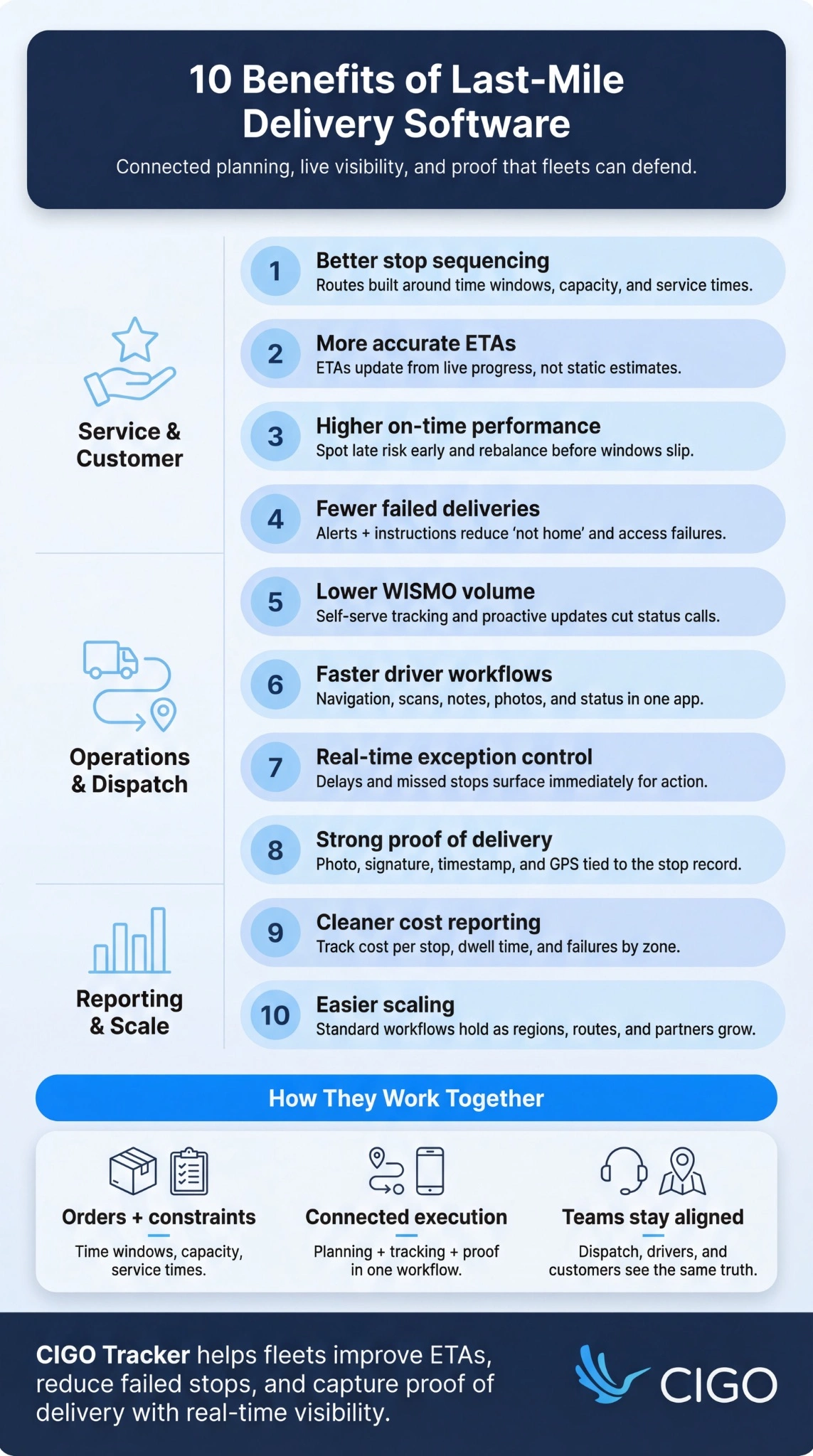
10 benefits of last mile delivery software for fleet operators
These benefits show how last mile delivery software boosts reliability, productivity, cost control, and scale.
1) Better route planning and stop sequencing
Better route planning starts when last-mile delivery software builds routes around real constraints.
Time windows, capacity, service time, and start locations shape a stop sequence drivers can follow without backtracking. That is the foundation of efficient multi-stop planning.
This discipline cuts wasted miles and keeps your stop order stable when volume spikes.
The US Department of Energy notes that planning optimal routes improves efficiency by reducing miles driven, time in traffic, and even the number of vehicles needed. With an executable plan, your routes stay consistent across shifts, and dispatch spends less time rebuilding the day.
2) More Accurate ETAs and Higher On-Time Performance
Accurate ETAs come from linking the plan to live route progress inside your last mile delivery software.
When traffic, dwell time, or a failed stop shifts the schedule, the ETA updates in real time, so customers get a window they can trust across the day, reinforced by geo-fencing delivery windows triggers that time-stamp arrivals and completions
Dispatch gets earlier visibility into problems, so the team can act before delays spread.
A route drifting late can be rebalanced, resequenced, or reassigned while options still exist, which protects on-time performance without frantic end-of-day recovery.
3) Fewer failed deliveries and reattempts
Failed deliveries look like a driver problem, but the cause is often missing context.
The customer is not ready, access codes are wrong, or instructions are vague, so the stop fails and the route eats a reattempt.
Last mile delivery software reduces misses by keeping customers and drivers aligned. Arrival alerts set expectations, delivery notes stay with the stop, and exceptions are captured on the spot.
When policy allows, you can offer safe drop, pickup points, or a quick reschedule, which protects first-attempt success consistently.
4) Lower WISMO Volume and Customer Support Load
WISMO spikes when customers cannot see what you see, so support teams absorb the pressure.
Delivery tracking software reduces that load by giving shoppers a reliable status view, plus delivery notifications reduce WISMO calls when the ETA shifts or an exception is logged, which answers most ‘Where is my order?’ questions before they reach support.
Radial notes WISMO can drive 25–35% of contact center interactions and spike to 50% during peak, which is why visibility is an operational lever, not a nice-to-have.
5) Faster driver workflows at each stop
Stop time is where your day is won or lost. A driver app that bundles navigation, checklists, scans, notes, photos, and status updates reduces the little friction points that add minutes across a route.
You also reduce back-office cleanup. When drivers capture structured exceptions in the moment, your team spends less time chasing clarity after the fact.
6) Real-time fleet visibility and exception management
Real-time fleet visibility changes how dispatch runs the day.
You stop chasing late routes and start managing risk while there is still room to act, because every delay and exception is visible in the same operational view.
This matters most at handoff moments, where information can get lost and small gaps turn into missed windows.
The Federal Highway Administration notes that intelligent freight technologies improve visibility and control, which increases operational flexibility during disruptions and delays, aligning with how a dispatch board supports faster intervention.
7) Strong proof of delivery and fewer disputes
Strong delivery proof protects revenue because electronic records turn a claim into a time-stamped, stop-level file you can pull up in seconds.
In the U.S., electronic records and signatures carry legal standing when handled correctly. The E-SIGN Act makes clear that a record cannot be denied legal effect solely because it is in electronic form.
- Photo at the drop location, linked to the stop and package identifier
- Receiver name and signature when handoff is required
- Timestamp and GPS captured automatically at completion
- Exception reasons with notes for refusals, damages, or access issues
- Audit trail showing who captured what, and when
8) Higher Driver Productivity and Better Capacity Use
Productivity comes from removing wasted minutes, so your best drivers are not slowed down by avoidable friction. With better sequencing, cleaner stop workflows, and fewer reattempts, you increase stops completed per route while keeping routes humane and repeatable.
9) Cleaner performance reporting and cost control
Clean reporting starts at the stop. When every outcome is captured the same way, your numbers hold up in reviews, so cost control becomes repeatable.
You also spot leakage early, before it compounds.
With consistent data, patterns surface fast and coaching stays fair, not anecdotal. Track a small set of KPIs that connect service and spend:
- Cost per stop by route and zone
- On-time rate plus ETA accuracy
- Failed delivery and reattempt rate
- Dwell time by stop type
10) Easier Scaling Across Routes, Regions, and Partners
As volume grows, scaling fails when regions apply different standards for finishing a stop. Standardized workflows for stop steps, exceptions, and proof keep execution consistent across depots and contractors.
That consistency shortens onboarding since new drivers and partners rely on guided steps rather than dispatch calls.
Because data is recorded the same way everywhere, reporting stays aligned across regions and partners, reducing friction in coaching and billing.
How these benefits show up in KPIs
KPIs turn the benefits into numbers you can manage daily, and these map closely to the top 10 last-mile delivery KPIs fleets use to track reliability, cost, and dispute risk week over week.
- On-time rate plus ETA accuracy
- Stops per route and per hour
- Failed deliveries and reattempt percentage
- Cost per stop and miles per stop
- Average dwell time by stop type
- WISMO tickets tied to tracking usage
- POD disputes, completeness, and exception accuracy
Key Features to Look for in Last Mile Delivery Software
Choose features that keep routes executable, drivers fast, and proof defensible:
- Constraint routing with time windows, capacity, service time, start-end rules.
- Dispatch board for edits, rebalancing, late-risk alerts, exception resolution.
- Driver app that merges navigation, scans, checklists, notes, proof capture.
- Customer tracking with live status, ETA windows, notifications, preferences.
- Configurable proof of delivery with photos, signatures, timestamps, geolocation, reason codes.
- Integrations, exports, APIs, and role-based access for ops and finance.
Implementation Best Practices for Fleet Operators
Implementation works best when you design the stop before you deploy the tool. Treat it like a rollout, so drivers and dispatch share one definition of “done.”
- Map stop types, proof requirements, and exception codes until nothing is ambiguous.
- Pilot a route set, tune service times, alerts, and edit rules from results.
- Clean addresses and customer instructions, since ETA credibility depends on inputs.
- Train with your own scenarios, so muscle memory holds under pressure.
- Lock a KPI review cadence, so improvements continue after go-live.
Metrics to monitor after launch
After go-live, you want metrics that reflect what customers actually experience.
Pair on-time rate with ETA accuracy, because a route can look on time while the promise drifted. When those two move together, you can trust the story.
Break failed deliveries and reattempts down by cause, so “not home” and “cannot access” become fixable patterns. Add dwell time to explain route duration and driver productivity, and connect inquiry volume to tracking visibility.
Round it out with POD completeness, since missing proof turns small issues into long disputes that drain time.
How CIGO Tracker Supports These Benefits
CIGO Tracker keeps delivery execution repeatable by connecting routing, visibility, proof, and reporting in one workflow. You plan routes with constraints, adjust in flight, and close every stop with a clear outcome with confidence.
Live status and ETAs come from delivery tracking tools, while customer engagement updates reduce inbound check-in calls. Secure access matters too, so security and compliance controls protect data and roles across ops, support, and finance.
With clean stop records, performance reports highlight where time, miles, and exceptions leak, so you can tighten the next day’s plan.
Common pitfalls to avoid
Most rollouts fail because you treat the project as routing only.
Routes may look efficient, yet drivers still juggle apps and customers still chase updates, so stops fail at the door. Slow, ambiguous stop steps erase a good plan in minutes.
You also lose trust when input data is messy. Bad addresses, missing instructions, and unrealistic service times distort ETAs, so teams blame the tool instead of the setup. Keep the rollout tight with a pilot, train dispatch and drivers together, and measure the same KPIs every week so improvements carry across regions.
Consistency matters, since uneven training leaves exceptions unrecorded and proof inconsistent.
Future Trends in Last Mile Delivery Software
Research is pushing last-mile platforms beyond static planning and into learning systems.
A 2025 review from Drones highlights AI-driven decision-making and IoT-supported real-time monitoring, which improves predictive ETAs as software learns from stop service times, traffic signals, and exception history.
Dynamic routing will mature alongside structured exception capture, because rerouting only helps when the system understands why a stop failed.
Customer preference controls will expand, letting you offer tighter windows, safe-drop rules, and message cadence without flooding support. Deeper analytics will tie cost per stop to service commitments, turning performance into levers you can tune, not reports you read.
Last mile delivery software improves cost control
Cost per stop is rarely lost in one dramatic failure. It leaks through small misses like drifting ETAs, long dwell time, and reattempts that quietly steal capacity.
If you want a quick self-check, review one week of routes and look for patterns you can act on.
Start with constraints that were ignored, stops that consistently ran long, and proof gaps that triggered disputes or credits. When planning, execution, visibility, and proof live in one workflow, those leaks show up clearly and become fixable.
See it in action with CIGO Tracker. Routing, live tracking, customer updates, proof of delivery, and reporting all flow through one stop record you can trust. Book a demo today.
FAQs
What is a last-mile delivery platform and what does it replace for fleet operators?
A last-mile delivery platform is the system fleet operators use to run deliveries end to end, from planning through closeout. It replaces spreadsheets, phone calls, and disconnected tracking links with a single workflow that covers route planning, dispatch, stop execution, and proof.
Route optimization turns orders into executable routes that respect real constraints, while delivery tracking keeps operations and customers aligned at the stop level with live status and verified completion.
How does a last-mile delivery platform improve on-time delivery rates?
On-time improves when live progress updates ETAs and dispatch can intervene early. Delivery tracking software surfaces delays, and route optimization software re-sequences stops or rebalances workload before missed windows cascade.
Which proof-of-delivery features reduce delivery disputes the most?
Disputes drop when proof is complete and tied to the stop: photo, signature, timestamp, GPS, and exception reason codes. Delivery tracking software stores evidence with the stop record for fast retrieval.
How long does implementation take for a mid-sized fleet?
Most mid-sized fleets pilot in weeks, and expand once data and training stabilize. Route optimization software needs clean addresses and service times, and delivery tracking software needs clear notification rules and exception codes.
What KPIs should fleet operators track after rollout?
Track KPIs that connect service and cost: on-time plus ETA accuracy, reattempt rate by reason, dwell time, cost per stop, and POD completeness. Use delivery tracking software data to spot patterns and coach consistently.