Foresight AI
Most scheduling problems don’t start in the field. They start the night before, when a planner treats a 45-minute installation the same as a 10-minute delivery drop.
That’s where a capacity planning system earns its place. It separates job types, assigns realistic service times, and builds routes that reflect what each stop actually demands from your crew and truck.
Without that structure, one overrun installation cascades into a missed pickup, then an angry customer, then overtime. A proper delivery management system like CIGO Tracker closes that gap before dispatch ever opens.
Key Takeaways
- A capacity planning system models time, skills, equipment, and windows across all job types together, not in silos.
- The biggest win is feasibility: you stop confirming work that cannot fit the day before you find out it cannot.
- Better utilization comes from bundling compatible jobs and cutting deadhead miles, not compressing schedules.
- A strong delivery management system feeds execution data back into planning so estimates improve over time.
- Success shows up in fewer reattempts, fewer reschedules, and better crew productivity across all three job types.
What Is a Capacity Planning System?
A capacity planning system is the planning layer that sits upstream of execution. Its job is to forecast incoming work, whether deliveries, pickups, or installations, and match that demand against what the fleet can absorb before any customer commitment is made.
That means modeling hours, crew skills, vehicle capacity, and service windows as one integrated picture, not a stack of separate calendars reconciled only when a route collapses.
According to Gartner workforce planning research, only 15% of organizations practice strategic capacity planning, and that gap shows up directly in overcommitted days and reactive reschedules.
Most operations compensate with dispatcher intuition and informal rules. That works at low volume. As scale grows, though, those systems fail in ways that are hard to diagnose, because the breakdown never happens in the same place twice.
How It Connects to a Delivery Management System
Capacity planning and execution are two halves of the same operation.
A capacity planning system decides what can be promised. A delivery management system takes that plan into the field, dispatching jobs, collecting proof, and surfacing exceptions in real time.
The two only work together, however, if they share the same picture of the day. When actual service-time data feeds into the capacity model, planning assumptions improve over time. That feedback loop is what separates a system that learns from one that simply repeats the same scheduling errors indefinitely.
Why Mixed Job Types Break Traditional Scheduling

Traditional scheduling was built for uniform work. Add pickups and installations without adjusting the rules, and the logistical challenges surface fast: one stop type can blow up the entire day when its time requirements are modeled the same way as every other stop.
Each job type consumes capacity differently.
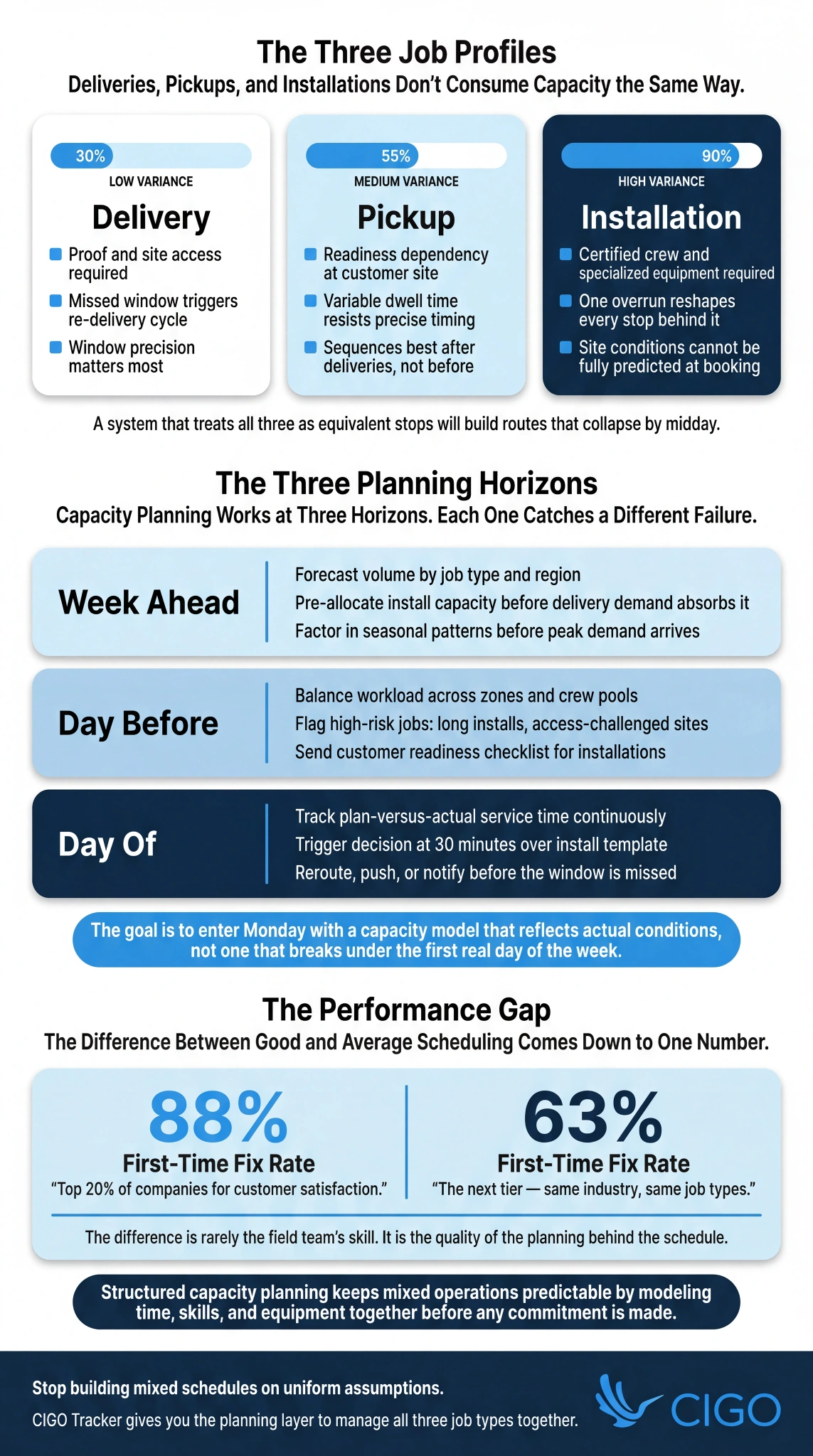
A system that treats all three as interchangeable will underprice installation complexity, over-commit pickup capacity, and build routes that collapse by midday.
The margin pressure is substantial. As Inbound logistics reports, last-mile delivery accounts for up to 53% of total shipping costs, making poor mixed-operation scheduling a structural problem, not a minor inefficiency.
The Three Job Profiles
Each job type carries a distinct capacity footprint. Treating them as equivalent stops is where mixed schedules break down.
- Deliveries require proof, site access, and defined windows. A missed window creates a re-delivery cycle that costs the original trip plus the repeat.
- Pickups introduce a readiness dependency. Variable dwell time makes precise timing difficult, especially when grouped with deliveries without adequate buffer.
- Installations carry the highest variance. Site conditions, customer preparation, and specialized crew requirements mean a single overrun reshapes everything scheduled behind it.
The Constraints Most Teams Underestimate
Service time variance is the most damaging constraint in mixed schedules.
One installation running forty-five minutes over removes the buffer protecting every stop behind it, and when that buffer is gone, the rest of the day follows.
Crew specialization is the next pressure point. Install teams are not interchangeable with delivery drivers. Pulling a certified two-person crew to cover delivery overflow solves one problem while creating another: the confirmed afternoon installation now has no assigned team.
Equipment availability closes the loop. Liftgates, disposal trailers, and specialist tools must be assigned at the booking stage, not assumed at loading time. When those constraints are absent from the plan, the route looks executable on paper right up until the truck leaves the depot without the right equipment on board.
How Capacity Planning Systems Keep the Day Feasible
A capacity planning system works at three stages: before commitments are made, during the planning build, and at execution when reality diverges from the plan.
Each stage catches a different category of failure before it reaches the field.
The results of structured scheduling are well documented. McKinsey research on field service scheduling found that AI-driven schedule optimization increased total on-job time by around 29%, with field worker productivity gains of 20 to 30%.
The gains came not from working harder, but from matching the right resources to the right jobs at the right time. A capacity planning system enforces exactly that logic, consistently and before the day starts rather than reactively once it has already broken down.
Normalize Work Into Capacity Units
A stop count tells you very little about whether the day is executable. Four installations and three pickups carry a fundamentally different load than eight standard deliveries, even when the numbers look identical.
Converting each job into expected time-on-site, travel time, and buffer creates a common unit that reflects real crew load.
Job-type templates encode that logic at booking. A standard parcel gets a fixed dwell estimate, while a white-glove installation gets the full estimate, including haul-away. Applied consistently, those templates mean the system knows the day is full before dispatch confirms one stop too many.
Allocate Capacity by Crew Type and Equipment
Separate capacity pools for install crews, delivery drivers, and pickup-capable vehicles prevent two costly mismatches:
- Specialist crews absorbing standard work a delivery driver could have handled
- Delivery drivers routed to jobs requiring certification they don’t hold
Protecting install capacity is particularly important because certified crews are the most expensive resource in a mixed operation.
When that capacity gets misallocated, the cost rarely appears as a line item. It surfaces instead as overtime, a delayed afternoon installation, and a customer receiving an adjusted arrival window with thirty minutes’ notice.
Time Windows and Sequencing Rules
The most reliable rule for mixed-operation scheduling is placing installations at the front of the day. Installs carry the highest variance, so positioning them first prevents a single overrun from cascading into the afternoon’s deliveries.
Geo-fencing for tighter delivery windows is a complementary tool that keeps deliveries anchored to their zones, so a delayed install doesn’t pull drivers into unfamiliar areas and compound the problem.
Pickups sequence naturally after deliveries, once vehicle space has opened on the return leg.
Building this into the sequencing rules makes it systematic rather than occasional. Cutoff times and buffer rules then protect against late-arriving orders turning a manageable day into an overtime finish.
Exceptions Without Chaos
An install running long doesn’t have to break the day if the response workflow is already defined. Smart route sequencing gives dispatch structured options before a delayed status becomes a failed window:
- Move compatible downstream work to a nearby available crew
- Reschedule the afternoon pickup to tomorrow’s run
- Notify the customer of the revised window before they’re waiting at home
Critically, every replan draws from the same capacity model that built the original route. Reassigning work only proceeds if the receiving crew has capacity and the window is still achievable, which prevents the recovery from creating a second downstream problem.
Planning Workflows for Deliveries, Pickups, and Installations

Weekly Capacity Review (Before the Week Starts)
The week-ahead review sets the foundation that daily planning builds on. It forecasts volume by job type and region, confirms crew availability, and pre-allocates install capacity before standard delivery demand can absorb it.
Seasonal patterns get factored in here as well. An operation running furniture installations knows weekends generate higher install volume and that holiday periods create pickup backlogs. Pre-allocating crew capacity for those windows prevents peak demand from overwhelming a plan built for average volume.
The goal is to enter Monday with a capacity model that reflects actual conditions, not one that breaks under the first real day of the week.
Daily Pre-Dispatch (Day-Before Planning)
Day-before planning is where abstract capacity meets actual confirmed orders. Workload gets balanced across zones and crews, and high-risk jobs get flagged early: long installs, access-challenged sites, and delivery slots tight enough that a single slip breaks the commitment.
Readiness confirmation belongs at this stage too. A customer who hasn’t cleared furniture or prepared utility connections costs the install crew productive time before the job starts. Sending a specific checklist the evening before converts that recurring failure into something the operation can control.
Day-Of Control (When Reality Changes)
Day-of control is where real-time visibility earns its place. Tracking plan-versus-actual service time gives dispatch the lead time to intervene before a running-late status becomes a missed window.
The threshold should be specific: an install running thirty minutes over its template estimate triggers a decision, not a watch-and-wait response. Three options should be executable directly from the dispatch view:
- Reroute compatible work to a nearby available crew
- Push downstream stops to tomorrow with a proactive customer notification
- Issue a revised arrival window while there is still time to manage expectations
Concrete Benefits You Should Expect
Higher First-Attempt Success
Structured capacity planning directly reduces failed attempts across all three job types.
When customers receive windows the operation can genuinely keep, arrival reliability improves and the conditions that generate “not ready” and “no access” failures shrink considerably
According to Salesforce field service research, the top 20% of companies for customer satisfaction achieve a first-time fix rate of 88%, compared to just 63% for the next tier. The difference is rarely the field team’s skill. It is the quality of the planning behind the schedule.
Setting realistic install readiness requirements at booking, confirming pickup preparedness the day before, and protecting delivery windows from overrun contamination each address a distinct failure mode that structured scheduling prevents before a driver is ever on-site.
Fewer Reschedules and Rework
Install overruns are the most common trigger for same-day rescheduling. When one installation runs over, the jobs behind rarely just shift. They fall off the day, generating new windows, crew reassignments, and another customer communication cycle.
Loqate research found failed deliveries cost $17.20 per attempt on average, and 24%of businesses report more than one in ten failing on the first try. Rescheduled installations carry even higher costs.
Capacity planning reduces this by building buffers that contain variance before spreading.
Better Utilization Without Burnout
Better utilization means ensuring planned hours produce work at their intended rate. When capacity is allocated intentionally, the gains become clear:
- Install pools stay protected from pickup detours
- Delivery capacity is sized to actual zone demand
- Pickup windows are clustered to reduce empty miles
As a result, crews finish within planned hours more consistently. Overtime shifts from a chronic outcome of optimistic planning to a genuine response to volume spikes.
Cleaner Customer Communication
When scheduling and dispatch share the same capacity model, the window given to a customer reflects what the operation can actually keep. There’s complete alignment between what’s confirmed at booking and what dispatch sees when the route is built.
Customers avoid the second call. Installation crews arrive at prepared sites. Reliability, therefore, is not a service feature. It is the direct outcome of a planning model built around real constraints.
Features Checklist for a Capacity Planning System in Mixed Operations
A capable platform for mixed operations handles all three job types without manual exceptions. Look for:
- Job-type templates with service times, buffers, and skill requirements set at booking
- Skill-based resource pools enforcing crew and equipment distinctions during assignment
- Capacity calendars with configurable caps by job type, zone, and day
- Readiness workflows confirming customer preparedness before crews depart
- Plan-vs-actual reporting by job type, with execution feedback keeping templates calibrated
KPIs to Track by Job Type
A single on-time rate is too broad for mixed operations.
Strong delivery numbers can mask a struggling install schedule, which is why top fleet manager KPIs for mixed operations require job-type-specific tracking. Key indicators include:
- On-time performance for deliveries versus install appointments tracked separately
- First-attempt success by job type, since failure modes differ across all three
- Time on stop versus planned, revealing templates running on stale assumptions
- Reschedule rate with reason codes, turning exceptions into prioritized improvements
- Cost per job type and overtime hours to confirm planning gains
Implementation Plan That Minimizes Risk
The safest rollout starts with the planning layer, not customer-facing booking changes. Job templates, capacity pools, and readiness workflows should all be defined internally before affecting any windows customers see.
From there, run a two-to-three week pilot in one service area to validate real service times.
Pre-allocate install capacity first, since delivery demand will absorb it otherwise. Once templates are validated, expand to adjacent zones. Record every exception reason so it continuously feeds the planning model.
Mistakes to Avoid
Even well-structured rollouts fail when a few common decisions go unchecked. The most damaging patterns in mixed operations are:
- Applying one capacity rule to all job types, which consistently overcommits install days
- Pulling install crews to cover delivery gaps, protecting one metric while breaking another
- Removing buffers before actual service time data confirms the variance is low enough
- Skipping readiness workflows at launch, absorbing preventable failures the checklist would have caught
How CIGO Tracker Supports Capacity Planning and Delivery Management Execution
At CIGO Tracker, live execution visibility makes capacity planning durable over time.
When actual service times feed back into the capacity model after each completed job, templates stay calibrated to reality rather than drifting from it.
Real-time tracking keeps dispatch, drivers, and customer support aligned on the same schedule.
Electronic proof of delivery standardizes completion records across all three job types, and logistics optimization ensures every exception captured at the stop level becomes a prioritized planning input rather than an unexamined aggregate.
Capacity Planning Systems Make Mixed Work Predictable

A capacity planning system keeps mixed operations predictable by modeling time, skills, and equipment together before a commitment is made. Start with one service area, validate time-on-site assumptions against real field data, and build from there once the model holds.
CIGO Tracker gives you the planning infrastructure, real-time visibility, and execution feedback loops to make that possible. Start your free trial or contact us to get started.
FAQs
What is a capacity planning system, and how is it different from dispatch?
A capacity planning system determines what can be committed before any order is confirmed, by modeling crew skills, equipment, and service windows. Dispatch manages execution after that. When the planning layer works correctly, dispatch receives a feasible schedule rather than recovering from one that was never achievable.
How do you plan installs without causing late deliveries?
Schedule installations earlier in the day with explicit buffers before adjacent deliveries begin. Separate crew pools are equally important. When the capacity planning system enforces those distinctions at allocation, an install overrun stays within the install pool without contaminating the delivery schedule.
What data is most important for accurate pickup and install scheduling?
For installations, actual time-on-site by product type and site condition. For pickups, readiness confirmation data and real dwell time. Building job templates from field data rather than assumptions is what makes a capacity planning system reliable enough to plan against.
Can a delivery management system replace capacity planning software?
No. A delivery management system handles execution: routing, dispatching, and proof collection. A capacity planning system controls what gets committed upstream. Mixed operations with distinct job types outgrow lightweight scheduling features quickly, and a persistent gap between scheduled and completed work signals a capacity planning problem, not an execution one.
Which KPIs prove capacity planning is working across mixed job types?
Three metrics matter most: first-attempt success rate by job type, average time on stop versus planned time, and reschedule rate by reason code. Together, they confirm whether the capacity planning system is improving the day before it starts rather than just tracking damage after execution.