Foresight AI
Customer selected delivery dates sound operationally risky but they are not. The risk lives in how that choice is designed.
Without guardrails, open date selection creates real problems: overloaded Fridays, half-empty Monday trucks, and zones that never balance. But those are product design failures, not consequences of customer choice itself.
When CIGO Tracker ties selectable dates directly to live capacity, customers only see windows the fleet can genuinely execute. That single constraint removes the operational risk while preserving everything customers value about choosing their own delivery date.
Key Takeaways
- Customer selected delivery dates reduce uncertainty and improve customer readiness at the door
- Capacity-aware delivery scheduling protects operations through caps, buffers, and cutoff rules
- Fewer reattempts and tighter route density drive the biggest missed delivery reduction gains
- Delivery windows shown at booking must match what the fleet executes at delivery
- Measure date adherence rate and schedule stability, not just customer satisfaction scores
- Delivery date selection only works when customer delivery preferences shape available options
What Are Customer-Selected Delivery Dates?
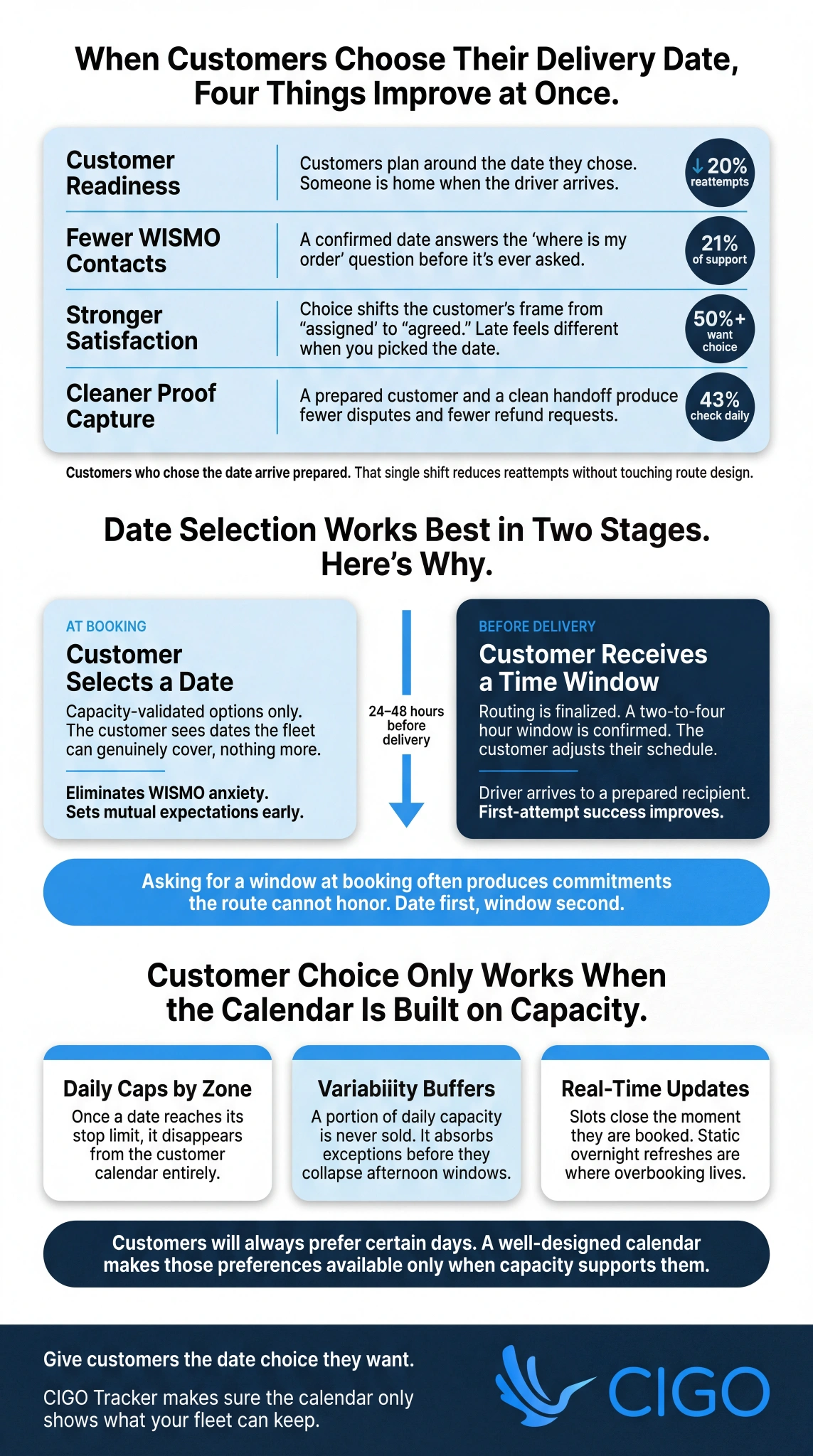
Customer selected delivery data give customers a choice of date, and sometimes a time window, from options the fleet can actually fulfill. The key word is available.
Customers are not browsing an open calendar. They are choosing from dates validated against zone loads, equipment availability, and depot cutoffs before any slot is ever surfaced.
That distinction matters because the alternative is worse. Vague three-to-five day ranges, voicemail appointment chains, and manual back-and-forth between support and operations all create friction that a well-designed delivery date selection experience eliminates at checkout.
According to McKinsey Research, more than half of consumers say the ability to schedule their own delivery is important. The demand is already there. The design just has to make it operationally safe.
Delivery Date Selection vs. Delivery Windows
Date selection and window selection are related but not identical. Each serves a different stage of the customer journey and requires a different operational trigger.
| Date Selection | Delivery Windows | |
| When it happens | At booking or checkout | 24-48 hours before delivery |
| What it commits to | The delivery date | A time range within that date |
| Customer benefit | Reduces open-ended uncertainty early | Allows precise planning closer to delivery |
| Operational trigger | Zone capacity and depot cutoffs | Route density and driver sequencing |
| WISMO impact | High, eliminates most early status contacts | Moderate, reduces day-of inquiries |
| Satisfaction gain | Earliest and broadest across customer base | Meaningful but narrower in scope |
Who This Works Best For
The most obvious fit is appointment-style delivery.
White-glove furniture, appliance installation, and two-person team stops all require the customer to be present and prepared, so giving them a voice in the date makes the commitment mutual from the start.
That logic extends further, though. Any last-mile operation with a consistent reattempt problem driven by customer unavailability stands to gain directly. When customers choose their own delivery date, they plan around it. They are home when the driver arrives.
That single behavioral shift reduces reattempts without requiring any changes to route design.
Why Choice Improves Satisfaction

Control is not just a preference in delivery. It is a psychological need that shapes how customers experience the outcome. When a date is assigned with a vague range, any deviation feels like a failure the retailer caused.
The customer’s starting frame is already adversarial.
A Journal of Marketing Research analysis on delivery time deviations found that late deliveries damage repurchase behavior more than early deliveries help it, with satisfaction as the key linking mechanism.
Delivery date selection shifts that dynamic entirely. Customers who chose the date arrive prepared, expect the driver, and experience the handoff as a commitment they made, not one imposed on them.
Fewer Missed Deliveries Because Readiness Improves
Reattempts are expensive before they are anything else.
HBR research confirms that up to 20% of e-commerce deliveries fail on the first attempt, with customer unavailability consistently among the top causes. Delivery date selection addresses that root cause directly.
A customer who picked Thursday has already arranged access, cleared the entry path, and flagged it in their calendar. The stop is ready before the driver leaves the depot.
Each avoided reattempt is a trip unmade, a driver hour unspent, and a support ticket that never opened.
Lower WISMO Volume
WISMO contacts are a symptom of uncertainty, not curiosity. Customers call because they do not know when their order is coming and need to plan around it.
Delivery tracking that cuts support ticket volume addresses part of that anxiety with real-time status updates, but date selection removes the underlying cause entirely. According to WeSupply Labs research, 93% of customers expect proactive order updates throughout the delivery process.
When a customer has already selected and confirmed their date, that question is answered before it is ever asked. Support time shifts from managing uncertainty to resolving genuine exceptions, which is a far more productive use of your team.
Stronger Post-Delivery Confidence
Fewer disputed deliveries follow when the customer expected the arrival and proof was captured cleanly. According to 4over delivery tracking research, 43% of consumers check their delivery status every day until their order arrives.
When a customer chose the date and actively anticipated the handoff, the proof of delivery record carries more weight. The result is measurable across three areas:
- Fewer post-delivery disputes tied to unexpected or missed arrivals
- Fewer refund requests driven by failed handoffs
- Less recovery time for the operations team
Customer readiness and clean proof capture compound each other. Both improve when the date was never a surprise.
The Operational Concern: “Will Customers Overload Certain Days?”
This concern is valid and worth taking seriously. Without capacity controls, customers naturally cluster on the same convenient dates, overloading specific days while leaving others underutilized.
The operational risk, however, comes from calendar management, not customer behavior. Customers will always prefer certain days and times.
A well-designed scheduling system simply makes those preferences available only when capacity genuinely supports them, redirecting demand toward open slots when preferred ones are full.
What Actually Causes Operational Pain
Customer date selection rarely causes operational pain. Poor calendar design does. The real failure modes are:
- Overselling popular days when the booking interface enforces no caps, turning Fridays into dispatcher-managed crises
- No variability buffers means one slow morning stop cascades into missed windows across the entire afternoon
- Manual scheduling that breaks the online promise by revising the customer’s selected date against a different availability view, building the miss into the plan before the day even starts
The Real Goal for Ops
Operations does not need unlimited control over customer dates. It needs stable, dense routes, low rework, and rare last-minute changes.
Properly designed delivery date selection delivers all three because the constraints work in both directions. Routes stay dense because the booking engine fills slots efficiently across the week rather than front-loading convenient days. Rework drops because customers show up prepared.
Last-minute changes shrink because the original commitment was grounded in what the fleet could actually execute.
How to Offer Customer Selected Delivery Dates Without Hurting Operations
The key is understanding what you are actually building. Customer date selection is not about predicting customer behavior. It is about building a capacity-aware calendar that only shows dates the fleet can genuinely cover.
Customers choose freely, but only from options your operation can execute.
That boundary is what makes it work. The dates customers see are determined by your capacity model, not your marketing team. When those two things stay aligned, every confirmed date is already a promise the fleet can keep.
Capacity-Based Date Inventory
A reliable date calendar rests on three operational controls working together:
- Daily caps by zone or depot set the maximum stops a date can absorb. Once reached, that date disappears from the customer-facing calendar entirely
- Variability buffers reserve a portion of daily capacity that is never sold, absorbing mid-shift exceptions before they collapse afternoon windows
- Real-time availability updates close slots the moment they are booked and reopen them if cancelled. Static overnight refreshes create the gaps where overbooking lives
Smart Guardrails That Keep the Promise Executable
A capacity-aware calendar only works if the rules behind it reflect operational reality. The guardrails that matter most are:
- Cutoff times for near-term slots prevent bookings the fleet cannot physically reach given route-build time and depot departure windows
- Stop-type restrictions apply different caps and buffers to bulky, two-person, or liftgate stops versus standard parcel drops
- High-risk area rules assign extra buffer to zones where dwell time consistently exceeds estimates
- Zone-specific slot sizing ensures difficult terrain like gated complexes or dock check-in sites does not share the same capacity rules as straightforward curbside drops
The Two-Stage Commitment Model
The strongest customer-date experiences use a two-stage structure that serves both the customer and the operation.
At booking, the customer selects a date and receives confirmation. The commitment at this stage is the date only, which is enough to eliminate most WISMO anxiety and prepare the customer for the arrival.
Then, 24 to 48 hours before delivery, routing firms up and the customer receives a refined two-to-four hour window. At that point, the customer adjusts their schedule, and the driver arrives to a prepared recipient. Both stages work together without ever surprising a customer with a date they did not choose.
Exception Handling That Preserves Trust
When capacity breaks, response time matters as much as the response itself. Electronic proof of delivery for clean exception records creates the documentation layer that makes exception handling credible.
Reason codes, timestamps, and photos show exactly what happened, so customer communication is based on fact rather than approximation.
From there, offering self-serve rescheduling within the same booking interface reduces support burden significantly. Customers who can reschedule themselves do not need to call. That shift lets support focus on genuine exceptions rather than functioning as a manual rescheduling queue, which is where trust erodes fastest.
The Business Benefits That Make This Worth It

The case for customer-selected delivery dates is strongest when it is measured at the operational level, not just through satisfaction scores. The financial and efficiency gains are direct and traceable.
Reduce Reattempts and Redelivery Miles
Reattempts are expensive in every dimension, costing fuel, driver hours, and route capacity while simultaneously damaging the customer relationship.
The primary cause is recipient unavailability, and customer-selected dates directly reduce it.
When customers plan around their delivery, someone is home, access instructions arrive ahead of the driver, and first-attempt success improves without any change to routing or fleet composition.
Improve Route Density and Utilization
Date selection can actively steer demand toward days with available capacity, smoothing the peaks that create overloaded Fridays and underutilized Tuesdays. Balanced demand means denser routes, lower cost per stop, and more stops per shift without adding vehicles.
Offering structured delivery windows also supports missed delivery reduction, since customers commit to dates they can actually plan around. The delivery scheduling system handles load-shifting automatically, which is why route optimization in last-mile delivery starts with controlling when demand enters the system.
Reduce Support and Dispatch Work
Manual scheduling and inbound support contacts are two of the most expensive labor costs in last-mile operations, and both shrink when customer date selection runs well. Customers who confirmed their delivery date stop asking where it is.
Dispatchers stop fielding scheduling calls because the booking system handles coordination. Each eliminated handoff is also a potential human error that never occurs.
Protect On-Time Performance
Load leveling from capacity-aware date selection creates steadier day-to-day workload distribution.
When no single day is overloaded relative to fleet capacity, routes stay within the performance envelope the fleet was designed to execute. As a result, late routes become less frequent because the schedule was never overcommitted.
On-time performance improves not because the fleet was pushed harder, but because the schedule was grounded in realistic capacity from the start.
Best-Fit Industries and Scenarios
Furniture and Bulky Goods
Furniture delivery involves constraints that make date selection operationally essential.
The customer must be present, access has to be arranged, and the delivery team needs the right equipment, typically a two-person crew and a liftgate vehicle.
When the customer chooses the date intentionally, those preparation steps are far more likely to happen. Without that commitment, reattempt rates climb structurally. Each failed attempt is a second trip that costs more than the route economics can absorb.
Appliances and Installation-Linked Delivery
Appliance delivery is frequently tied to installation or removal services that require coordination beyond the delivery itself. When delivery and installation are scheduled independently, the gap between them is a common source of rescheduling.
The delivery arrives before the installer, or the installer is booked on a day the carrier cannot cover. A customer-selected date that both parties confirm eliminates that coordination failure before either side is in the field.
B2B Appointment Deliveries
Business receiving operations have precise constraints that make capacity-aware date selection particularly valuable:
- Dock receiving hours are fixed and non-negotiable
- Staffing for unloading is scheduled in advance
- Deliveries outside receiving windows can result in refused loads
When the date and approximate window are agreed in advance, the B2B customer staffs appropriately and the driver arrives to a prepared receiving team.
Without that alignment, the risk is not an empty doorstep but an unprepared dock.
E-Commerce With High WISMO Risk
E-commerce operations with wide delivery windows or multi-day estimated ranges generate anxiety-driven support contacts that are entirely preventable.
The customer who knows their package arrives Wednesday stops checking tracking hourly and stops emailing support. That behavioral shift is operationally real, even when no one is home for the drop.
Replacing a vague delivery range with a customer-confirmed date, even without a tight window, measurably reduces contact volume and frees support for genuine issues.
Features to Look For: Customer Date Selection Checklist
- Capacity-aware availability engine so customer selected delivery dates only show when they can be honored
- Rule-based restrictions by stop type with different slot sizes for bulky goods and standard parcels
- Dynamic availability updates so delivery scheduling reflects real bookings and no slot is sold twice
- Self-serve rescheduling with approval rules for capacity-constrained delivery windows
- Customer notifications tied to date confirmation and window refinement without manual outreach
- Ops visibility into booked dates to catch load imbalances before they become day-of problems
- Reporting on demand shifting, missed delivery reduction, and delivery date selection performance over time
KPIs to Prove It Helps: Customer and Ops
Tracking date selection performance requires metrics on both sides of the operation.
Standard last-mile KPIs establish the baseline, but date selection adds a commitment-accuracy dimension that most frameworks do not capture.
These are the metrics that matter:
- Date adherence rate: how often the fleet delivers on the customer-selected date, tracked by zone, stop type, and day of week
- Reattempt rate: whether unavailability-driven failures are declining relative to your pre-date-selection baseline
- On-time window performance: confirms the refined delivery commitment held, not just the date
- WISMO contact rate: should decline as customers respond to confirmed dates rather than chase uncertain ones
- Manual scheduling touches per order: a direct measure of coordination labor displaced
- Capacity utilization variance: flatter week-over-week variance signals demand is being steered toward available capacity effectively
Implementation Plan That Keeps Risk Low
The safest rollout starts narrow.
Pick one region where missed deliveries are frequent, define capacity caps, buffers, and cutoff rules before any customer sees the calendar, and train dispatch and support on the same promise rules the booking system enforces.
Misalignment between what the system shows and what ops schedules creates confusion rather than clarity. Building a resilient last-mile strategy means rolling out in phases, then expanding only once accuracy KPIs confirm the model holds.
Common Mistakes to Avoid
Most date selection failures trace back to three avoidable decisions:
- No capacity logic behind the calendar. Unlimited dates transfer all operational risk to delivery day, leaving the fleet recovering through heroics rather than executing a plan
- Static availability that refreshes overnight. In a live booking environment, that gap allows the same slot to sell twice
- Uniform rules across all stop types. A parcel drop and a two-person furniture delivery are not the same operational commitment, and treating them identically breaks profitability for both
How CIGO Tracker Helps Make Customer-Selected Dates Operationally Safe
CIGO Tracker keeps availability aligned with execution reality through real-time delivery tracking and live exception signals that update the capacity picture as the day evolves.
When a vehicle goes down or a zone runs long, the planning layer adapts before the next booking creates a commitment the fleet cannot cover.
Optimized routing, customer engagement automation, and last-mile management work together so proof, reason codes, and reattempt patterns continuously refine the calendar customers see.
Customer Selected Delivery Dates Create Win-Win Scheduling

Customer choice and operational control are not in conflict when the calendar is built on capacity. Start by identifying what drives your missed deliveries. If customer unavailability ranks among the top failure reasons, date selection addresses the root cause directly.
CIGO Tracker gives you the capacity logic and real-time visibility to make it work from day one. Start your free trial or contact our team today.
FAQs
Do customer selected delivery dates increase missed deliveries or reduce them?
They reduce them. When customers choose their delivery date, they plan around it, arrange access, and ensure someone is home. Since recipient unavailability drives most first-attempt failures, date selection addresses the root cause directly, producing consistent missed delivery reduction over time.
How do you prevent customers from choosing the same popular day?
Capacity caps. Each date in the customer-facing calendar has a maximum stop count per zone. When that cap is reached, the date closes automatically. Customers only see what the fleet can cover, so delivery scheduling distributes demand across available capacity rather than concentrating on popular days.
Should customers select a date, a time window, or both?
Both, in sequence. Delivery date selection at booking eliminates most WISMO contacts and sets accurate expectations early. Delivery windows should be confirmed 24 to 48 hours before delivery, once routing is finalized. Asking for a window at booking often produces commitments the route cannot honor.
What rules should be applied to bulky-goods or high-service-time deliveries?
Caps should reflect crew and equipment availability, not stop count. Service-time assumptions should match actual dwell-time data for that stop type. Buffer rules should be wider than standard parcels, since access delays and placement time are more variable and harder to compress mid-route.
How do you measure whether date selection improved satisfaction and ops?
Track both sides separately. For satisfaction, monitor WISMO contact rate, rescheduling requests, and post-delivery disputes. For ops, measure date adherence rate, reattempt rate, and workload variance by day. Establish baselines in your pilot zone before rollout and review weekly for the first six to eight weeks.