Real-time delivery tracking once felt reserved for the biggest carriers. Now, customers expect it as standard and judge you on how clearly you communicate when orders move or stall.
Replacing a Transportation Management System (TMS), Warehouse Management System (WMS), or Enterprise Resource Planning system (ERP) to meet that expectation rarely makes sense.
Costs, change fatigue, and downtime risk stay high. A better path is to layer integrated logistics management software on top of what already works. With CIGO Tracker, you use shipping integration software to connect carriers, driver apps, and order systems so real-time tracking becomes a natural extension of your stack.
Key Takeaways
- Real-time tracking is now a basic expectation in logistics, and you can deliver it without a full system overhaul.
- Integration layers, such as CIGO Tracker, bridge the gap between legacy systems and modern tracking capabilities, enabling you to maintain control of your stack.
- Connecting data across your TMS, WMS, ERP, and carrier systems improves visibility, communication, and customer experience.
- Integrated logistics management software reduces the cost, complexity, and risk of modernization by coordinating what you already have.
- Shipping integration software helps you avoid rip-and-replace projects by enabling intelligent integration and letting you move at the pace your operation can handle.
Why Real-Time Tracking Is Table Stakes in Modern Logistics
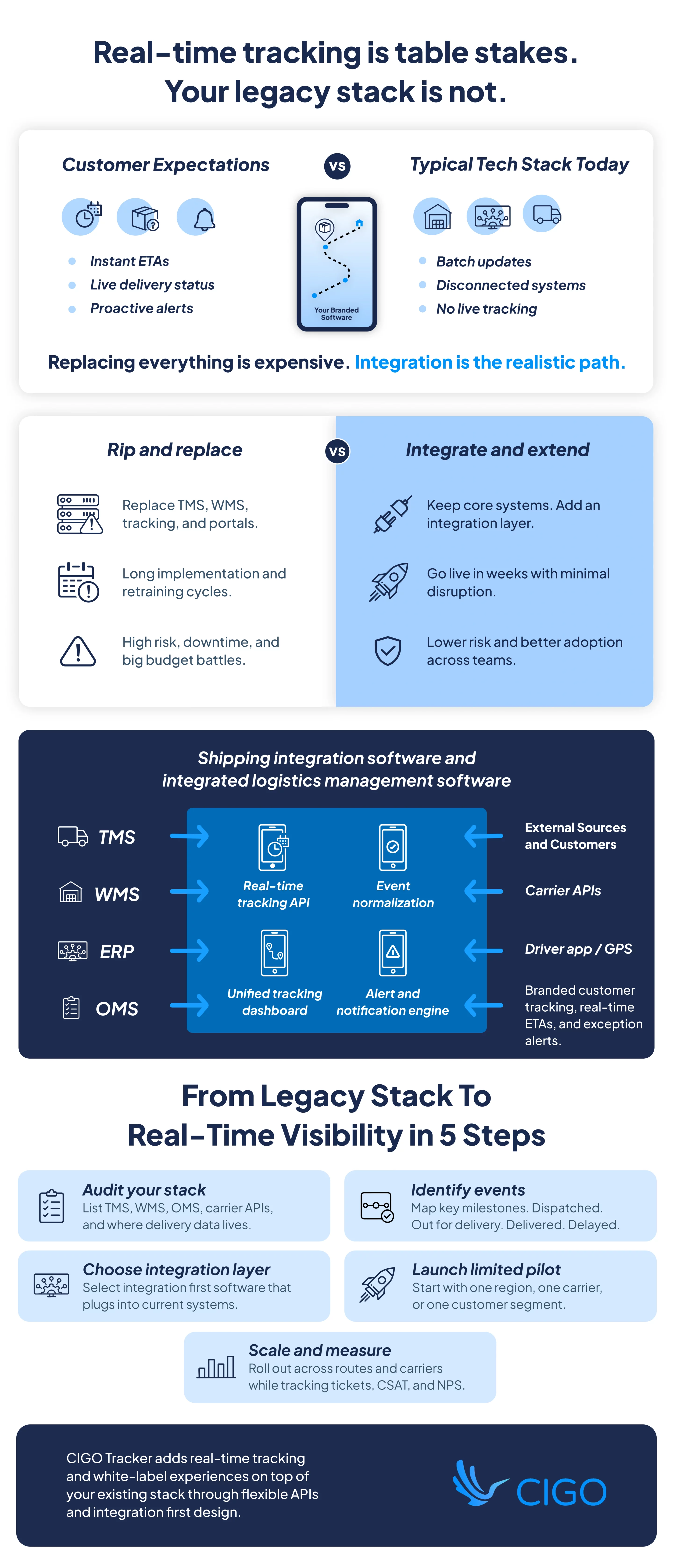
Tracking is no longer a nice extra. Customers treat it as a part of the promise you make at checkout, so they expect live status, ETAs, and a clear plan when something slips.
MDPI research on last-mile delivery shows that reliability and information quality drive satisfaction alongside speed. When people cannot see what is happening, they fill the gap with doubt, which becomes complaints and pressure to support.
Large retailers have trained customers to expect real-time maps, proactive alerts, and branded tracking pages, and those habits follow your clients into B2B. They want the same clarity when a pallet leaves your depot that they get when shoes leave an online warehouse.
Real-time tracking lets you replace tense calls with live status updates on a page.
The Operational Costs of Not Offering Real-Time Delivery Tracking
When real-time delivery tracking is missing, costs pile up in places you feel every day.
- Support teams absorb constant “Where is my order?” contacts that flood queues and push complex issues aside. The Shopify guide notes that WISMO is among the most common support inquiries, which means every missing update becomes an avoidable ticket.
- Each extra contact lifts cost per delivery and stretches the limited headcount during peaks. Agents bounce between systems to piece together status, work that a single, integrated view could automate.
- Operationally, vague windows hide delays until customers escalate. By the time complaints arrive, NPS has slipped, and visibility gaps keep generating the same avoidable friction.
The Legacy Problem—Why Traditional Logistics Tech Can’t Keep Up
Most logistics stacks were built to move freight efficiently, not to deliver a polished, real-time tracking experience.
Your TMS plans and tenders loads, your WMS controls inventory and picking, your ERP keeps orders and billing aligned, and carrier portals hold labels and scan events in their own world.
Each piece does its job, yet customers still cannot see a simple live ETA on their phone.
Replacing all of this with a single integrated logistics management software suite can look neat on a slide.
In reality, you face long projects, heavy change management, and exposure if go-live stumbles. A ScienceDirect study on ERP implementations notes that failure rates remain stubbornly high, which underlines how risky full core replacements can be.
Why “Rip and Replace” Rarely Works
Full replacement projects often start as elegant diagrams in a slide deck. Once you translate them into timelines, budgets, and headcount, the cracks appear quickly.
- Leadership must fund licences, consulting, data migration, and training while still paying for existing systems. When you spread that over years, the projected ROI becomes harder to defend against simpler, faster wins.
- Existing TMS and ERP deployments usually sit at the centre of dozens of custom integrations with carriers, warehouses, and finance systems. Rebuilding those integrations and running parallel systems for months exposes you to errors, chargebacks, and missed SLAs.
- Your teams already rely on familiar workflows under pressure. Forcing them to relearn core tools while maintaining service quality almost always creates fatigue, workarounds, and morale issues.
This is why a serious strategy treats integration as the primary path. You add real-time tracking around the systems you trust instead of gambling on a clean slate.
What Is Shipping Integration Software?
Shipping integration software is the connective tissue between your orders, carriers, and visibility tools.
It plugs into order systems, TMS, carrier APIs, and driver apps so status events flow into a single stream your teams and customers can actually use.
Instead of hopping between portals, you route everything through one integration layer that listens for label creation, pickup, in transit, out for delivery, delayed, delivered, or failed events, and keeps those updates tied to the right order and customer.
A ResearchGate study on information integration notes that shared, timely data improves supply chain performance and decision quality. In that spirit, shipping integration software consolidates scattered delivery signals into a single, reliable source of truth you can use for dashboards, alerts, and support workflows.
Capabilities of Integration-First Tracking Solutions
An integration-first tracking layer builds on shipping integration software with features tailored for visibility and customer experience:
- API connectivity across systems
The platform connects not only to carriers but also to your TMS, WMS, ERP, and ecommerce channels, so shipment status always ties back to the right order and customer. - Unified tracking dashboards
Operations teams can view all open deliveries in a single view. Filters by route, region, carrier, or status help identify at-risk shipments before customers reach out. - Custom alert and notification routing
You decide which events trigger which message, who receives it, and through which channel. The same delivery data can power SMS alerts, branded emails, or chat updates. - Middleware for messy data
The software smooths out differences in carrier event codes and data formats. It serves as a translation layer between legacy systems and modern applications.
When this layer is in place, real-time tracking becomes a configuration problem, not a new-platform problem.
What Is Integrated Logistics Management Software?
Integrated logistics management software ties planning, execution, and visibility together in a single environment.
Instead of treating transport, warehousing, and customer service as separate projects, it supplies modules and APIs that let each function share data in real time and act on the same version of events.
In practical terms, integrated logistics management software links TMS, WMS, dispatch, and other operational tools so orders move cleanly from pick to loading to proof of delivery. It pulls tracking and exception data into customer service, stores performance and cost side-by-side, and provides a foundation for analytics and continuous improvement.
Benefits of Real-Time Tracking via Integration, Not Replacement

When you treat real-time tracking as an integration project, not a system swap, the gains look very different.
- Faster, lower-risk deployment: You connect integrated logistics management software to your TMS, WMS, ERP, and carrier APIs, so you can pilot real-time tracking on a few lanes instead of waiting for a full platform cutover.
- Cleaner cost story: You keep core systems in place and spend on the visibility layer customers actually touch, which makes it easier for finance to link investment to lower WISMO volume and better retention.
- Flexible carrier mix: Shipping integration software becomes your single carrier gateway. You plug in new partners there, while tracking pages and notifications stay consistent for customers and internal teams.
- Consistent delivery experience: Everyone sees the same branded tracking view, regardless of which carrier delivers the order. Support and operations work from that shared picture, so issues are spotted earlier and resolved with fewer back-and-forths.
Example: Layering Real-Time Tracking Onto a Legacy TMS
One mid-sized 3PL runs a dependable but aging TMS.
It plans routes and tenders loads smoothly, yet customers still see only vague in-transit messages. An integration layer connects driver apps to carrier scans, feeds branded tracking portal data, and triggers live ETAs and alerts.
The TMS remains the system of record for planning and settlement, while the new layer provides real-time tracking on top without forcing teams to rewrite their daily workflows.
How to Layer CIGO Tracker into Your Existing Ecosystem
CIGO Tracker is designed to behave as an integration-first visibility layer. We sit between your existing systems and the customer, without asking you to rebuild everything around us.
In a typical deployment, CIGO Tracker:
- Connects to your carriers and delivery partners through APIs.
- Integrates with your TMS, WMS, or ERP to tie orders and routes together.
- Normalises events into a unified tracking model for maps, ETAs, and exceptions.
- Powers branded tracking pages and alerts, paired with our delivery tracking on your domain.
Key Features for Seamless Implementation
CIGO Tracker supports carrier-agnostic integrations so that you can plug in parcel, freight, and regional partners into a single visibility layer. Its APIs link jobs, routes, drivers, and events to your existing TMS or ERP, so status changes appear where your teams already work.
On the customer side, white-label tracking pages, configurable alerts, and exception views ensure consistent updates. Paired with optimized routing, operations get clear ETAs, live route adjustments, and a single view of risk by order, route, or region.
Best Practices for Tech Stack Integration

A clear integration plan keeps work focused and makes real-time tracking much simpler to roll out.
- Run a compact system audit.
Begin with a compact audit of every system that touches orders or deliveries and sketch how data flows between them today. - Locate and connect key events.
Use that map to identify where key delivery events originate and select APIs or feeds where CIGO Tracker can read and publish those updates without rewriting core workflows. - Roll out around a focused pilot.
Roll out in a focused slice, such as one region or carrier with heavy WISMO, measure the impact, and expand real-time tracking only once that pilot proves itself.
Key Metrics to Track Post-Integration
Visibility only matters if it moves your numbers, so start by setting a baseline before rollout.
WISMO rate per 100 deliveries shows how often customers chase orders, while CSAT and NPS tell you whether new tracking flows actually change how people feel about your service.
You also want harder operational signals. On-time delivery performance reveals whether better data closes gaps in planning, and exception resolution time shows how quickly teams move once an issue appears.
Tracking engagement rounds it out, showing how often customers rely on your status pages and notifications rather than your support lines.
Common Pitfalls to Avoid
Some mistakes show up in almost every real-time tracking project, and they quietly drain momentum if you do not call them out early.
- Treating core replacement as the only path: Teams jump to new TMS or ERP projects when the real goal is visibility. You can get faster wins by layering tracking on top and letting those results guide any future platform decision.
- Underestimating integration work: Carrier APIs, legacy systems, and in-house tools rarely align on formats. Shipping integration software helps, yet you still need clear owners for mappings, event standards, and testing.
- Ignoring branding and communication: A raw event feed does not feel like an experience. Customers need a calm, branded tracking journey on your domain that turns codes into plain, reassuring language.
- Skipping stakeholder buy-in: Real-time tracking reshapes how support, operations, and account teams work together. If they are not involved early, adoption lags, and the new tools never reach their full impact.
The Bigger Picture: Integrated Logistics for Scalable, Agile Delivery
Real-time tracking is one part of a broader move toward integrated logistics. When planning, execution, and customer channels share data, you can adjust routes quickly, feed delivery feedback into planning, and tie service levels to both cost and customer expectations.
A ScienceDirect study links end-to-end visibility with stronger resilience, which is the real destination for logistics teams.
Integrated logistics management software provides that structure, and an integration layer such as CIGO Tracker lets you access it without a disruptive vendor swap.
Why CIGO Tracker Leads in Flexible Real-Time Delivery Visibility
We built CIGO Tracker on a simple idea: you should not have to rip out a working stack to deliver modern visibility.
Our platform combines real-time delivery tracking with route planning and seamless integration, so we sit alongside your TMS rather than replace it. With driver apps, live ETAs, and customer notifications, we keep parties aligned while existing systems stay in control of orders and billing.
We pair SOC 2 Type 1 security with proven routing and dedicated heavy equipment tools, so you gain a flexible visibility layer that scales as your delivery model evolves.
Where Do You Go Next With Real-Time Tracking?
Real-time tracking now sits at the core of your delivery promise.
It is how you keep customers informed, cut WISMO noise, and prove that your operation is reliable in a crowded market. Integrated logistics management software gives you that control without forcing a risky restart on your tech stack.
We designed CIGO Tracker to plug real-time delivery tracking and routing into the systems you already rely on. You keep your TMS, WMS, and ERP in place while we connect carrier events, driver updates, and customer touchpoints into one live view that your teams and shippers can share.
If you want to see how that could work in your network, our contact team can map a rollout that respects your existing tools and unlocks the visibility your customers now expect as standard.
FAQs
Do I need to replace my TMS to get real-time tracking?
Not usually. Integrated logistics management software sits on top of your existing TMS, WMS, and ERP rather than replacing them. You use shipping integration software to connect carriers and driver apps, so real-time tracking appears without rebuilding every workflow.
How fast can we go live with CIGO Tracker?
You move faster when you treat CIGO Tracker as integrated logistics management software rather than a full core swap. Shipping integration software connects to a few priority carriers and routes first, so you prove value, cut WISMO, and expand once teams are comfortable.
What systems does integrated logistics management software connect to?
Integrated logistics management software links TMS, WMS, ERP, ecommerce platforms, and support tools into one flow. With shipping integration software handling carrier APIs and events, every system sees the same delivery story, which keeps operations and customer service aligned.
How does this improve customer experience in practice?
Integrated logistics management software keeps status, ETAs, and exceptions in sync across your stack, so customers see clear updates instead of vague windows. Shipping integration software feeds branded tracking pages and alerts, which replace anxious calls with simple self-service.
Is this approach suitable for smaller or mid-size logistics teams?
Yes. Integrated logistics management software helps smaller and mid-size teams add real-time tracking without the weight of a full replacement project. Shipping integration software lets you start with a narrow pilot, control costs, and grow coverage as volume and needs increase.