Your customers move through each day guided by notifications and status bars, so when an order goes quiet, they treat silence as risk.
Inside your operation, the picture can be unclear. Dispatchers juggle calls, drivers answer pings, and your team stitches deliveries out of emails and guesswork. That is not delivery risk management. It is a gamble with customer trust and operational efficiency in logistics.
Here, you’ll see what happens when tracking is missing and how a practical layer, such as CIGO Tracker, turns delivery data into visibility and control. The goal is clear: less chaos, predictable deliveries.
Key Takeaways
- The lack of delivery tracking erodes visibility, accountability, and customer confidence.
- Operational decisions drift toward guesswork rather than live data, weakening delivery risk management.
- WISMO tickets and failed delivery attempts rise in untracked networks, which pulls support and dispatch into constant firefighting.
- Tracking sits at the core of delivery risk management and route optimization, because you cannot control what you cannot see.
- CIGO Tracker lets you add real-time visibility on top of your existing stack so your team gains control without a painful rebuild.
The Cost of Being “Blind” on the Road
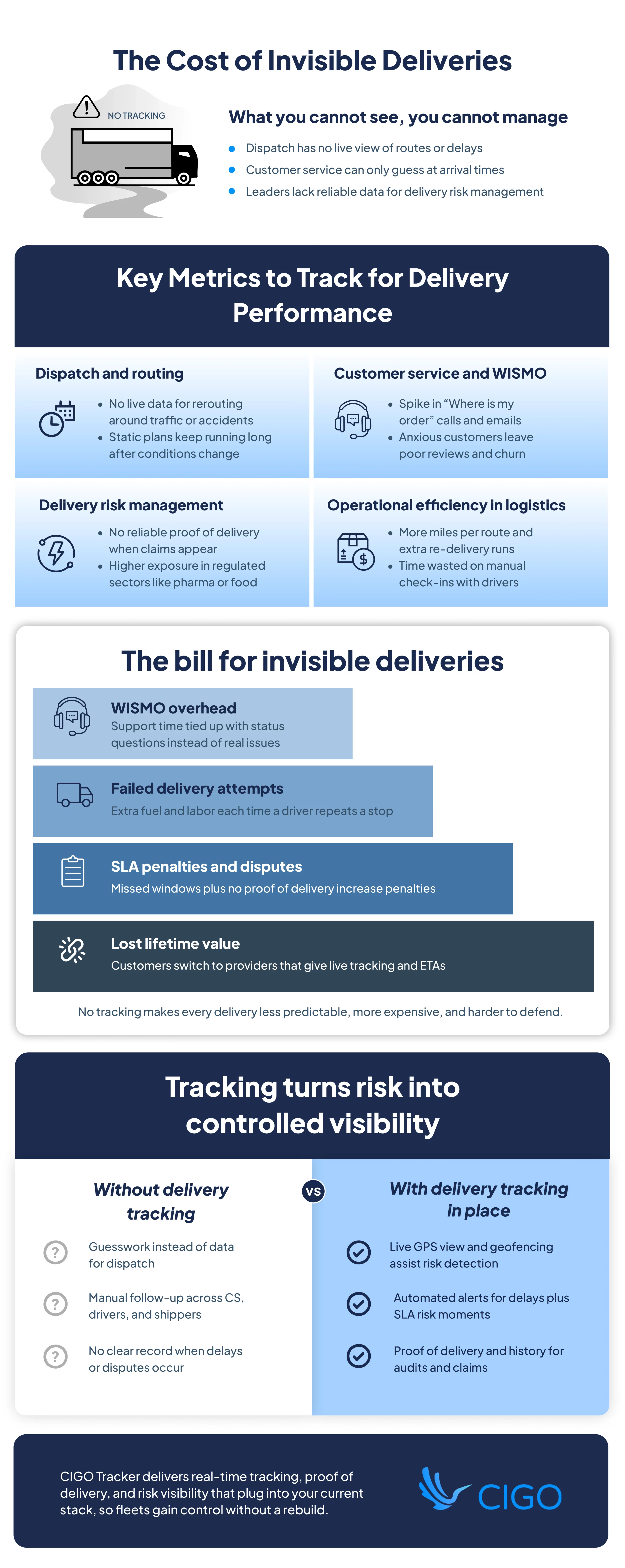
When a delivery leaves the dock without tracking, you enter a blackout period. You know the manifest, you know the route plan, yet you cannot see how reality diverges once tires touch the road. That blind spot carries a cost.
Operational Gaps Caused by Lack of Tracking
Dispatchers end up operating without a view of vehicles. They discover delays when a driver calls or a customer complains, so intervention arrives late, and orders stay exposed.
The control room drifts into reactive firefighting instead of directing the day with data. Without dispatch software, that pattern becomes the default.
Road issues and congestion arrive as shocks instead of manageable events. Without proactive alerts or GPS context, your team cannot resequence stops with confidence, which creates threads, instructions, and routes that drift out of alignment. Punctuality suffers, and buffers shrink.
Dwell times, recurring route deviations, and hidden bottlenecks go unnoticed, so managers lean on anecdotes rather than evidence. As reported by Seattle University, low visibility creates bottlenecks and increases operating costs, which explains why blind networks are difficult to control.
Customer Experience Suffers
Another cost of missing delivery tracking is a poor customer experience.
Your support team turns into the tracking system. Delayed orders trigger “where is my order” contacts, and agents chase updates across tools and call dispatch, driving up support tickets across the week.
That scramble drains capacity and makes your brand sound reactive instead of confident.
Customers notice. They see no ETA or progress bar, only silence between confirmation and delivery, so they refresh inboxes, call your team, and post frustrations. A survey conducted by Survicate found that more than half of consumers switch to a competitor after a single bad experience, suggesting that a run of poor deliveries can weaken loyalty.
Compliance and Risk Exposure Without Visibility
In regulated sectors such as pharma, medical devices, and food, location and handling history anchor safety rules, audit trails, and license conditions.
Without tracking, each run carries blind spots that surface during audits and complaints.
When visibility is missing, risk concentrates around the evidence that a solid ePOD record is designed to capture in real time.
- Chain of custody: gaps in timestamps or locations make it harder to show who held goods at each stage.
- Quality assurance: missing temperature or route history limits your ability to prove products stayed within required conditions.
- Incident response: during recalls, teams cannot quickly isolate affected shipments, leading to disruption that spreads.
Delivery Risk Management Relies on Tracking
Delivery risk spans late arrivals, failed attempts, theft, damage, and disputes, and each event becomes harder to control without tracking.
Live visibility links every vehicle, route, and stop into one movement record, so you can validate routes, enforce geofences, and catch exceptions before they harden into missed SLAs.
As Harvard Business Review explains, supply chain visibility gives leaders earlier warning signals and more options to respond to disruption, which is exactly what proof of delivery data and historical logs provide inside delivery risk management.
How Lack of Tracking Damages Operational Efficiency
Running a fleet without tracking feels like flying an aircraft without radar. You know the manifest and the route plan, yet everything that happens between the dock and the door sits in a fog.
Dispatchers, drivers, and support staff react to issues after they bite, rather than steering the day with clear signals.
Without real-time location data, route plans stay rigid even as reality shifts.
A breakdown, a traffic jam, or a last-minute priority delivery can only be handled through calls and chat threads. Each status check pulls several people away from higher-value work and stretches delivery windows, which slowly erodes operational efficiency in logistics.
Key Efficiency Losses
Fuel spend rises when vehicles follow routes rather than plans that adapt to conditions. Drivers loop back across territories and add miles, so cost per stop creeps up.
- Fuel and miles: Static routing ignores congestion, so trucks idle in traffic while odometers climb. As DHL Insights explains, route optimization cuts fuel use and shortens delivery times.
- Time and capacity: Small pauses at each stop compound into fewer deliveries per hour, while office teams repeat calls and arrange re-deliveries when missed windows force extra runs.
Hidden Cost Centers When Tracking Is Absent
Finance rarely sees a neat budget line labeled “cost of no tracking.”
Instead, the impact hides inside support staffing, fuel, overtime, and credits paid to unhappy customers. On paper, amounts seem small. Together, they chip away at the margin and mask the real price of operating blind.
WISMO overhead expands as support agents handle questions that a simple status page could resolve.
Those conversations pull people away from revenue work and extend hours for support and dispatch. At the same time, failed delivery attempts consume labor, vehicle time, and fuel, yet bring in no new income.
There is also a quieter revenue leak. Unreliable delivery experiences lower repurchase rates, and SLA penalties erode the value of large contracts, making it harder to hit growth targets.
Missed Optimization Opportunities
Without tracking, your operation loses the data that powers improvement, so each adjustment relies on intuition rather than evidence.
- No reliable baseline: Stop duration and route variance remain unclear, keeping efficiency problems out of sight.
- Competitors learning faster: Rivals with AI routing keep learning. The World Economic Forum notes that visibility data enables supply chains to optimise continuously and reduce costs.
- Static capacity planning: Without demand history by area and time, it is harder to position vehicles and people.
- Weak feedback loop: Drivers get little structured feedback, and planners lack proof that operational changes truly worked.
How Delivery Tracking Powers Delivery Risk Management
Delivery tracking turns delivery risk management into a proactive system for prevention, intervention, and resolution.
Prevent the Risk Before It Happens
Real-time tracking turns your delivery network into an early warning system for risk.
GPS and geofencing highlight route drift and missed checkpoints early enough for intervention, helping protect delivery windows when conditions change mid-route.
Dispatch can resequence stops, protect priority orders, and reset expectations before delays harden into failed deliveries. Driver apps pull check-in, check-out, ETA updates, and route guidance into one workflow.
That structure reduces improvisation and keeps each stop aligned with your service promise.
Automatic triggers flag orders at risk of an SLA breach so your team can prevent problems rather than apologize after the fact.
Resolve Issues Faster
When a delivery breaks, tracking turns confusion into a clear timeline. Support teams see the last recorded location, the planned stop sequence, and the elapsed time so that they can answer customers with specifics rather than soft apologies.
That precision calms tension because people understand what happened and what comes next.
Dispatch works within the same view, isolates the moment a route went off track, and quickly determines whether the issue lies with access, traffic, or process.
Historical logs extend that clarity into claims and internal reviews. Insurers, partners, and leaders can view photos, timestamps, and signatures for each stop, eliminating guesswork in disputes.
Delivery risk management becomes a cycle of evidence, root cause analysis, and corrective action, not a search for someone to blame.
Boosting Operational Efficiency in Logistics with Real-Time Visibility
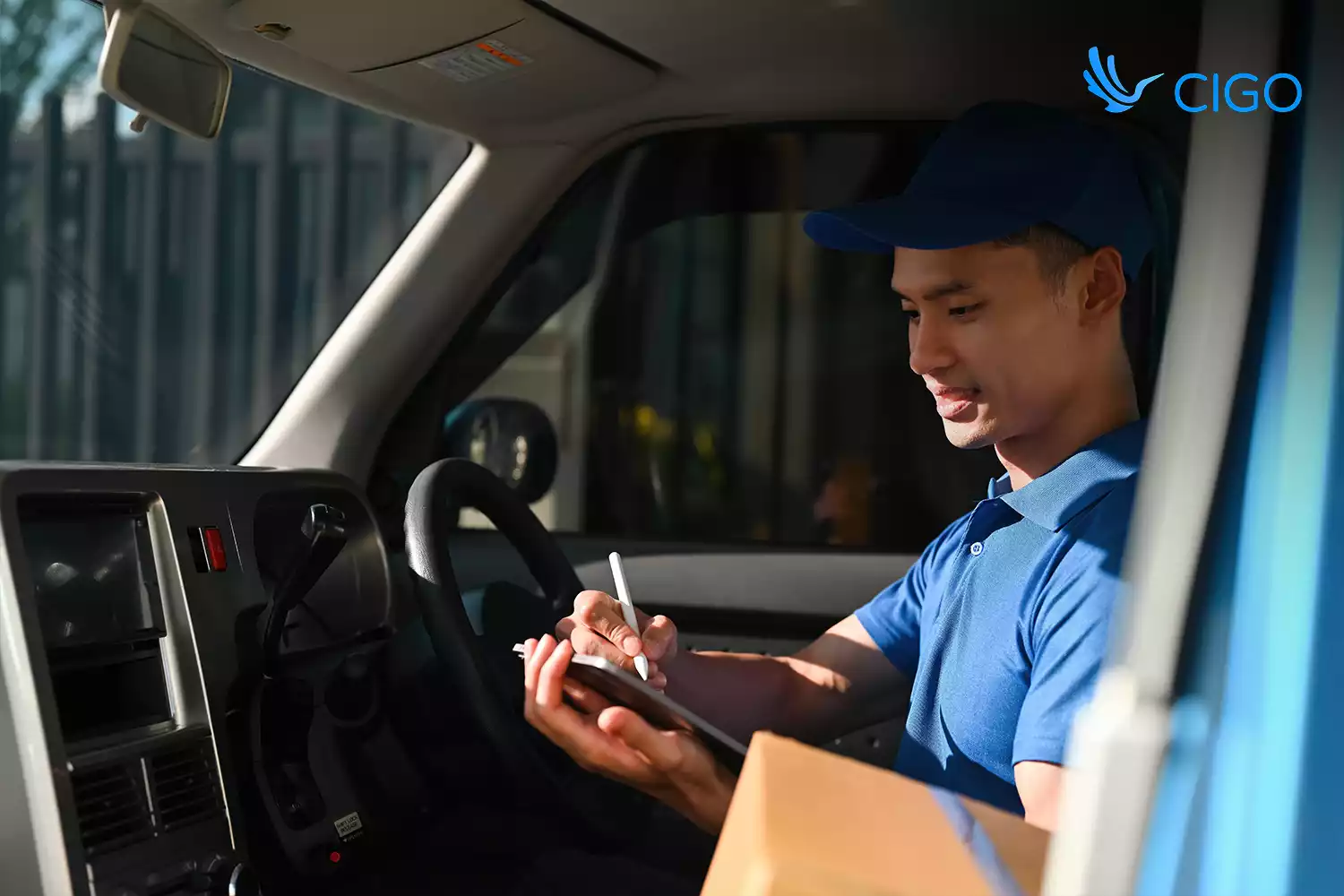
Live tracking turns scattered roles into a coordinated operation.
Dispatch, customer service, and leadership share the same view of vehicles, orders in motion, and time leaking out across the day. With that shared picture, you treat operational efficiency in logistics as a system to manage, not a string of isolated emergencies.
- Faster decisions: Real-time maps and alerts surface issues early, so teams adjust routes before delays spread.
- Better asset use: Idle vehicles, unbalanced territories, and repeat detours become visible, which supports smarter allocation.
- Safer execution: Clear instructions and live status reduce rushed driving and last-minute changes at the curb.
- Lower cost base: Fewer empty miles and failed attempts reduce the cost per delivery. McKinsey & Company links higher adoption of real-time visibility and telematics with lower waste and stronger logistics performance.
Use GPS Data to Inform Route Optimization
GPS data turns route optimization into a living process instead of a static plan.
You see how long each stop really takes, the stretches where congestion keeps repeating, and the pockets of territory where drivers burn unnecessary miles. Planners can test new route patterns, compare results side by side, and lock in the options that consistently perform best.
When conditions shift mid-route, the same data guides confident adjustments. Dispatch can resequence stops, bypass bottlenecks, and protect time-critical deliveries without guessing.
Each iteration trims fuel, eases vehicle wear, and steadily lifts operational efficiency in logistics.
Competitive Baseline: Who Is Offering Tracking Now
Modern expectations come from brands like Amazon and Uber Eats, not just from your promises. They made real-time tracking, map views, and delivery photos feel like default parts of ecommerce.
UPS, FedEx, and national postal services send step-by-step status updates, so people rarely feel in the dark about parcels.
That standard now reaches local markets.
Regional couriers, grocery delivery services such as Instacart, and food platforms such as DoorDash promote live tracking as a core feature. Enterprise shippers increasingly request comparable visibility when evaluating carriers and fleet partners.
If You Are Not Matching, You Are Falling Behind
Even without loyalty programs, customers expect delivery transparency. They look for a status page, clear ETAs, and reminder messages through email or SMS so they are not guessing about the doorbell.
- They want proof of arrival at the doorstep via a scan, signature, or photo.
- They compare your experience with platforms that provide live tracking and instant confirmations.
Providers that miss this baseline feel dated beside tech-enabled rivals, so buyers shift volume toward carriers that deliver clear status, reliable tracking, and evidence that every delivery landed as promised.
How CIGO Tracker Fills the Tracking Gap
We built CIGO Tracker to close the gap between legacy tools and real delivery control. You keep existing systems while our platform sits on top, unifying orders, routes, drivers, and customer updates in a live view.
With delivery tracking, dispatch, support, and operations sharing a single source of truth.
Features Built for Risk and Efficiency
CIGO Tracker works as a delivery management layer that links tracking, routing, and proof of delivery inside everyday workflows. You see active stops, driver progress, and customer updates in a single interface, rather than scattered tools.
- Data security: SOC 2 Type 1 controls and an encrypted cloud infrastructure protect shipment data and support security.
- Electronic proof: Drivers record photos, signatures, and notes in the app, so disputed stops become documented events.
- Equipment tracking: Industry templates help equipment fleets manage safety, compliance, and time-sensitive drops in high-risk sectors.
Case Scenario: Pre-Tracking vs Post-Tracking Results
Picture a mid-size regional fleet that handles home delivery for bulky retail orders.
Before tracking, the failure rate sits at 12%. Drivers miss customers, arrive outside acceptable windows, or run into access issues nobody anticipated, so every route feels slightly out of control.
Support fields more than 200 WISMO tickets in a typical week. SLA compliance hovers below 88%, which strains customer relationships and contract reviews. Leadership senses that delivery risk management is weak, although they lack hard evidence to pinpoint the biggest problems.
After a real-time tracking layer like CIGO Tracker goes live, the failure rate drops to around 4%. WISMO volume falls by roughly two-thirds because customers can see deliveries in motion and adjust their plans.
SLA uptime climbs into the mid- to high-nineties, and internal conversations shift away from fire drills toward targeted improvements backed by data.
Best Practices for Rolling Out Delivery Tracking
Start with a focused, high-impact slice so the rollout feels manageable and early wins stay visible. Prioritise routes with high revenue, strict SLAs, or sensitive customers, since progress there offers a clear case for investment.
A simple rollout framework helps you turn that pilot into repeatable habits across teams and drivers.
- Align operations, customer service, and finance on one pilot set of lanes, agree on a small group of target metrics, and review results together.
- Involve drivers early and show how ETAs and proof of delivery protect them in disputes. Use tracking data in coaching sessions to make delivery risk management a practical habit.
Common Misconceptions About Delivery Tracking
“It Is Too Expensive.”
Many teams treat tracking as a pure cost while ignoring the hidden P&L impact of avoidable failures, WISMO, and lost customers. Support hours, fuel, driver overtime, and SLA penalties already absorb budgets that a tracking layer can help protect.
A modern, software-driven approach to delivery risk management gives you more control over those expenses. You trade guessing for measurement, which opens the door to lower delivery costs and healthier margins.
“It Is Too Complex to Integrate.”
Older tracking systems sometimes required extensive customization. Newer platforms build around APIs and prebuilt connectors for TMS, WMS, and CRM systems.
Integration becomes a configuration project rather than a multi-year rebuild.
The goal is not perfection on day one. You can start with a narrow segment of deliveries, integrate key data points, and expand coverage as your team grows comfortable with the workflow.
“We Are Not Big Enough to Need It”
Small fleets often feel the impact of delivery risk more sharply than large networks. A few failed deliveries, a handful of bad reviews, or the loss of a key account hit harder when volume is modest.
Tracking helps smaller operations scale responsibly.
You gain clarity on capacity, identify process issues early, and show larger customers that your operation handles deliveries with the same discipline they expect from bigger providers.
Bringing Visibility to the Center of Your Logistics Strategy
Data now sits at the core of serious logistics strategy, and delivery tracking is one of the tools that exposes it. Every trip, stop, delay, and confirmation becomes structured information that supports delivery risk management and the delivery KPIs that separate stable networks from guesswork.
Better visibility also reshapes how people work. Dispatch, customer service, driver leaders, and compliance review the same live picture rather than trading partial updates.
Turning Delivery Visibility Into An Advantage
Choosing not to offer delivery tracking is a choice to live with preventable risk. You accept higher delivery uncertainty, relentless WISMO demand, and costs hidden in fuel, overtime, and SLA penalties.
That pattern weakens delivery risk management and makes it much harder to sustain operational efficiency in logistics.
With CIGO Tracker, you add real-time visibility, cleaner proof of delivery, and smarter routing on top of systems that already run your operation. Drivers, dispatchers, and customers share the same story instead of trading guesses.
If you want delivery promises your customers can actually feel, reach out through our contact page and explore how modern tracking can reduce risk while strengthening day-to-day performance.
FAQs
How does delivery tracking support delivery risk management in practical terms?
Delivery tracking gives delivery risk management real leverage. You see live locations, route deviations, and missed checkpoints, so late arrivals and disputes stop hiding in guesswork. Teams use alerts, ETAs, and proof of delivery to prevent incidents, document events, and close claims faster.
Why does WISMO volume increase when tracking is missing, and how can tracking reduce it?
Without tracking, customers cannot see progress, so every delay becomes a “where is my order?” complaint. Delivery tracking publishes status, ETAs, and delivery confirmation, answering most questions instantly, reducing repeat contacts, and giving support space to handle higher-value issues.
What kind of proof of delivery data should a modern tracking system collect?
A modern system should capture photos at drop-off, timestamps for each stop, the recipient’s name, a digital signature, the precise drop location, and any access notes. That proof-of-delivery record strengthens delivery risk management and provides operations with clear evidence during disputes or audits.
How does delivery tracking affect operational efficiency in logistics for small or mid-size fleets?
Delivery tracking lifts operational efficiency in logistics by turning small fleets into coordinated networks. Dispatch can batch stops intelligently, avoid duplicate trips, and see idle vehicles. Leaders measure cost per drop, failed attempts, and on-time rates, so improvement efforts target the right routes and behaviors.
What should a logistics leader look for when evaluating delivery tracking platforms?
A logistics leader should look for accurate GPS data, flexible integrations, and robust delivery risk management. Priorities include driver adoption, customer-facing tracking pages, proof-of-delivery tools, clear reporting on WISMO and SLA performance, and security controls that meet internal and customer standards.