Customers already rely on their phones for shopping, support, and parcel tracking, often checking the same screen several times a day. When delivery updates are hard to find or slow to refresh, uncertainty grows, and WISMO contacts start to climb.
Mobile delivery tracking is where those expectations collide with the realities of last-mile delivery.
Give customers a clean, real-time view on their phone, and you replace guesswork with calm, self-serve visibility while WISMO calls start to fade. CIGO Tracker sits in that moment, connecting routes, drivers, and customers so mobile delivery tracking supports accurate ETAs and protects margins, rather than creating chaos.
Key Takeaways
- Mobile delivery tracking gives customers live parcel visibility on their phones, reducing anxiety and keeping them informed without constant calls.
- Logistics providers that invest in mobile-friendly parcel tracking often see higher satisfaction scores, stronger repeat business, and fewer complaints about missed communication.
- A mobile-optimized tracking interface improves transparency and tends to lower WISMO call volume, since customers can self-serve order status.
- Real-time mobile parcel tracking supports better operational efficiency, tighter ETAs, and improved first-attempt delivery success for fleets.
- CIGO Tracker delivers a scalable, mobile-first tracking experience that aligns dispatch, drivers, and end customers on one shared view of the journey.
Why Mobile-First Matters in Last-Mile Delivery
Last-mile delivery sits at the crossroads of rising mobile usage and rising delivery expectations.
Customers browse, buy, and check parcel tracking on the same screen, so friction on mobile quickly turns into support pressure and frustration.
Mobile ecommerce now drives a majority of online traffic and a large share of sales. As reported by Capital One Shopping, mobile commerce accounts for more than half of global ecommerce revenue and continues to grow each year.
That behavior also sets the baseline for delivery visibility and modern customer expectations.
Traditional tracking flows struggle in this environment. Static emails lag behind events, desktop-only pages feel cramped on phones, and phone-based support never quite catches up.
A mobile-first mindset changes this, since you design mobile delivery tracking around real-time status, clear ETAs, and simple controls customers use on the move.
Statistics Proving the Mobile-First Shift
Customers no longer check tracking pages casually. They see them as part of the buying experience. Data shows how strong this habit has become.
- BusinessWire reports that 90% of consumers actively track packages and check their status several times per day.
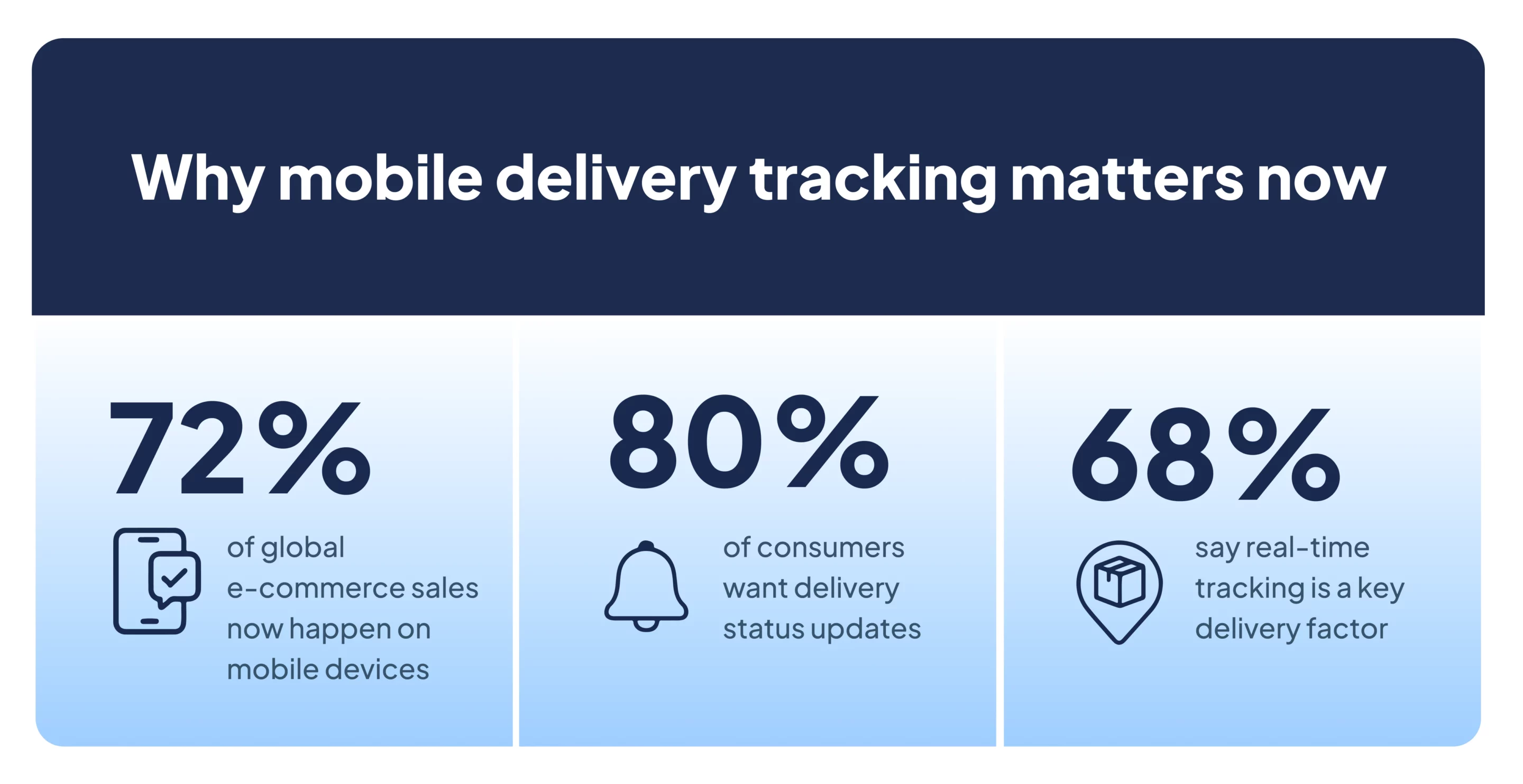
- Shopify research finds that 80% of customers want to receive delivery status updates, not occasional notifications that leave gaps in the story.
- In a separate analysis of ecommerce behavior, a MetricsCart report notes that 68% of consumers view real-time package tracking as a core part of delivery convenience.
Taken together, these signals paint a clear picture: people hold a phone in their hand and check parcel tracking frequently, which directly ties into modern delivery optimization efforts in last-mile logistics. They expect real-time clarity instead of vague updates.
What Is Mobile Delivery Tracking and How It Works
Mobile delivery tracking covers every part of the tracking experience that lives on a phone.
It turns scattered updates into a continuous, real-time view of each parcel journey that feels natural on a small screen your customer already trusts. According to the Gauss report, 72% of global e-commerce sales now happen on mobile devices, so the tracking layer has to keep pace with how people already shop, browse, and communicate.
Several pieces work together in the background:
- Status updates and alerts via SMS, email, push notifications, or chat apps at key stages.
- Mobile-optimized parcel tracking pages that show status, ETAs, and live location without awkward zooming.
- Location and event data inside driver tools that feed scans and GPS into the tracking view.
- Automation and APIs that connect ecommerce, routing, and delivery systems, keeping information current without manual effort.
Benefits of Mobile Delivery Tracking for Logistics Providers
Mobile-friendly parcel tracking feels like a customer feature. Under the surface, it acts as a powerful operational tool.
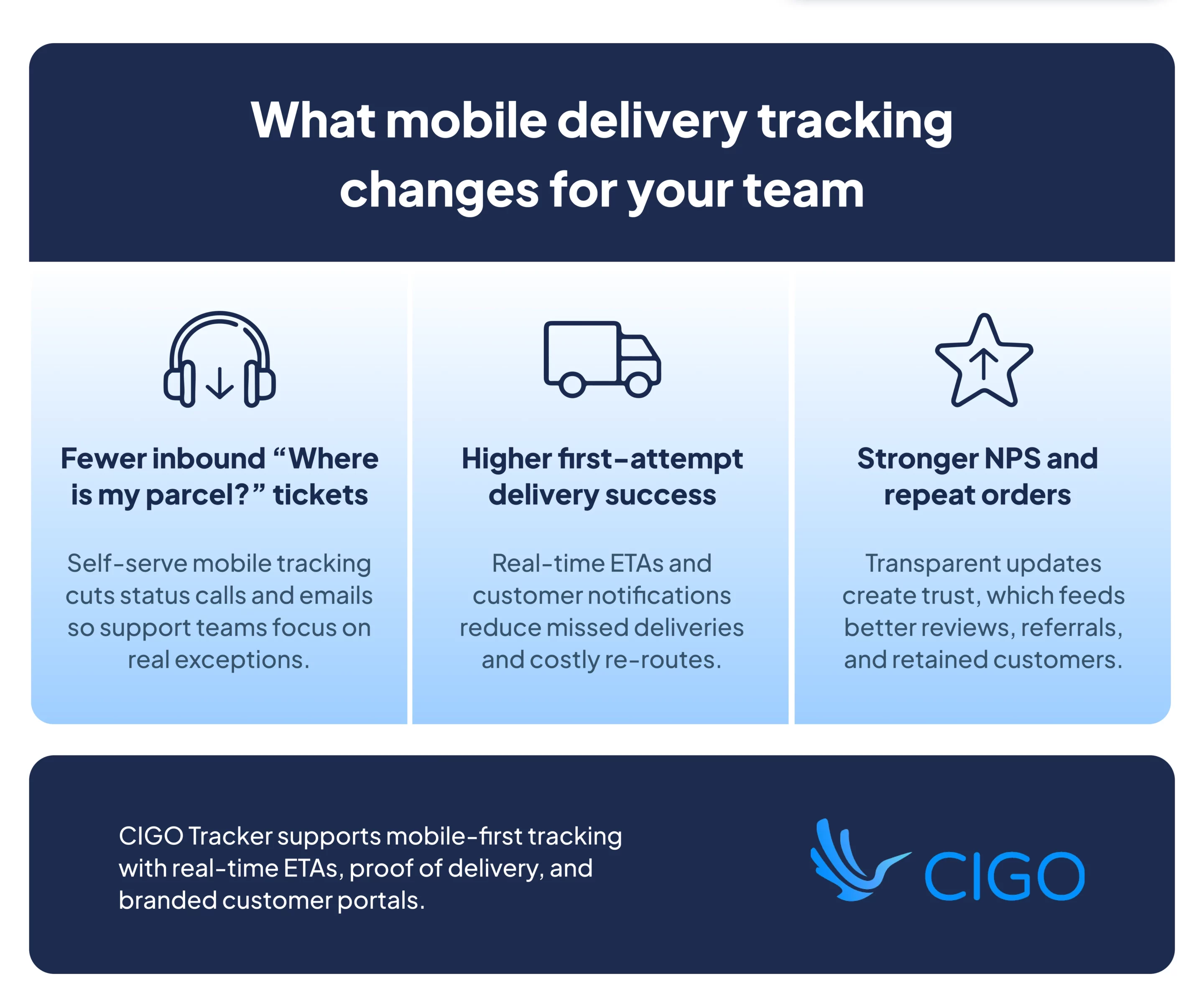
Fewer inbound “Where’s my parcel?” calls
High WISMO volume rarely happens by accident.
Those “Where is my parcel?” calls usually point to gaps in real-time visibility and weak confidence in the promised delivery window.
As reported by McKinsey, US shoppers increasingly prioritize reliable, clearly communicated delivery information over raw speed, which means silence feels risky.
When mobile delivery tracking provides live status, ETAs, and timely alerts on a phone, backed by reliable tracking software, customers can solve most questions themselves, and your agents spend time on actual exceptions rather than routine reassurance.
Stronger trust through transparent communication
Customers remember how delivery felt long after they forget the exact basket total.
Communication in that last stretch either reinforces trust or quietly erodes it, because delivery is the final proof that every promise you made was real. Mobile delivery tracking keeps that moment clear and honest through small, steady signals:
- Clear status language instead of cryptic scan codes
- ETAs linked to real routes, not generic service levels
- Consistent updates when delays appear
You show customers the same reality your teams see, which makes every promise feel safer to believe.
Better fleet coordination and visibility
Mobile-first tracking ties driver apps, dispatch dashboards, and customer views into one shared picture of the day.
When your tracking portal pulls status and location directly from route plans, GPS, and centralized route management, planners see which stops are on pace and which need attention. That level of clarity helps drivers feel supported rather than second-guessed, since everyone works from the same live map of reality.
Over time, decisions feel less reactive, and your fleet operates with a calmer, steadier rhythm.
Improved customer experience and NPS
Delivery is the moment shoppers remember, so weak communication quickly turns into disappointment.
Analysis in Digital Commerce shows that shipping and delivery sit at the heart of how people rate their overall shopping experience, not just as a side detail. That link between delivery and satisfaction gives mobile delivery tracking real weight.
When you reduce negative surprises, give customers simple control over timing and location, and invite feedback on the same mobile tracking view, confidence builds with each order. Consistent, mobile-friendly communication becomes part of your brand promise, and NPS tends to reflect a stronger relationship.
Impact on Operations and Customer Service Metrics
Mobile delivery tracking not only changes how customers feel, but it also reshapes the numbers your teams watch every day. Once the workflow stabilizes, you start to see patterns in both operations and support that point to healthier routes and cleaner communication.
Key metrics to monitor include core delivery KPIs such as:
- WISMO contacts per 100 orders.
- Average handle time for delivery-related tickets.
- First-attempt delivery success rate.
- On-time in full (OTIF) percentage.
- CSAT and NPS are tied specifically to delivery touchpoints.
Even modest gains across those metrics add up quickly within a busy route network, freeing your team to focus on higher-value work.
Key Features of a Mobile-Optimized Parcel Tracking System
| Feature | What it does for customers | Why it matters for your operations |
| Real-time GPS visibility and ETAs | Shows live parcel movement, clear status steps, and ETAs that adjust during the day, so customers know when to be available. | Uses driver GPS and route data to accurately reflect reality on the map, helping planners spot delays early and make smarter routing decisions. |
| Mobile-friendly tracking layout | Delivers a clean view with large tap targets, a simple progress timeline, and concise address details that are easy to scan on a phone. | Reduces confusion, lowers WISMO risk, and keeps support teams out of basic, “how do I read this?” questions. |
| SMS and email delivery alerts with deep links | Sends short updates that open directly into the right tracking view on mobile, without searching for order numbers or logging into portals. | Keep customers engaged through the full delivery journey and reduce manual outreach when status changes. |
| Customer communication tools | Let customers add delivery notes, choose safe drop-off locations, or reschedule in a few taps, instead of calling support. | Captures accurate last-mile instructions at scale and reduces avoidable failed deliveries. |
| Branded tracking experiences | Keeps customers on a tracking page that uses your colors, logo, and tone, rather than a generic carrier template. | Strengthens brand recognition during a critical touchpoint and keeps the experience aligned with your service promise. |
| Dynamic proof of delivery | Displays photos, signatures, and time-stamped updates clearly on mobile, so customers feel confident about where a parcel ended up. | Provides strong, visual confirmation for disputes, reduces chargebacks, and gives teams clear records for every completed stop. |
CIGO Tracker weaves these pieces into configurable, mobile-first tracking portals that match your routes, service model, and customer base. You keep control over the experience while customers see the same clear, real-time picture your teams already use to run the last mile.
Use Case: How Mobile Delivery Tracking Enhances the Customer Journey
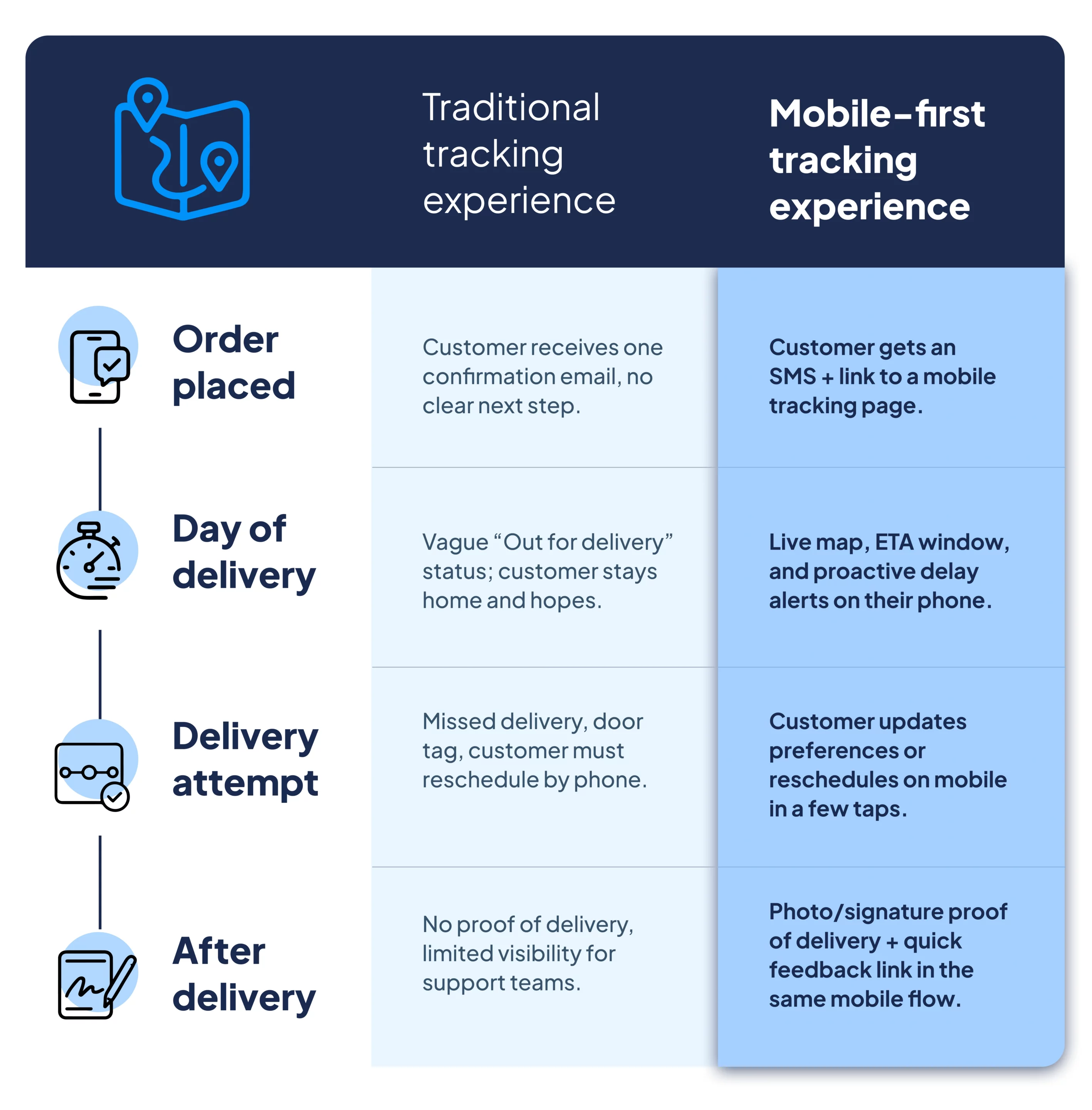
A customer places an order during a short break and receives a confirmation almost immediately.
The message includes a tracking link that opens cleanly on their phone, so they bookmark it without thinking about it. When they return to work, a quick glance at the mobile tracking page is enough to see where the parcel sits in the process.
As the day unfolds, the experience becomes more precise. A new notification tightens the ETA window based on the driver’s live route, not a generic promise. The customer notices there are only a few stops ahead and adds a short note about the gate code directly in the same view, eliminating the need for support to pass instructions along later.
The final stretch clearly closes the loop. Delivery updates appear on the tracking page, including a photo, timestamp, and status, so the customer can see exactly where the parcel landed without calling neighbors or checking every entrance.
A compact, mobile-friendly feedback prompt sits just below that confirmation, making it simple to share a quick rating or comment while the experience is still front of mind.
Case Example: Reducing Customer Churn Through Transparency
A regional retailer continues to face high WISMO volume and complaints about missed deliveries, so support spends most days calming frustrated customers rather than resolving true exceptions.
Leadership rolls out mobile delivery tracking with live ETAs, proactive alerts, and a branded tracking page that works smoothly on phones.
Within a quarter, the delivery story looks different:
- WISMO tickets drop as customers rely on self-serve parcel tracking
- Support teams handle exceptions instead of repeating reassurance scripts
- Survey comments call out clear tracking as a reason shoppers stay loyal
Choosing the Right Mobile Delivery Tracking Solution
Every platform can claim mobile capability. You need a more precise lens. Helpful questions for logistics leaders include:
- How well does the tracking page adapt to different smartphone screen sizes and network conditions?
- Does the system support multiple notification channels, such as SMS, email, and chat apps that suit your customers?
- Can customers change delivery preferences, provide instructions, or reschedule on mobile without calling support?
- How accurate are ETAs, and do they tie directly into route planning data rather than generic service promises?
- What insights do operations and customer service teams gain out of the box for WISMO, OTIF, and first-attempt success?
- How deep is integration with existing tools, including TMS, WMS, ecommerce platforms, and route optimization software?
A mobile-first solution should not just display data on a phone. It should plug into your live operations to make the entire delivery chain more predictable.
How CIGO Tracker Powers Mobile-First Delivery Experiences
CIGO Tracker brings white-label control straight into mobile delivery tracking.
We let you brand customer portals on your own domain, while our delivery tracking engine keeps maps, ETAs, and proof of delivery up to date on any phone. Because the same data powers delivery management and route optimization, dispatchers see what customers see and can adjust plans without breaking the experience.
Customer engagement features add SMS and email notifications under your name, so every tap on a tracking link feels like a direct conversation with your team.
Getting Started: Implementation Tips for Mobile-First Delivery Tracking
A mobile-first shift does not need to happen overnight. You can move in stages that align with your existing delivery model.
Practical steps include:
- Audit your current tracking flows: Map how customers receive updates today, which pages they see, and which moments create WISMO frustration.
- Define success metrics: Choose concrete targets for WISMO volume, first-attempt delivery success rate, OTIF, and delivery-related CSAT.
- Select tools with mobile behavior in mind: Compare platforms using live demos on real phones. Pay attention to load times, ETA clarity, and ease of interaction.
- Align internal teams: Prepare dispatchers, drivers, and support teams with clear explanations of how tracking will change and how each role contributes.
- Launch in controlled segments: Roll out mobile delivery tracking to a subset of routes or regions. Monitor performance, gather feedback, and refine communication templates.
- Review metrics and feedback regularly: Track WISMO contacts, support workload, satisfaction scores, and on-time performance after launch. Adjust notification triggers, page layout, and messaging where needed.
CIGO Tracker can support each stage, especially where route data, driver apps, and customer tracking come together.
Looking Ahead: The Future of Mobile Delivery Visibility
Mobile-first delivery tracking feels standard, yet the next phase centers on systems that anticipate issues. AI models refine ETAs with traffic and route history, while predictive alerts flag at-risk stops so planners can adjust and customers get clearer time windows.
A recent Reuters report on Amazon’s AI-enabled driver eyeglasses describes navigation guidance and instant photo capture for proof of delivery, all feeding real-time updates.
As wearables and smarter analytics roll out across US fleets, mobile delivery visibility feels woven into daily routines rather than tacked on afterward.
How Will You Meet Customers On Mobile?
Customers already live in a mobile world, so mobile delivery tracking shapes how they remember your brand long after the parcel lands.
Clear, self-serve parcel tracking softens WISMO pressure, while route-aware ETAs keep drivers and dispatchers aligned with what customers see on their phones. The result is a delivery story that feels predictable instead of fragile.
CIGO Tracker treats mobile visibility as part of a wider discipline, not a single screen. The same mindset runs through work on delivery security and equipment tracking, where real-time information protects both assets and relationships.
The lingering question is simple: how well does your current tracking experience match how your customers already use their phones every day? When it does not, contact us to close the gap.
FAQs
What is mobile delivery tracking?
Mobile delivery tracking is the parcel tracking experience built for phones. Customers receive alerts, live status, ETAs, and proof of delivery on a compact screen instead of desktop-only pages. Good setups link driver apps, route data, and customer updates into one real-time view.
How does mobile parcel tracking reduce “Where’s my order?” calls?
Mobile parcel tracking reduces “Where is my order?” calls by providing answers before customers reach support. Real-time status, updated ETAs, and clear alerts reduce the sense of a missing parcel, so phones stay open to exceptions instead of routine checks.
What should logistics providers look for in a mobile-first tracking solution?
A mobile-first tracking solution should offer a branded, responsive page, accurate ETAs tied to real routes, and simple controls for instructions or rescheduling. Strong integration with routing and driver tools keeps parcel tracking data consistent, while reporting highlights WISMO, delivery success, and satisfaction.
How can I measure the impact of mobile delivery tracking?
You measure the impact of mobile delivery tracking by watching both operations and sentiment. Track WISMO contacts, handle time, first-attempt success, OTIF, and arrival windows, and pair those numbers with CSAT and NPS scores that mention delivery clarity and communication.
Do customers really check tracking pages that often?
Customers check parcel tracking frequently, often multiple times a day while commuting, working, or relaxing at home. Mobile delivery tracking recognizes that habit, keeps status a tap away, and turns each quick glance into clear, reassuring information instead of a guessing game.