Foresight AI
Most delivery schedules are built on assumptions that were accurate when someone made them, not when the truck leaves the depot.
By the time drivers are on the road, conditions have already shifted.
Real-time demand capacity data keeps the schedule honest as routes, stops, and conditions evolve. When capacity is treated as a live constraint rather than a fixed morning number, the windows you publish reflect what the fleet can actually execute right now.
Without it, overbooking, missed windows, and WISMO contacts become predictable outcomes. CIGO Tracker is built around the principle that scheduling accuracy starts with live capacity, not morning assumptions.
Key Takeaways
- Scheduling accuracy improves when capacity is treated as a live constraint, not a fixed morning estimate.
- Real time demand capacity reduces overbooking because slot availability updates before customers receive a window the fleet cannot honor.
- Better capacity inputs produce tighter windows, fewer reattempts, and less manual rescheduling.
- Delivery scheduling software delivers the strongest results when it combines execution signals, constraint modeling, and overbooking guardrails.
- Tracking scheduling accuracy as a service metric separates teams that improve from teams that just cope.
What Real-Time Capacity Data Actually Means
Real-time capacity data is an always-updating view of what the fleet can still deliver today.
It is not a vehicle count. It is a composite picture: driver hours remaining, vehicle availability by stop type, open time windows by zone, and depot cutoff times that close the door on new work.
The word “real-time” carries weight here. A capacity view refreshed every morning is still a static view. Genuine real-time demand capacity changes with exceptions, field progress, dwell variances, and mid-shift coverage changes.
When a truck goes down at 11 a.m., the model should reflect it immediately.
IBM Institute for Business Value research found that 81% of supply chain leaders are actively pursuing AI-enabled real-time demand sensing, precisely because static inputs cannot keep delivery scheduling software aligned with what is actually executable on the ground.
The Three Inputs That Form Real Time Demand Capacity
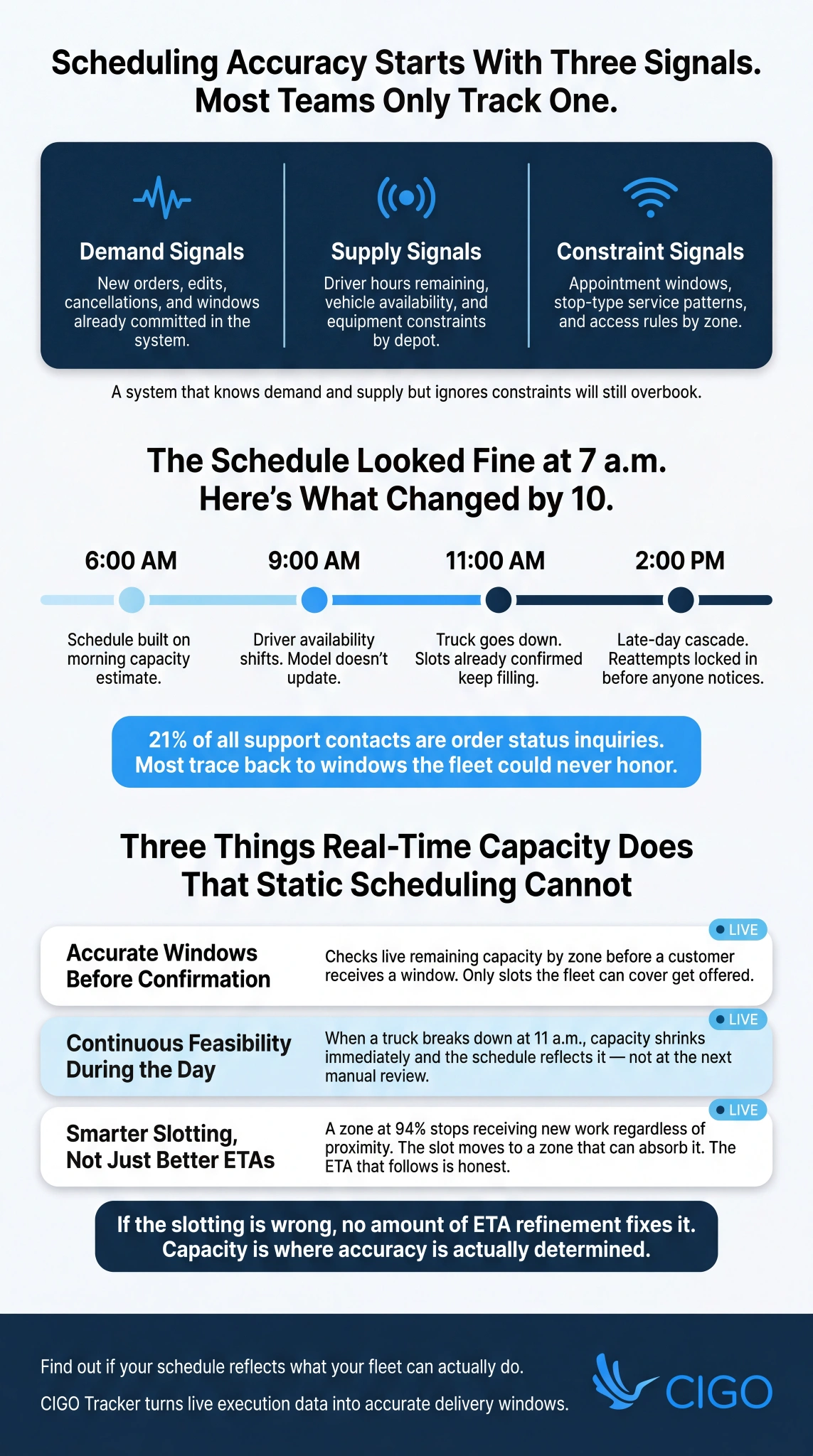
Real time demand capacity is only accurate when three signal types update continuously and feed into the same model:
- Demand signals: new orders, edits, cancellations, and promised windows already in the system
- Supply signals: available trucks, driver hours, shift time remaining, and equipment constraints by depot
- Constraint signals: appointment windows, stop-type service patterns, access rules, and historical stop complexity
Each input depends on the others. A system that knows demand and supply but ignores constraints will still overbook. Stale supply data produces windows the fleet cannot cover.
Accuracy comes from integrating all three in real time, not treating any one as a fixed morning assumption.
Why Delivery Scheduling Breaks Without Live Capacity
Static schedules assume that conditions at planning time will hold when the truck leaves the depot. They rarely do. Driver availability shifts, orders get modified, and time windows tighten, but the schedule does not update to reflect any of it.
Customers receive windows that operations can no longer honor, and dispatchers spend the day reacting instead of managing.
That pressure shows up directly in support volume. Research from Digital Genius found that order status inquiries account for around 21% of all customer support queries in a typical month, rising to an average of 36% during peak periods.
The root cause is not carrier failure or weather. It is schedules built on capacity inputs that were already stale before the first stop was made.
The Common Failure Patterns
- Promising windows after capacity is consumed. Without live visibility, booking systems keep offering slots the fleet cannot cover, making misses predictable.
- Treating stop count as capacity. Thirty stops at 8 minutes differs from 30 at 22; that imbalance surfaces as late deliveries daily.
- Scheduling into invisible constraints. Dock delays, call-ahead requirements, and early cutoffs rarely appear in static models, producing commitments the route cannot honor.
- Updating routes without updating customer windows. When dispatch adjusts mid-day, customers still hold the original window, so accuracy drifts silently until the damage is done.
The Downstream Impact
Research published by Harvard Business Review found that up to 20% of online orders are not delivered on the first attempt. Each failure compounds quickly once customer churn, refund handling, and recovery logistics are included, turning a single missed window into a cost event that extends well beyond the route.
Beyond the per-stop impact, missed windows generate WISMO contacts, supervisor escalations, and manual rescheduling work that pulls dispatch attention away from the rest of the route.
Late-day route collapse is almost always traceable to a schedule that started overbooked, with no mechanism in place to course-correct before drivers run out of time.
How Real-Time Capacity Improves Scheduling Accuracy

The improvement is a loop, not a one-time fix. The system senses what is happening in the field, evaluates whether the current schedule is still feasible, then updates capacity as execution data flows back.
Each cycle becomes more accurate because the model learns from real patterns rather than assumptions built before the first truck left.
That compound effect produces a practical outcome: the schedule stays aligned with what the fleet can actually finish, reducing broken promises without dispatchers having to manually intervene on every exception.
More Accurate Time Windows Before Confirmation
The most valuable place to apply real-time capacity is before a window is confirmed, not after. When a customer books a delivery, the system should check live remaining capacity by zone, account for service-time patterns, and offer only windows the fleet can realistically cover.
Geo-fencing tools that tighten delivery windows add another layer by grounding the arrival estimate in actual movement patterns rather than optimistic averages.
Buffers matter here too. Live capacity modeling should size variability buffers to each zone’s historical performance, so one slow stop does not cascade into four missed afternoon commits.
Continuous Repricing of Feasibility During the Day
In delivery operations, the speed advantage of live data matters most in the window between when an exception occurs and when it starts cascading. If a truck breaks down, capacity shrinks immediately and the schedule should reflect that contraction right away, not at the next manual review.
The flip side is equally useful. When the fleet is running ahead of plan, live capacity modeling lets dispatchers absorb additional work that a conservative morning estimate would have declined, protecting against overload on bad days and capturing upside on good ones.
Better Slotting, Not Just Better ETAs
ETA accuracy gets attention, but slotting is where scheduling accuracy is actually determined.
Slotting decides which work goes to which zone and driver. ETA is simply the output of executing that decision well, so if the slotting is wrong, no amount of refinement fixes it.
Real time demand capacity improves slotting by preventing over-commitment before it happens:
- A zone at 94% capacity stops receiving new work regardless of proximity
- The slot moves to a zone that can absorb it
- The ETA that follows is honest because the plan beneath it is achievable
What Delivery Scheduling Software Should Do With Live Capacity
Not every tool treats capacity as a live input.
Many operate like a calendar, allocating work into slots without validating whether the fleet can cover what it has accepted. Effective route scheduling software gives dispatch a real-time picture of how each zone is loading and which stops are at risk before they become misses.
Three behaviors separate effective tools from glorified spreadsheets: guardrails that prevent overbooking, smart rescheduling logic when the plan breaks, and exception awareness that feeds real patterns back into future decisions.
Guardrails That Prevent Overbooking
Hard caps set a maximum on how much work a zone, depot, or equipment type can accept for a given window.
Once hit, the system stops offering that slot regardless of customer pressure. Soft caps allow exceptions but require explicit sign-off, so the decision is made consciously and leaves an audit trail.
Cutoff times ensure the schedule never commits work with no one available to cover it.
Smart Rescheduling When Reality Changes
When a stop becomes infeasible, the system should auto-suggest the next best available windows rather than leaving dispatch to resolve it manually. Those suggestions should account for current capacity, not just geographic convenience.
Customer communication also has to stay consistent:
- If a window shifts, the notification goes out immediately with the updated commitment
- The gap between a schedule change and a customer update is where trust erodes
- The right automation closes that gap entirely
Exception-Aware Scheduling
Exceptions are not random. A zone with consistent access delays, a stop that always runs over, a neighborhood that spikes dwell times every Friday: these are patterns a live system should capture and apply.
Electronic proof of delivery tools that capture exception data create a clean record at each stop, so the scheduling model works from real data rather than optimistic defaults.
Use Cases Where Real-Time Capacity Data Pays Off Fast
High-Volume Last Mile With Tight Windows
High-volume operations have the least margin for error. When each driver is running 40 to 60 stops, one overloaded zone cascades into late runs across the entire fleet.
The DHL Online Shopper Trends Report found that 9 in 10 consumers say tracking is important once an order is placed, and what customers expect from delivery operations has shifted accordingly. Real-time capacity prevents small misses from compounding.
When zone four approaches its feasible limit at 10 a.m., new work gets redirected before that zone becomes the reason six customers call that afternoon.
Mixed Stop Types and Variable Service Times
Residential curbside drops, job-site deliveries, and B2B receiving docks with narrow acceptance windows are three different operational challenges that should not be scheduled identically.
A static model that assigns the same service time to each stop type embeds systematic error before the day starts.
Real-time capacity data lets you build scheduling rules that reflect the actual time cost of each stop category. When those differences are modeled accurately and updated as field data refines the estimates, the schedule becomes genuinely predictive rather than optimistically wrong.
Peak Seasons and Promo Spikes
Promotional spikes and peak season surges are where static capacity models fail most visibly.
A business handling 200 deliveries in September that suddenly absorbs 340 in November will find that existing zones and routes do not scale automatically. Without live visibility, overbooking only surfaces after the missed-window cascade has already started.
Real-time demand capacity closes that gap at the booking stage. When the system surfaces live zone constraints, you can:
- Adjust slot availability before capacity is consumed
- Redirect volume to unconstrained areas
- Prevent the commitments that create peak season failures entirely
Key Features Checklist for Scheduling Accuracy
- Capacity calendars showing live remaining capacity by day, zone, and depot
- Constraint modeling for time windows, equipment, and service time by stop type
- Buffer rules and overload scoring visible to operations teams before decisions are made
- Real-time alerts when schedules drift outside feasible range for dispatch to act
- Rescheduling workflows with approvals and audit trails for every capacity exception
- Customer notification support tied directly to schedule changes without manual outreach
- Reporting for accuracy, reattempts, and manual touches to measure schedule performance
Data Quality That Makes or Breaks Accuracy

Software does not improve accuracy on its own. Weak address data, missing service-time assumptions, and incomplete fleet records create gaps the system papers over with bad defaults.
Fixing inputs is unglamorous work, but it is the only place the fix actually sticks.
The good news is that you do not need perfect data to start. A small number of high-impact upgrades to the inputs driving the most errors will produce measurable gains faster than a months-long overhaul.
The Minimum Data to Start
Every scheduling model needs three core inputs to function reliably:
- Order details including address, time window, and stop type
- Fleet availability by vehicle, equipment, and depot departure window
- A basic service-time assumption by stop category, even if derived from rough averages
The Upgrades That Improve Results Quickly
From there, targeted upgrades compound gains faster than a broad overhaul:
- Actual time-on-stop trends by area, captured from field execution data
- Exception reasons mapped to customers and zones for smarter buffer assignment
- Driver feedback flagging recurring access friction so it gets built into the schedule
- Historical reattempt patterns tied to specific addresses or stop types
KPIs to Track After Rollout
Tracking accuracy starts with knowing your baseline. Without measurement, improvement is invisible. The key last-mile delivery performance metrics to monitor after rollout are:
- Window hit rate by zone and day of week
- ETA accuracy at two hours out and thirty minutes out
- Reattempt rate and top failure reasons
- Manual reschedule rate and touches per order
- Overbooking events and override frequency
- Cost per stop tracked quarterly
Implementation Plan That Keeps Risk Low
Activating dynamic capacity updates fleet-wide without clear rules or feedback loops creates chaos before it creates improvement. Start smaller and tighter.
Pick one zone where missed windows are already frequent, define the scheduling rules, and document how exceptions get approved before anything goes live. The problem is visible there, and the baseline data already exists.
Run a two-to-four week pilot with dispatch and field teams sharing real exception data. Refine buffers, confirm accuracy gains, then expand zone by zone, locking in override governance at each stage so progress holds as scope grows.
Common Mistakes to Avoid
Even well-configured systems fail when implementation habits undermine the model:
- Skipping customer messaging protocols before dynamic updates go live means accuracy gains never reach the customer experience
- Removing buffers too early strips out the variability margin the model has not yet learned to predict
- Logging exceptions as one-offs breaks the feedback loop the model depends on to stop repeating the same failure
How CIGO Tracker Helps Turn Real-Time Execution Into Accurate Scheduling
CIGO Tracker feeds live stop progress, driver location, and exception signals back into the planning layer continuously, so dispatchers work from a schedule that reflects reality rather than morning assumptions.
Features including route optimization, delivery tracking, logistics optimization, and enterprise-grade data security ensure every exception sharpens future service-time estimates.
Over time, each week of real field data makes the next schedule more accurate, which is where compounding operational gains actually come from.
Is Your Schedule Built on What Your Fleet Can Actually Do?

Scheduling accuracy starts with treating capacity as a live constraint, not a morning assumption.
Measure your current window hit rate and reattempt rate by zone, identify where the schedule breaks most frequently, and add live capacity visibility there first. CIGO Tracker gives you the tools to make that shift. Start your free trial or contact the team today.
FAQs
What does real time demand capacity mean in delivery operations?
Real time demand capacity is a continuously updated view of how much work the fleet can still absorb. It combines order demand, driver hours, vehicle availability, and zone constraints into a live picture that updates as field conditions change throughout the day.
How does delivery scheduling software use capacity data to prevent overbooking?
Delivery scheduling software connects the booking layer directly to a live capacity model, validating every window before confirming it. Hard caps, soft caps with approval workflows, and cutoff times tied to actual route logistics prevent the system from committing work the fleet cannot realistically absorb.
Which data signals improve scheduling accuracy the most?
Three signals matter most: actual stop-level service time by zone and stop type, exception reason codes that explain why stops fail, and real-time driver and vehicle availability. Together, they replace static defaults with inputs that reflect what the fleet actually encounters each day.
How do you measure scheduling accuracy after rollout?
Track window hit rate, ETA accuracy at two and thirty minutes out, reattempt rate, and manual reschedule frequency. Segment by zone and day of week. Establish your baseline before rollout, then measure weekly for the first six to eight weeks.
What is a realistic timeline to see fewer reattempts and reschedules?
Most teams see measurable improvement within four to six weeks of piloting live capacity management, provided order data is clean, scheduling rules are defined, and dispatch maintains a closed feedback loop with field teams. Data quality is the biggest variable affecting how fast gains compound.