
A 38-stop route that looks optimized at 7 AM can deteriorate by 4 PM. That gap is where static routing vs dynamic routing stops being a theoretical debate and starts costing real money.
Static routing assumes stable volumes, predictable stops, and patient customers. Modern last-mile delivery offers none of those. Dynamic routing solves for variability but creates its own failure modes when data quality drops or dispatchers override without understanding the system.
Both approaches break. They break differently, at different scales, and at different costs. CIGO Tracker helps you see exactly where each cracks before the day is lost.
Key Takeaways
- Static routing uses pre-fixed routes planned in advance. Dynamic routing reoptimizes stop sequences in real time based on live data.
- Static routing fails when volume grows, demand shifts, or time windows tighten. Inflexibility becomes a structural cost.
- Dynamic routing fails when data quality is poor, change management is skipped, or the team adapts too slowly.
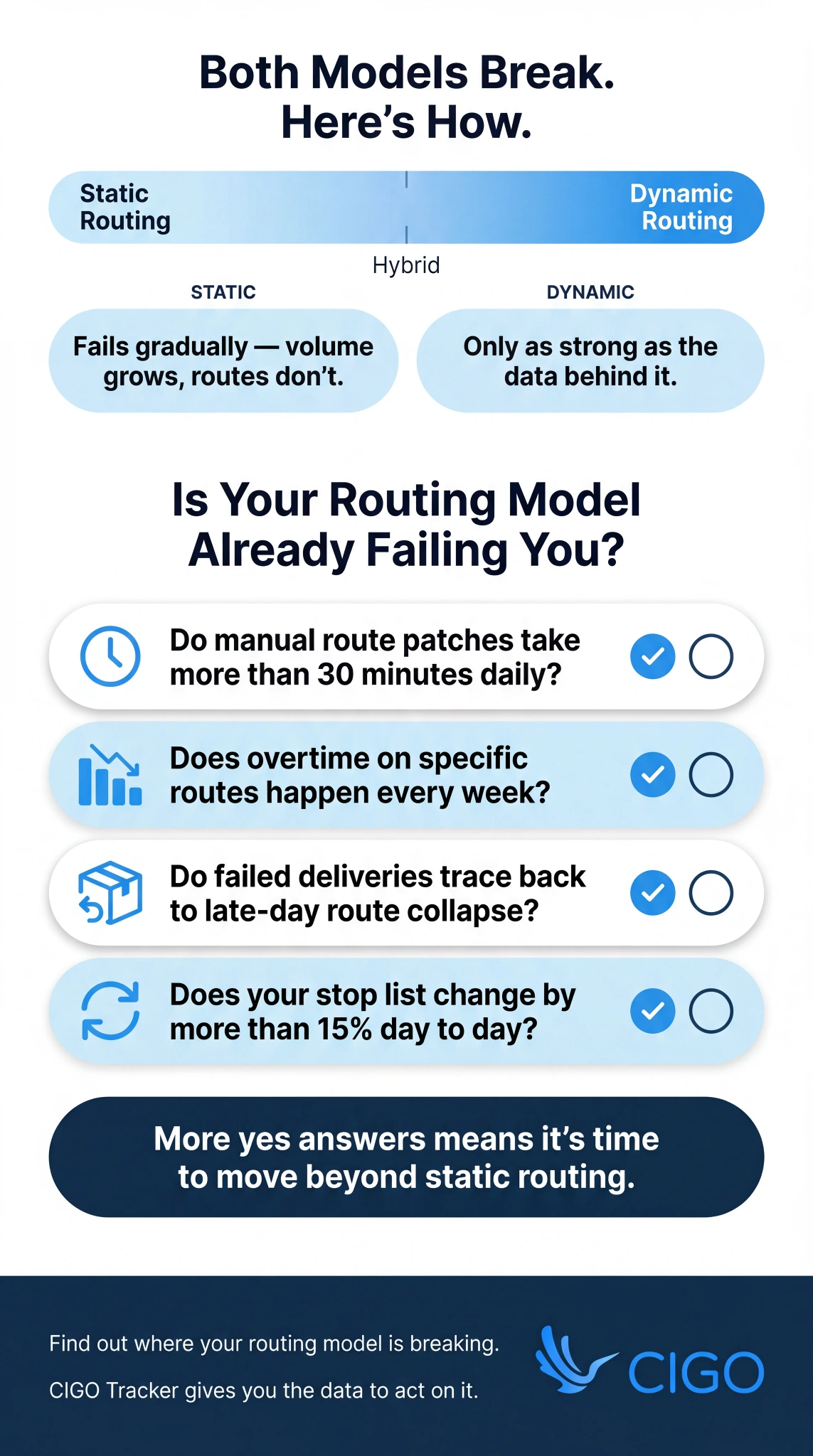
- Most high-performing fleets use a hybrid: static frameworks for predictable routes, dynamic optimisation for variable or on-demand work.
- The question isn’t which model to use permanently. It’s which model fits your current demand profile and where your transition triggers are.
What Is Static Routing?
Static routing means your drivers follow pre-planned, fixed routes that don’t change based on daily demand, live traffic, or last-minute order additions. The stop sequence is set. The schedule is set. On any given day, administration is minimal because the plan already exists.
Routes are typically built once, whether weekly, monthly, or at contract renewal, then adjusted manually only when the disruption is significant enough to justify replanning. Until that threshold is reached, the plan runs as-is.
That consistency is the strength. It is also the ceiling. When demand shifts faster than your replanning cycle, static routing stops being efficient and starts being expensive.
How Static Routing Works in Practice
A planner builds routes in advance using expected stop lists and historical demand patterns. Drivers receive the same route each day, or a close version of it. That consistency keeps daily administration low.
When a stop is added, removed, or rescheduled, your planner manually rebuilds or patches the affected route. No automated reoptimization runs. The route stays as-built until someone intervenes, and that intervention takes time your team could spend on higher-value work.
Where Static Routing Still Makes Sense
- Highly predictable, recurring delivery patterns where the same stops, days, and time windows repeat consistently and variation is the exception.
- Small fleets where manual adjustments are fast and the overhead of dynamic software isn’t justified by the scale of operation.
- B2B delivery with contractual fixed schedules where customers expect consistent arrival windows, regardless of what optimisation could otherwise offer.
What Is Dynamic Routing?
Where static routing holds a fixed plan until someone rebuilds it, dynamic routing takes the opposite approach.
Routes are built fresh each day, or multiple times per day, based on the actual demand picture at that moment.
Live traffic, order additions, cancellations, driver availability, and vehicle status all feed into continuous reoptimization throughout execution. A priority order gets inserted. A broken-down vehicle’s stops get redistributed. No manual rebuilding required.
Peer-reviewed research in Nature Scientific Reports confirms that dynamic routing heuristics with traffic flow analysis deliver measurable delivery time and cost reductions, and those gains compound as your fleet grows.
How Dynamic Routing Works in Practice
Orders arrive and the system immediately builds optimal routes based on your current driver availability, vehicle assignments, and live traffic. As conditions shift throughout the day, new orders or driver call-outs trigger automatic reoptimization, pushing updates directly to drivers.
Your dispatcher shifts from building routes to managing exceptions. That’s where smart route sequencing prevents missed deliveries, keeping execution aligned with what’s actually happening on the ground rather than what was planned at dispatch.
Where Dynamic Routing Delivers the Biggest Gains
- High-frequency, variable demand environments like same-day delivery, e-commerce fulfilment, and on-demand service where stop lists shift daily and last-minute additions are the norm.
- Large multi-vehicle fleets where manual replanning is no longer practical and the optimisation gains from resequencing consistently justify the software investment.
- Fleets where customer time-window expectations are tight and ETA accuracy has become a direct competitive differentiator.
Head-to-Head Comparison: Static vs. Dynamic Routing
| Static Routing | Dynamic Routing | |
| Planning effort | High upfront design, ongoing manual patches | High initial setup, low daily overhead once running |
| Response to distribution | Manual intervention required every time | Automatic reoptimization without dispatcher involvement |
| ETA accuracy | Based on historical assumptions that degrade over time | Updates in real time from live traffic and actual progress |
| Cost per stop | Efficient for predictable, stable demand | More efficient when demand is variable and stop consolidation shifts daily |
| Driver experience | Familiar and consistent | Requires daily adaptation, a real change management challenge |
The cost column is where the decision becomes financial.
A Boston Consulting Group analysis of parcel logistics costs found that last-mile delivery accounts for 50-60% of total shipping costs, with more than one in seven carriers reporting delivery costs above $5 per parcel.
Dynamic routing chips away at that number by consolidating stops more intelligently as demand shifts.
How Static Routing Fails Fleets
Static routes are optimised for the demand pattern that existed when they were built. As demand evolves, the routes drift out of alignment, and the misalignment compounds silently until it surfaces as a visible cost problem.
The Volume Tipping Point
Static routes fail when daily order volume exceeds what the route was originally built for. Stops get added without reoptimization, creating overloaded routes that can’t be completed within shift hours.
When more than 15-20% of your daily routes need manual patches, the planning overhead alone signals it’s time to transition. That’s typically where the signs you’ve outgrown manual route planning first appear.
The Demand Variability Problem
When your delivery patterns become less predictable, whether from shorter booking windows, new customer types, or promotional spikes, static routes stop reflecting actual daily demand.
Drivers end up with too many stops or too few, with no mechanism to rebalance without manual intervention. Understanding route density and its impact on profitability makes that imbalance easier to catch before it compounds into structural cost.
The Cost Accumulation Trap
Static routing failures accumulate gradually. A few overtime hours here, some missed windows there, unnecessary empty miles from routes that no longer reflect demand density.
Because each failure is small, the total rarely gets attributed to the routing model.
Instead, it gets absorbed as “just how things are” until a cost-per-stop analysis reveals what’s actually been hiding in plain sight.
How Dynamic Routing Can Fail Too
Dynamic routing is not a universal fix. It introduces its own failure modes that need active management, especially during the transition from static.
Data Quality Dependencies
Dynamic routing is only as good as the data feeding it. Inaccurate dwell time assumptions, stale driver availability, or incorrect vehicle capacity inputs produce routes that look optimised but fail in execution.
The most common failure point is dwell time. When stop durations are underestimated, the system schedules more stops than your driver can realistically complete, and the route collapses in the back half of the day.
Research on last-mile delivery optimisation strategies consistently shows that data accuracy is the variable that separates real efficiency gains from optimised-looking failures.
The Change Management Challenge
The biggest change management challenge is not the software. It is your team.
Drivers familiar with fixed routes lose a genuine operational advantage during transition, and that resistance shows up in execution before it shows up in your data.
Dispatchers moving from manual route building to exception management need a clear workflow.
Without it, they revert to manual patches that quietly undermine the system’s optimisation logic. Implementing real-time tracking alongside routing changes gives your team visibility they can trust, which is what makes the transition stick.
Which One Fails Your Fleet? A Decision Framework
- If your stop list changes by more than 15% day-to-day, static routing is already failing you. That variability accumulates as overtime, missed windows, and manual planning overhead that compounds quietly.
- If your customer time-window requirements are tightening, static routing cannot adapt quickly enough to meet narrowing windows across a variable stop list.
- If your data quality is poor, inaccurate stop times, stale driver availability, or no dwell time tracking, dynamic routing will fail you until the data layer is cleaned up first.
- If your drivers cover the same stops on the same days, volume is stable, and customers have flexible windows, static routing is probably not failing you yet and the switch cost may not be justified.
The Right Time to Switch From Static to Dynamic
Three signals tell you the switch is overdue.
First, when manual route patches consume more than 30 minutes of planning time daily, your static routes no longer match current demand variability. Second, when overtime on specific routes becomes a weekly pattern without a clear demand justification, the route is simply built for lower volume than you’re asking it to carry.
Third, when rising reattempt rates trace back to late-day route collapse, your scheduling model is the bottleneck, not your drivers.
The Hybrid Approach: Getting the Best of Both
Most high-performing fleets don’t choose one model. They use static frameworks for predictable recurring routes and dynamic optimisation for variable or on-demand work.
The hybrid approach reduces your change management challenge directly. Drivers keep familiar routes for the predictable portion, while dynamic assignments handle the variable portion where flexibility is genuinely needed.
Over time, as your data quality improves and your team adapts, the proportion of dynamically optimised routes grows naturally with the operation.
Key Features to Look For in Dynamic Routing Software
- Real-time reoptimization: rebuilds affected routes as conditions change, without manual dispatcher intervention.
- Live traffic and ETA integration: route sequences update based on actual road conditions, not assumptions built hours before departure.
- Priority order insertion: add a high-priority stop to an in-progress route without rebuilding the entire plan.
- Driver app with live updates: your drivers receive changes in real time rather than relying on a plan that was accurate at 6 am and outdated by 9.
- Exception management and reassignment: when a driver goes unavailable or a vehicle breaks down, affected stops are automatically redistributed.
- Dwell time learning: stop-time estimates improve over time using actual execution data, so your planning assumptions get sharper with every cycle.
Those features compound. A U.S. e-commerce case study on dynamic route optimisation found that integrating machine learning with dynamic routing reduced delivery times by 20% and fuel costs by 15%, driven by exactly the real-time learning capabilities listed above.
What Data You Need for Dynamic Routing to Work
- Accurate dwell time by stop type and zone: the most critical input you can provide. Optimistic assumptions produce overloaded routes regardless of how good your algorithm is.
- Live driver availability and shift data: updated in real time as your schedules change, not batched at the start of the day when conditions are already shifting.
- Vehicle inventory by type and capability: equipment constraints like liftgate, reefer, and payload limits must be enforced at the assignment level before your routes are built.
- Customer time windows and access notes: constraints your system must respect in every sequence it produces, not exceptions your dispatcher patches after the fact.
Keeping the Model Accurate Over Time
Review and update your dwell time assumptions quarterly using actual execution data.
This input drifts most as your customer or stop type mix changes, and stale assumptions are what cause routes to collapse late in the day.
Track override frequency closely. When your planners regularly override system recommendations, that signals a wrong input, not a broken system. That distinction points you directly toward the fix.
Best-Fit Use Cases
Same-Day and High-Frequency Delivery Operations
When your stop lists change daily and last-minute additions are standard, dynamic routing is the only viable model. Static planning overhead stacks up fast in this environment. Dynamic routing reduces your dispatcher’s role to exception management, which is where their time actually belongs.
Predictable Recurring B2B Routes
Static routing performs well when your operation checks all three boxes:
- Same customers, same volumes, and same windows running consistently day to day
- Manual adjustments are infrequent enough that the overhead stays manageable
- The cost of dynamic software isn’t justified by the scale or variability of your work
When your B2B routes start requiring frequent manual patches, your static model is approaching its failure threshold.
Mixed Fleets With Both Scheduled and On-Demand Work
The hybrid model fits this scenario directly. Static sequences handle your scheduled portion while dynamic reoptimization covers on-demand work.
The shared driver and vehicle availability data running across both is what connects your fleet route management strategy to daily execution without creating two separate planning problems.
Implementation Best Practices
Before switching, clean up your data first. Dwell time assumptions, driver availability accuracy, and vehicle inventory are the three inputs most likely to undermine dynamic routing in the first 90 days.
Next, pilot on your most variable routes, where static is most visibly failing, before extending to the full fleet. That gives you a controlled environment to validate the model.
Finally, invest in driver onboarding. Turning the system on without context creates resistance that has nothing to do with the technology.
Common Mistakes to Avoid
- Assuming dynamic routing is plug-and-play. Without clean input data and a change management plan, it produces well-optimised versions of the same problems you already have.
- Keeping the static mindset in place. Planners who continue thinking in fixed-route terms will patch your dynamic system’s outputs rather than letting it optimise. That behaviour quietly undermines the entire model.
- Measuring success only on on-time delivery. The real ROI shows up in cost-per-stop reduction, overtime elimination, and planning time savings. Track all three from day one.
KPIs to Track After Switching to Dynamic Routing
- On-time delivery rate: should improve as your routes adapt to real conditions rather than assumed ones.
- Cost-per-stop: the primary profitability metric. Dynamic routing’s value shows up here first.
- Planning time per day: should decline as route building is automated and your dispatcher shifts to exception management.
- Overtime hours: a direct signal of route overloading. Should drop as reoptimization prevents late-day cascades.
- Reattempt rate: should reduce as dynamic routing redistributes load in real time before routes collapse.
- Override frequency: tracks how often your planners override the system, a direct proxy for data quality and model accuracy.
The DHL Logistics Trend Radar identifies AI-optimised route planning as a major driver of efficiency and sustainability, noting that machine learning models recognise routing patterns beyond human capability.
These KPIs are how you measure whether your operation is moving in that direction.
How CIGO Tracker Enhances Dynamic Routing
With CIGO Tracker, real-time execution data, including stop completion times, dwell actuals, and exception reasons, feeds directly back into your routing layer. That feedback loop is what keeps your planning assumptions accurate over time.
Features like optimized routing, delivery tracking, logistics optimization, and capacity management work together so your dispatcher manages exceptions, not fire drills.
Future Trends in Route Optimisation
Three trends are tightening the gap between plan and execution.
- Continuous intra-day reoptimization rebuilds your active routes every few minutes based on real-time progress, not just at day start.
- AI-driven dwell time prediction uses stop history, customer type, and driver experience to eliminate the single biggest source of routing inaccuracy.
- Autonomous exception management handles and resolves disruptions without dispatcher input, reserving human decision-making for genuinely novel situations.
The World Economic Forum’s report on intelligent transport found AI can reduce freight emissions by up to 10-15% through optimised routing and capacity utilisation. That’s the direction your fleet routing is heading.
Static vs. Dynamic Routing: Know Which One Is Failing You

Static routing fails gradually. Dynamic routing fails fast when the data layer isn’t ready. Either way, the cost shows up in overtime, reattempts, and planning overhead before anyone names the cause.
CIGO Tracker gives you the execution data to identify which failure mode is active in your fleet. Start a free trial or contact us today to see where your routing model is breaking down.
FAQs
What is the difference between static and dynamic routing?
The core difference in static routing vs dynamic routing comes down to when the plan is built. Static routing uses pre-fixed routes planned in advance.
Dynamic routing reoptimizes stop sequences using real-time data like traffic, order changes, and driver availability. Static suits predictable demand; dynamic routing handles variability better.
When should I switch from static routing to dynamic routing?
Switch when manual route patches consume over 30 minutes daily, overtime becomes weekly, or reattempts trace to route overloading. These signals mean static route planning no longer matches your demand variability.
What are the main failure modes of static routing?
Static routing fails through volume overload, demand variability mismatch, and gradual cost accumulation. Routes built for old patterns drift as demand evolves, creating overtime, missed windows, and hidden cost-per-stop inflation.
Can dynamic routing fail? What causes it?
Dynamic route optimization fails with poor data quality, especially optimistic dwell time assumptions. Skipping driver change management and dispatcher training also undermines results. Clean data and team preparation are essential for success.
What is a hybrid routing approach and when does it make sense?
A hybrid approach uses static frameworks for predictable recurring routes and dynamic routing for variable demand.
It works for mixed fleets with both scheduled B2B and on-demand work, reducing change management risk. The right fleet routing software supports both models from a single platform, so you’re not managing two separate planning systems.