Foresight AI
The mattress is rarely the reason a delivery review goes sideways.
What customers remember is the late arrival, the scuffed banister, and the old box spring left leaning in the garage. Those forty minutes at the door end up standing in for the entire brand, which is why white-glove delivery now defines the mattress retail experience more than the showroom ever did.
Retailers who win repeat buyers treat that window as the product itself. That is why we built CIGO Tracker around live visibility and last-mile delivery optimization, so the handoff feels as considered as the mattress inside.
Key Takeaways
- White glove delivery in mattress retail means in-home placement, assembly, packaging removal, and careful handling, covering the full scope of mattress delivery logistics beyond drop-off.
- Service quality at the door shapes reviews, repeat orders, and avoidable returns more than most pre-purchase touchpoints.
- The recurring failure points are missed windows, inefficient routing, thin real-time visibility, and tricky in-home access.
- Better route-planning software, flexible scheduling, and trained crews improve performance across final-mile delivery services.
- On-time rate, first-attempt success, and reattempt cost reveal whether your white-glove delivery service and supporting delivery management software actually move the needle.
What Is White-Glove Delivery in the Mattress Industry?
White glove delivery is the full-service alternative to curbside drop-off. Rather than leaving a heavy box on your driveway, the crew brings your mattress into the bedroom, assembles the frame if needed, removes the old set, and takes the packaging with them when they leave.
This matters more for mattresses than for most other products. You cannot test a mattress until it is unrolled and in place, which means the delivery is part of the experience you paid for, not a step that happens after it.
A white glove delivery service closes that gap by handling everything from the truck to the bedroom.
Demand is rising for the same reason. The U.S. market is projected to reach $21.45 billion by 2030, with a 5.66% CAGR, led by furniture and home goods. When you spend $800 to $3,000 after weeks of research, standard parcel handling does not meet the bar for bulky goods delivery solutions at this scale.
Why White-Glove Delivery Matters for Mattress Retailers
The stakes sit higher than most operators realize. A mattress is one of the priciest items a customer buys over five years, making delivery a brand-defining moment rather than a logistics line item.
- Reviews: A professional setup earns five stars, while a rough drop-off posts one-star feedback within hours.
- Repeat purchases: Satisfied customers come back for protectors, pillows, frames, and eventually a replacement.
- Returns: Proper unboxing and positioning reduce first-week buyer’s remorse.
That last outcome hits the P&L hardest. The NRF and Happy Returns 2024 report pegged U.S. retail returns at $890 billion, and mattresses rank among the costliest to reverse-handle due to weight, disposal laws, and resale restrictions.
You absorb the full cost of missed deliveries in pickup fees, haul-away, and restocking, so strong mattress delivery logistics pay off fast.
That math tightens at scale. The ISPA 2023 Mattress Industry Trends Report recorded 39.7 million units shipped across a $9.8 billion U.S. market, where delivery is the only differentiator you control.
Common Challenges in Bulky Item Delivery Service

Before you fix performance, you have to see where your day actually breaks down. In bulky goods delivery solutions for mattresses, four pain points account for most of the issues you face.
Delivery Delays and Missed Time Windows
Start here, because this pattern cascades into all the others. Your mattress appointments run on narrow 2-to-4-hour windows, so a single late-morning stop pushes every subsequent delivery past its promised slot.
The fallout hits twice. You absorb reattempts in driver hours and fuel, and you lose something harder to repair: customer trust. Peer-reviewed research in the Journal of Service Research shows that late deliveries lengthen the time before a customer buys from you again, with satisfaction the mechanism driving that gap.
Inefficient Route Planning
Delays aren’t your only cost sink. When you build routes manually, you optimize for what you can see. Traffic overlaps, zone density, and the gap between a one-bedroom and a four-story walk-up all get missed.
On a mattress route, those gaps compound fast:
- Longer drives between stops, burning fuel, and driver hours.
- Backtracking across zones, the route was poorly sequenced.
- Over time, as crews chase slots that were never realistic to begin with.
Without route-planning software, the plan looks tight on paper but falls apart by the third stop.
Lack of Real-Time Tracking
Even a well-planned route falls apart without visibility. Your customers paid for white-glove delivery and expect a text or tracking link as the truck gets close, because a 2-hour window feels like an 8-hour one once the morning slot drifts past noon.
Your dispatchers sit on the other side of the same gap. Without real-time visibility across your operation, they cannot see which driver is running ahead of schedule, which one is stuck on a walk-up, or which stop has gone silent since the last scan.
So when a customer calls at 1 p.m. to ask where the truck is, your team is guessing in real time, and the refund request usually follows that call within the hour.
Complex Delivery Requirements
Visibility tells you where the truck is, but the job waiting at the door is a separate challenge.
Mattress deliveries regularly involve stairs, narrow hallways, tight elevators, and bed frames that need assembly on the spot. These are not exceptions; they describe most stops in a day’s route.
Picture a crew pulling up to a third-floor walk-up with a Victorian staircase they were not briefed on. The stop runs 40 minutes longer than planned, and that overrun compounds fast. The driver starts rushing, the customer reads the rush as disrespect, and the next three stops absorb the delay.
By the end of the route, a 4 p.m. delivery lands at 7 p.m., and a five-star job quietly becomes a one-star review.
How to Improve White-Glove Delivery Performance

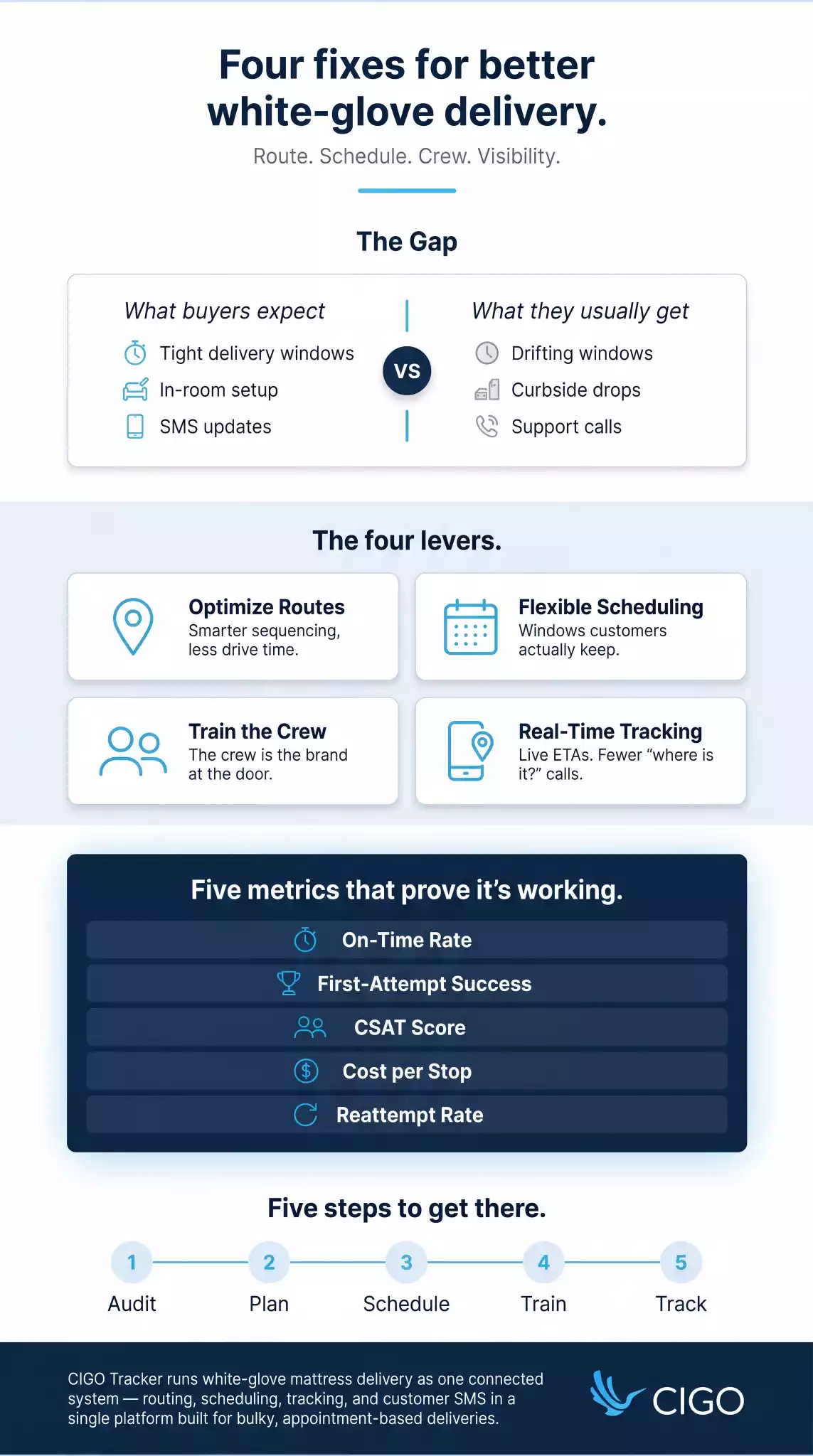
Lifting your white glove delivery performance is less about heroic effort and more about installing the right systems across four specific areas. Fix these four, and the route stops fighting you.
Optimize Delivery Routes
Tackle routing first, because it carries more leverage than any other fix you can make. Good route planning software sequences your stops by zone density, traffic, service times, and vehicle capacity, not in the order the tickets came in.
The payoff is measurable. Recent research published in IRE journals found that smart routing can cut travel time by up to 20% and fuel costs by nearly 15%. In mattress operations, where a single day burns hundreds of miles and dozens of driver hours, those percentages compound fast.
Three upgrades pay back quickly:
- Zone-based sequencing: Group stops by neighborhood to cut drive time between deliveries.
- Capacity-aware planning: Match truck size and liftgate availability to each stop’s actual needs.
- Time-window enforcement: Build routes that respect appointment slots instead of averaging them.
Offer Flexible Scheduling Options
Routing fixes supply. Scheduling fixes demand. When your customers pick their own window, they’re home when the crew arrives, and they rate the experience higher for it.
A self-serve scheduler gives them that control and protects your capacity, because the system only offers slots your fleet can actually run, so double-bookings from juggled spreadsheets disappear.
A scheduling workflow worth running gives you:
- Self-service booking with visible, truthful windows.
- Automated confirmations and reminders before the delivery date.
- Rescheduling through text or web, not phone-tree queues.
Train Delivery Teams for White-Glove Service
Your software can sequence the day, but the crew is the customer’s only point of contact with your brand. Uniformed, well-trained teams are why customers upgrade to white glove delivery service in the first place.
Three areas matter most:
- Product handling: carrying a king-size mattress without scuffing walls or corners.
- Assembly: frame assembly, foundation placement, and old-mattress removal done neatly.
- Customer interaction: a short script for walking customers through setup.
Pair that training with one of the best apps for delivery drivers, so your crews stay aligned with dispatch and capture proof of delivery on the spot.
Use Real-Time Tracking and Notifications
Tracking does two jobs at once. It reassures your customer and reduces the inbound calls your support team fields when ETAs drift.
A stronger stack includes branded tracking links, an SMS when the crew is 30 minutes out, and two-way messaging so customers can flag access issues before the truck arrives. That same data also feeds logistics optimization, which is where your efficiency gains compound month over month.
When tracking works, “Where is my delivery?” almost disappears from your support queue.
How to Measure Success in Delivery Operations
You cannot improve what you do not measure. The right KPIs tell you whether your white glove delivery investments are paying off.
Five metrics matter most for mattress delivery logistics:
- On-time rate: stops completed inside the promised window.
- First-attempt success: deliveries completed without a reattempt.
- CSAT and review scores: the customer’s perception of quality.
- Cost per stop: labor, fuel, and exception handling combined.
- Reattempt rate: routes that had to run twice.
Pair those with route-level metrics, such as miles per stop and dwell time. For a broader view, the top KPIs for last-mile delivery performance provide a comprehensive benchmarking layer, so you can see whether the software powering your mattress deliveries is meeting your brand’s promises.
Final-mile delivery services only earn the white-glove label when these numbers back it up.
How CIGO Tracker Helps Mattress Retailers
CIGO Tracker was built for bulky, appointment-based deliveries where the in-home experience must match the product’s price tag. Four capabilities carry the load for mattress retailers:
- Optimized routing: Plans are built around real constraints like zone density, vehicle type, service times per stop, and driver availability, so your white glove delivery service stays efficient at scale.
- Real-time tracking: Your dispatchers see live route progress, and your customers get branded tracking links and timely updates without picking up the phone.
- Automated dispatch and scheduling: Capacity-aware booking prevents overcommitment, and automated assignments remove the manual errors that creep in during a busy day.
- Customer communication: SMS notifications, reschedule workflows, and two-way messaging cut WISMO calls and keep the relationship intact when plans shift.
Put together, you get a delivery operation that runs cleanly rather than by firefighting, and a delivery management software platform purpose-built for mattress logistics rather than borrowed from a small-parcel world.
Ready to Upgrade Your White-Glove Delivery?

Improving bulky goods delivery solutions isn’t one decision. It’s a series of small, compounding upgrades across routing, scheduling, training, and visibility. White glove delivery is where loyalty is won or lost in the mattress category.
Customers who get a smooth delivery become repeat buyers. Those who rarely come back.
Ready to see what stronger mattress delivery logistics look like in your operation? Book a CIGO Tracker demo or start a free trial and run it on your own routes.
FAQs
What does white-glove delivery include for mattresses?
White-glove delivery includes in-home placement, bed frame assembly, removal of the old mattress, and complete packaging and haul-away. A white glove delivery service for mattresses also covers protective floor coverings, staircase navigation, and customer walkthroughs, so the setup is complete before the crew leaves.
How much does white-glove delivery increase customer satisfaction?
Professional white-glove delivery significantly lifts CSAT scores, repeat purchase rates, and positive reviews for mattress retailers. Because mattress buyers expect premium handling to match a premium product, strong last-mile delivery optimization often becomes the deciding factor in overall brand satisfaction.
Which route-planning software features help mattress retailers the most?
Look for constraint-based routing, real-time tracking, capacity-aware scheduling, and proof-of-delivery capture. Good route planning software also supports appointment windows, vehicle type rules, and live dispatch edits, which together address most operational headaches in mattress delivery logistics and bulky goods delivery solutions.
How can delivery management software reduce returns?
Delivery management software reduces returns by improving on-time performance, setting accurate expectations through live tracking, and ensuring mattresses arrive assembled and positioned correctly. Fewer damaged deliveries and missed windows translate into fewer post-delivery complaints and a lower return rate for final mile delivery services.
How long does it take to see results after implementing new delivery software?
Most mattress retailers see measurable improvements in on-time delivery and first-attempt success within 30 to 60 days. Cost-per-stop and reattempt reductions typically follow in the second or third month, once routing, scheduling, and crew workflows stabilize around the new delivery management software.