Foresight AI
One missed mattress delivery costs you more than a second truck roll. It costs the review your customer was about to post, the referral they were about to make, and the trust your brand spent months earning.
The math is brutal, and most mattress retailers underestimate it.
Part of the reason is that bulky delivery challenges compound differently than parcel delivery challenges do. Your customer cleared space, blocked their morning, and waited, so when the crew misses, rescheduling alone can’t reduce failed deliveries back to zero risk. The trust moment has already cracked.
CIGO Tracker keeps routing, dispatch, and customer communication aligned so the first stop is the one that lands.
Key Takeaways
- Failed deliveries hit mattress retailers three ways at once: direct cost, lost revenue, and damaged brand trust.
- The root causes are predictable: incorrect addresses, missed windows, access issues, and poor customer communication.
- Failed delivery solutions start with better tooling, including delivery route planning software, two-way messaging, and proactive exception handling.
- Last-mile delivery optimization is the umbrella discipline that ties routing, dispatch, driver execution, and post-delivery feedback into a coordinated system.
- Fleets that track the right metrics and act on them consistently improve delivery success rate in ways your customers actually notice.
Why Failed Deliveries Are a Big Problem for Mattress Retailers
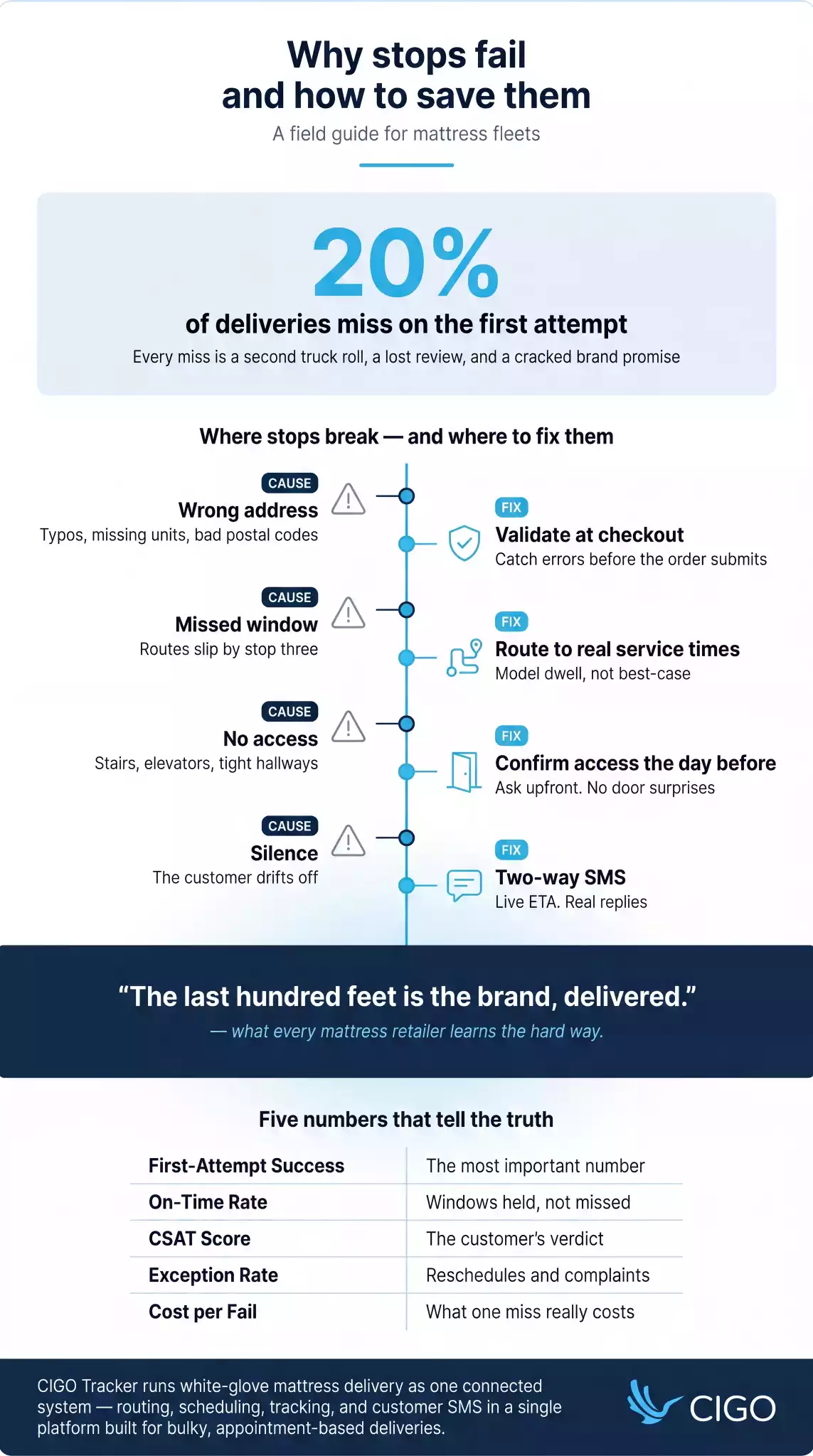
Failed deliveries carry a compounding cost structure most retailers underestimate, because the line item on your dispatch report is only the visible portion.
Harvard Business Review research reports that up to 20% of e-commerce packages fail on the first attempt, and every failure ripples into customer service, reverse logistics, and replacement inventory that your original P&L never captures.
The direct costs stack up fast:
- Redelivery fees: A crew that loads, drives, and returns an undelivered mattress still burns through a full cycle of time and diesel.
- Warehouse drag: Undelivered mattresses are returned to the floor, tying up dock space allocated to incoming products.
The indirect costs hit your brand harder. PwC’s 2025 Customer Experience Survey found 29% of consumers stop buying from a brand after a poor customer experience, and mattresses are a high-consideration purchase where one botched delivery steers the next shopper elsewhere.
A mattress miss costs more than a parcel miss because bulky freight adds crew time, truck cycles, and reverse logistics to every failure. Track the cost of missed deliveries on its own dashboard line so the number drives decisions.
Common Causes of Failed Mattress Deliveries
Now that you know what failed deliveries cost, here’s what’s causing them. Four root causes appear in almost every mattress fleet, and each has a specific fix.
Work through them in order, because the later causes often compound on the earlier ones.
Incorrect or Incomplete Addresses
Address errors are the cause to fix first, because a wrong address wastes every other decision downstream.
A missing apartment number, a wrong postal code, or a typo in the street name sends your two-person crew and box truck to the wrong side of town. Most mattress retailers inherit these errors from the checkout process, where your customer rushed through on their phone.
The fix sits in your order pipeline:
- Address validation at checkout catches typos, missing units, and unrecognized postal codes before the order submits.
- Pre-delivery confirmation asks your customer to verify the full address the day before the appointment.
- Clean data handoff syncs verified addresses from checkout into your routing system without manual re-entry.
Close this loop, and most address failures never make it onto your route.
Missed Delivery Windows
With the address fixed, time becomes your next failure point.
When you miss the promised window, your customer is often gone, or worse, already losing confidence in your brand. That’s why strong delivery route planning software has to hold the window by modeling realistic service times, traffic, and stop density, rather than a theoretical best-case.
Poor sequencing is usually the culprit. A route that looks clean in a spreadsheet falls apart by the third stop once dwell time, double-parking, and elevator delays start compounding.
So when one stop runs long, your engine has to automatically protect the rest of the day.
Accessibility Issues
Even a well-timed delivery fails when the mattress can’t physically get inside. Think about it: a king that won’t fit through an attic pull-down, a condo with elevator restrictions, or a neighborhood with no truck access all turn your scheduled stop into a reschedule request before the crew can even unload.
That’s why the fix has to start at checkout. Ask your customers the access questions upfront, then confirm them the day before the appointment. By the time dispatch runs, your crew already knows which stops need extra hands, which require a stair carry fee, and which can’t accept a king at all.
Lack of Real-Time Communication
You can nail the address, time, and access, and still lose the stop to silence. When your customer can’t see where the truck is, they leave to run an errand, stop answering unknown numbers, or assume the job has been canceled.
Then your driver can’t reach them, and the window closes.
The Sifted 2025 Consumer Survey found 76% of shoppers say delivery experience directly influences whether they buy again. That’s why real-time visibility turns this from a service gamble into an operational certainty.
How Technology Helps Prevent Delivery Failures

Four capabilities carry most of the weight:
- Route optimization built for mattress constraints: A routing engine that models service time, stop density, and vehicle capacity holds your delivery windows together.
- Live tracking for dispatchers: ETAs update in real time, so your team can redirect a crew, notify a customer, or sequence a recovery stop before the window expires.
- Proof of delivery with photos and signatures: Electronic POD documents disputes and captures the small details that protect your brand at review time.
- Customer notification workflows: Branded tracking links, SMS alerts, and two-way messaging replace silence with certainty.
Tying these tools together is the point of last-mile delivery optimization. Forrester’s 2024 CX Index found US CX scores at their lowest ever, with 39% of brands declining. Delivery is one of the few touchpoints you fully control, so winning retailers treat it as a brand experience.
Strategies to Reduce Failed Deliveries
Technology sets the floor. Strategy sets the ceiling. The mattress retailers who reduce failed deliveries at scale run the same set of plays, and you can build your version of it around four moves that compound on each other.
Invest in Route Optimization and Tracking Software
Manual routing loses the game before the first truck leaves your dock.
Strong delivery route planning software accounts for service time, vehicle capacity, and stop density, so your routes can actually execute on schedule. Then layering real-time tracking on top gives your dispatch team the visibility to react when something slips.
For shared fleets working across multiple accounts, the stakes climb. Routing built for 3PLs handling multi-account delivery keeps one client’s volume from breaking another’s windows, which is how manual planning usually fails at scale.
Offer Flexible Delivery Windows
Narrow, inflexible windows create more failures than they prevent. Give your customer a reasonable range, plus the ability to modify it when plans change, and they become a partner in the delivery, not a passive recipient.
Pair that with driver-level flexibility, like swapping two stops when a customer is suddenly unavailable, and your day stays on track even when the plan has to bend.
Flexibility is where failed delivery solutions compound. Every adjustment you make prevents the support calls, reschedules, and second truck rolls that would have followed.
Use Proof of Delivery and Signature Capture
Proof of delivery isn’t paperwork, it’s insurance.
A photo of the mattress in the right room, a customer signature, and a timestamped system entry protect your brand when a dispute surfaces days later. Electronic proof of delivery replaces paper manifests with structured data that feeds directly into the customer record.
That same data sharpens your operation over time. Patterns in exceptions, like certain neighborhoods, apartment types, or crews, become visible only when every stop is captured consistently.
Improve Communication with Customers
Customer communication is the most underinvested lever in mattress delivery, and the fix is cheaper than most retailers expect. Your baseline should cover three touchpoints that keep your customer in the loop from the day before through the moment the truck arrives:
- Day-before confirmation: Verify the address, the window, and any access notes before dispatch runs.
- 30-minute-out alert: Give your customer enough lead time to be ready at the door, not scrambling from across town.
- Two-way reply channel: Let your customer flag a change, like a gate code or a rescheduling request, without calling support.
The driver’s side of the loop matters just as much. Give your crew a mobile workflow that handles messaging, proof capture, and ETAs on one screen, so your driver, customer, and dispatch team all see the same updates in real time. That’s how silence disappears from your operation.
Train Drivers and Customer Support Teams
Technology covers the structural problems, but the moment of truth is still human.
A driver trained on setup expectations, damage inspection, and customer conversations creates a different experience than one who treats the job as drop-and-go. On the back end, your support team needs live route data to handle inbound calls with confidence, not guesswork.
That’s where fleet management software earns its keep.
When every role on your team, from driver to dispatcher to support agent, sees the same truth about the day, your response to any exception stays coordinated instead of improvised.
Common Mistakes to Avoid in Load Planning

Even with strong communication and routing, avoidable load errors still cost you stops. Three patterns show up in operations that otherwise look healthy:
- Loading without regard to route sequence: When the first stop of the day is buried behind the last stop’s inventory, your driver spends minutes rearranging at every door, and those minutes stack into missed windows by afternoon.
- Over-promising on truck capacity: Planning against a theoretical maximum instead of realistic cube and weight limits sends your crew out with loads that can’t be delivered without a second run.
- Skipping pre-load verification: Without a pre-dispatch check against the route manifest, your crew may leave the yard without a mattress scheduled for the route. That stop fails before the truck starts moving.
A fourth error sits beneath all three: treating the load plan as a warehouse task rather than a coordinated decision across routing, dispatch, and service. Fleets that avoid these mistakes tie fleet route management into the same workflow that plans the load, so your truck leaves with exactly what the route needs, in the order it needs it.
Measuring Delivery Performance
You can’t fix what you don’t measure. A small set of numbers separates fleets that consistently reduce failed deliveries from the ones that only talk about it:
- First-attempt success rate: The single most important metric. Track it weekly by route, crew, and product category.
- On-time delivery rate: The percentage of stops that land inside your promised window.
- Customer satisfaction scores: Post-delivery survey data tied to the specific stop, not the overall order.
- Exception rate: Share of deliveries that triggered a reschedule, complaint, or damage claim.
- Cost per failed delivery: An internal metric that combines support time, reshipment, and refund exposure into a single number.
A broader view of the top KPIs for last-mile delivery performance gives you the measurement layer to benchmark against peers. When your leadership sees these numbers together, the conversation shifts from bad-week anecdotes to structural decisions about routing, staffing, and technology.
How CIGO Tracker Helps Reduce Failed Deliveries
CIGO Tracker was built for the friction mattress retailers who hit every day. Four capabilities carry most of the lift:
- Smart routing: Stops sequence around realistic service times and capacity, and your dispatch team can re-sequence live when plans shift.
- Real-time tracking: Everyone sees the same truth, which collapses the silence that turns near-misses into failures.
- Two-way customer SMS: ETAs and replies keep your customer engaged, so the crew isn’t knocking on an empty door.
That’s how failed delivery solutions start compounding across your operation.
Ready to Win the Last Hundred Feet?

Every mattress delivery is a moment of truth for your brand.
A successful one reinforces what your marketing promised, and a failed one unwinds it. Retailers who consistently reduce failed deliveries know the last hundred feet isn’t a logistics problem hiding behind the brand; it is the brand, delivered.
Ready to protect your margins, reviews, and repeat purchases? Book a CIGO Tracker demo or start a free trial and run it on your own routes this week.
FAQs
What is the main cause of failed mattress deliveries?
Most failed mattress deliveries trace back to four preventable causes: incorrect addresses, missed windows, access issues at the door, and weak customer communication. These bulky delivery challenges compound quickly, but delivery route planning software and proactive messaging eliminate most failure patterns.
How can technology help reduce failed deliveries?
Technology helps reduce failed deliveries by tightening routing, adding real-time visibility, and closing communication gaps. A modern last-mile delivery optimization stack combines route planning, live tracking, electronic proof of delivery, and two-way messaging so fleets can solve issues before stops fail.
Why is customer communication so important in delivery?
Customer communication is the difference between an appointment the customer is ready for and one they’ve drifted away from. Confirmations, ETAs, and two-way replies keep customers informed about the stop, which is how retailers improve the delivery success rate for mattress installs.
What is proof of delivery, and why does it matter?
Proof of delivery is documentation that confirms a mattress was delivered to the customer in acceptable condition. Digital signatures, photos, and timestamps feed the customer record, protect retailers when disputes arise, and create the data trail that powers better failed-delivery solutions across future routes.
How does CIGO Tracker help improve delivery success rates?
CIGO Tracker ties routing, dispatch, driver workflows, live tracking, and customer communication into one platform. Retailers using it face fewer bulky delivery challenges because missed windows drop, exception handling sharpens, and discipline reduces failed deliveries across the peak season.