Foresight AI
A half-empty truck is the most expensive vehicle in your fleet. It burns the same fuel, pays the same driver, and carries the same insurance as a full one, but earns back only part of what it costs to run.
The gap between what your trucks can carry and what they actually carry has a name: weak load planning.
Mattresses make this harder than most freight. They’re light for their size, easy to compress the wrong way, and brutal on cube utilization when picked in order. Strong load planning sorts for volume, weight, and sequence at once, which is why CIGO Tracker treats routing and loading as one problem.
Key Takeaways
- Load planning is how you organize cargo so every truck you run goes out closer to full capacity without crossing weight or safety limits.
- Mattresses are voluminous, lightweight, and shift easily, so cube utilization and securement are the two biggest levers in your fleet.
- Overloading costs you in fines, roadside enforcement, vehicle wear, cargo damage, and higher crash risk.
- Pairing last-mile delivery planning with load sequencing cuts your reloads, empty miles, and total route time.
- Modern truck load planning software replaces your guesswork with visualization, automation, and constraint checking before the first mattress leaves the dock.
Why Load Planning is Important for Mattress Delivery Businesses
Load planning is where your cost and service quality meet. A well-planned truck runs fewer trips to move the same volume, which lowers your fuel, labor, and wear across the fleet. Poor planning quietly compounds costs that never show in a single day’s P&L, but land hard by quarter-end.
Three outcomes shift with disciplined load planning:
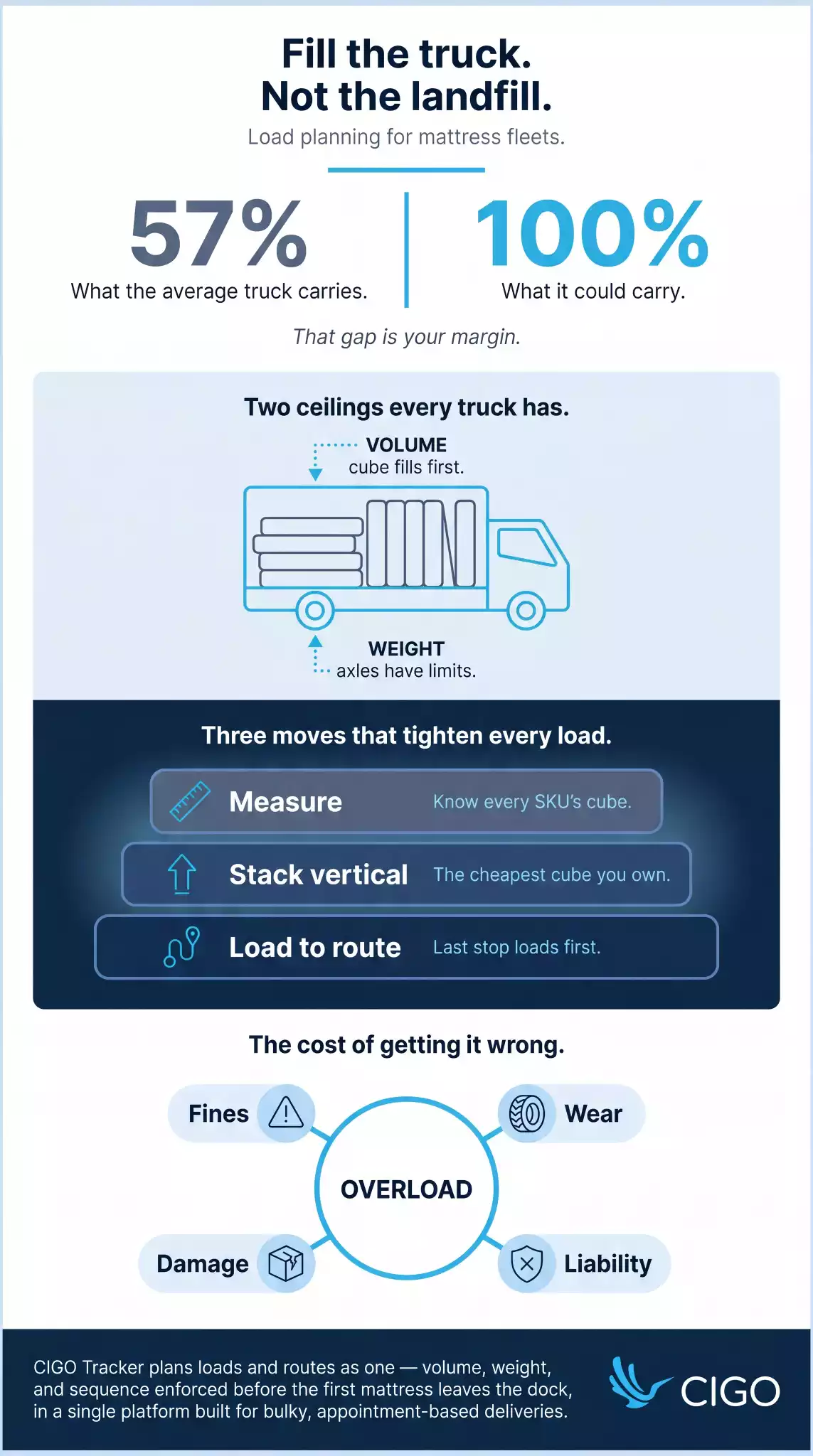
- Fuller trucks, fewer trips: The ACEEE Smart Freight brief finds that unloaded trucks average only 57% of capacity, leaving real room to grow.
- Lower cost per stop: The ATRI 2025 Operational Costs report puts the average cost of operating a truck at $2.26 per mile in 2024, so every avoided trip has a dollar value you can measure.
- Faster, more reliable deliveries: Pre-planned loads reduce driver time spent restacking at each stop, protecting the window you promised the customer.
When the load matches the route, your mattress delivery operation delivers the service level your brand promised.
Understanding Truck Capacity vs. Overloading
Truck capacity has two ceilings, and mattress operators trip over the distinction more than they admit.
| Capacity type | What it measures | Why test mattresses |
| Volume Capacity | The cubic feet the truck can physically hold. | King-size mattresses, box springs, and packaging fill a 26-foot box truck (~1,500 cu ft) long before weight becomes the issue. |
| Weight Capacity | Max payload your axles and GVWR can carry legally. | Mattresses are light per unit, but adding frames, adjustable bases, and reverse logistics returns quickly pushes the weight up. |
Breaching either ceiling is overloading, and the costs land quickly:
- Fines: The FMCSA 2024 civil penalty revisions raised penalties for recordkeeping, out-of-service, and overweight violations.
- Safety: Overloaded trucks stop more slowly, stressing tires and brakes and increasing rollover and incident risk.
- Wear: Chronic overloading accelerates suspension, axle, and drivetrain damage.
- Exposure: 3PLs running route optimization across accounts face audit risk when records show repeat overweight trips, and insurance claims can be contested.
Weight distribution matters as much as the totals. A truck at 90% GVWR loaded forward of the drive axle handles differently than the same weight balanced correctly, especially through turns.
Best Practices for Efficient Load Planning
You know your capacity ceilings. Now you have to use them well. That’s the real work of load planning, and three practices separate the fleets that run tight loads from those that leave money in the aisles every trip.
Measure and Categorize Mattress Sizes
Start with the numbers, not the truck.
Before a mattress moves, you need its dimensions, weight, and packaging type on record. Then group the day’s orders by size and type, so your crew can plan the stacking pattern against usable cube rather than solving it mattress by mattress on the dock.
Standard dimensions give you a predictable starting point:
- Twin: 38″ x 75″
- Full: 54″ x 75″
- Queen: 60″ x 80″
- King: 76″ x 80″
- California King: 72″ x 84″
With those numbers in hand, you can calculate usable cube per truck and catch overcapacity before it becomes a second-trip problem.
Use Vertical Space Wisely
Vertical space is the cheapest cube you own, yet most mattress loads leave it on the table.
Stand mattresses upright on their long edge, separate them with soft dividers, and you maximize floor utilization without compressing the coils inside.
Two practices protect quality as you climb:
- Securement between layers: Straps, e-track, or load bars keep stacks from collapsing inward under braking or cornering forces.
- Soft protection for trailer walls: Corner boards or furniture pads between mattresses and metal walls help prevent abrasion during transit.
The FMCSA cargo securement rules require your system to withstand 0.8 g forward, 0.5 g rearward, and 0.5 g lateral forces, with a total tiedown capacity of at least 50% of the cargo weight. Mattress loads rarely fail on weight, but they often fail on shifting.
Plan Delivery Stops Before Loading
Your load order should mirror your route. The last-in, first-out principle means the first delivery of the day gets loaded last, so the driver isn’t digging through the back of the truck on stop one.
Three moves make this work in practice:
- Print the route manifest and mark each stop’s truck position before loading begins.
- Group stops by zone, then loads the truck in the same zone pattern.
- Build capture steps into the workflow so electronic proof of delivery is collected in the order the stops were planned.
When your load order matches your delivery order, the driver spends less time rearranging at each stop, which shortens your route and cuts the risk of handling damage.
How Route Optimization Supports Load Planning

Routing and loading are the same conversation, not two separate ones. The sequence of your stops decides what gets loaded in what order, and the density of those stops decides how many trucks you need in the first place.
Delivery route optimization reshapes load planning in four specific ways:
- Zone-based clustering: Close stops load together, so your cargo area mirrors the driver’s day.
- Reduced backtracking: Drivers stop returning to the same area twice, eliminating mid-reload trips.
- Capacity-aware sequencing: Every truck gets a route that its cube and weight limits can actually execute.
- Real-time rerouting: When a stop cancels or traffic hits, the engine adjusts without breaking the load plan you already built.
Pair that logic with fleet route management built around load constraints, and your decisions stay coordinated instead of siloed.
Role of Technology in Modern Load Planning
Manual load planning costs more than you realize. A planner working from memory, a spreadsheet, and tribal knowledge makes the same three mistakes every week: over-promising on cube, under-estimating dwell time, and missing sequence conflicts that only surface once the truck hits the road.
Digital planning removes those errors at the source. A modern delivery dispatch software stack ties load planning, routing, driver assignment, and live tracking into one workflow, so each decision reinforces the next.
Here’s what it unlocks for you:
- Automated cube and weight checks that block overloaded trucks before they leave your dock.
- Visual load layouts that show stacking patterns on a diagram, not in a planner’s head.
- Real-time coordination between drivers and dispatchers, so mid-route changes adjust the next trip’s plan.
- Data capture that sharpens your capacity model with every route you run.
The more your fleet runs this loop, the fewer surprises hit the field. That’s the difference between fleet management software that tracks assets and one that shapes your decisions.
Using Truck Load Planning Software for Better Results
Truck load planning software converts a rough estimate into a precise, visualized plan. You see your truck as a 3D space, mattresses as blocks with measurable volume, and constraints as hard stops instead of vague reminders.
Four capabilities separate real software from a glorified checklist:
- 3D load visualization: Spot interference before pickers stage a load that won’t fit.
- Constraint validation: Weight limits, axle rules, and stacking requirements are enforced automatically.
- Sequence awareness: Plans align with your delivery route, so last-in, first-out is built in.
- Scenario comparison: Test alternate layouts in seconds, not on the dock floor.
Strong logistics optimization that ties routing and loading together turns the software strategic, not just tactical. Smart truckload planning software anchors a resilient last-mile strategy by ensuring every planning decision respects real capacity.
Common Mistakes to Avoid in Load Planning

Even experienced mattress operators repeat the same avoidable errors. Three patterns account for most of the preventable costs your fleet absorbs week after week.
- Overloading beyond safe limits: Pushing your truck past its weight or volume ratings invites fines, faster wear, and cargo damage. The trip you saved rarely outweighs the compliance and safety risk you just took on.
- Ignoring delivery sequence when loading: Loading randomly and hoping your driver sorts it out on the road costs you minutes at every stop. Those minutes stack into missed windows and overtime hours.
- Skipping available technology: Running modern fleets on paper manifests and spreadsheet math results in predictable waste. Fleets that invest in real logistics load optimization tools consistently outperform those that don’t, across cost per stop, on-time rate, and damage incidents.
A fourth mistake lies beneath all three: treating load planning as a warehouse function rather than a whole-operation discipline. Fleets that escape these patterns treat planning, routing, loading, and execution as one connected system.
How CIGO Tracker Helps Optimize Load Planning
CIGO Tracker was designed around the real challenges mattress fleets face every day. Four capabilities do the heavy lifting for your operation:
- Route-aware planning: Stops cluster by zone and sequence against real service times, so load patterns reflect your actual day.
- Real-time tracking: Dispatchers see live progress and adjust load plans for the next trip based on actual dwell times.
- Constraint-based capacity management: Capacity rules live at the assignment layer, so trucks never carry more than they can execute safely.
- Integrations that keep data flowing: Connections with the top systems to integrate with a delivery platform eliminate double entry and timing mismatches that introduce load-planning errors in the first place.
Every truck leaves your depot with a plan the crew can execute, and fleet management software keeps routing, loading, and execution pulling together.
Get More Out of Every Truck You Run

Load planning determines how much value each truck delivers on each trip.
Get it right, and the gains compound into fuller trucks, fewer empty miles, safer operations, and on-time deliveries that customers notice. Get it wrong, and the costs compound the same way, just hidden inside reloads, overtime, and damage claims.
That’s why stronger load planning pays for itself faster than most operators expect. Ready to see what it looks like across your mattress delivery operation? Book a CIGO Tracker demo, or start a free trial and run it on your own routes this week.
FAQs
What is load planning in mattress delivery?
Load planning is the process of organizing mattresses, frames, and accessories inside a truck so every trip runs near full capacity without crossing weight or safety limits. Good last-mile delivery planning aligns load order with route sequence, reducing reloads, protecting cargo, and speeding up the day.
How does truck load planning software reduce costs?
Truck load planning software reduces costs by increasing cube utilization, sequencing loads to match the route, and blocking overloads before trucks leave the dock. Fewer trips, shorter stop times, and less cargo damage translate directly into lower fuel, labor, and maintenance spending across your fleet.
What happens if a mattress delivery truck is overloaded?
Overloaded trucks face regulatory fines, higher accident risk, accelerated vehicle wear, and possible insurance complications.
Overloading also increases load shifting, which damages mattresses and raises complaint volume. Strong logistics load optimization prevents the problem by enforcing weight and volume constraints before loading begins.
How does delivery route optimization connect to load planning?
Delivery route optimization determines the order of stops, which dictates the order in which items are loaded. When routing and loading are coordinated, drivers spend less time rearranging cargo, trucks run fewer empty segments, and last-mile delivery planning translates directly into faster, more predictable service.
What should fleet management software include for mattress operations?
Fleet management software for mattress operations should cover route optimization, load visualization, constraint-based dispatch, real-time tracking, and electronic proof of delivery. Integration with order management and customer notification tools turns load planning from a standalone task into part of a unified operational workflow.