Your delivery promise now lives in a tiny progress bar on a customer’s phone.
When that bar stalls, they blame your brand, not your carriers or tech stack. Inside the operation, dispatchers juggle calls, spreadsheets, and half-synced portals just to answer a simple question: “Where is that order?”
Legacy tools cannot carry that load forever. You need fleet management software features that connect orders, routes, drivers, and customers into a single view. With CIGO Tracker, you add delivery tracking on top of your systems so the noise starts to settle and your team works from a shared truth.
Key Takeaways
- A modern delivery tracking system serves two audiences at once: customers who want clarity and operations teams who need control.
- Real-time data, exception alerts, and route optimization turn delivery tracking from a map view into a performance engine.
- You get the best results when fleet management software features link dispatch, routing, drivers, and customer communication into a single, connected workflow.
- Strong logistics management software features include open APIs, automation rules, reporting, and flexible notifications that keep every team working from the same story.
- CIGO Tracker delivers end-to-end tracking, branded communication, and analytics without forcing a rebuild of your existing tech stack.
1. Real-Time GPS Tracking
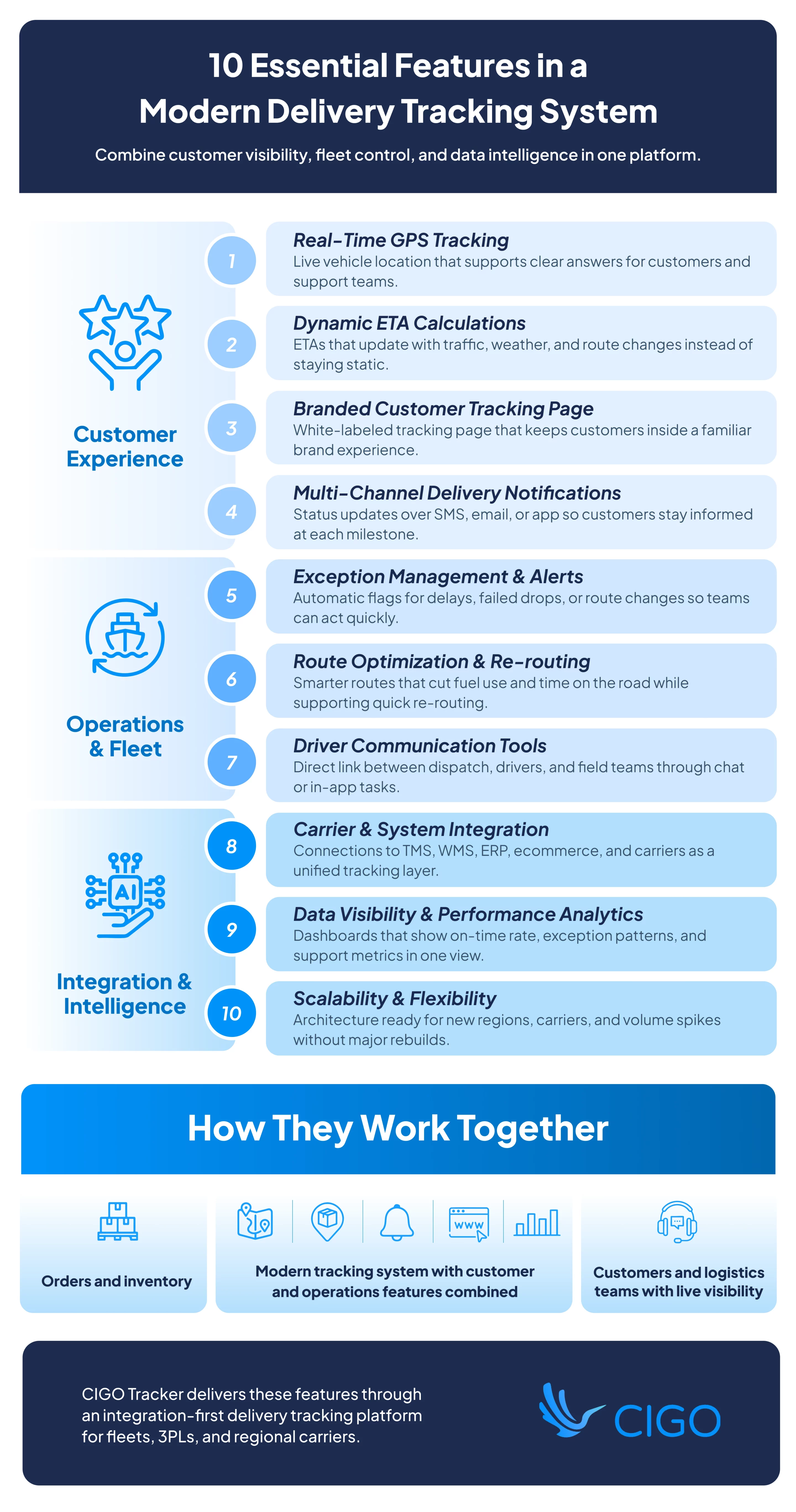
Real-time GPS tracking sits at the center of modern delivery. Without it, you steer fleets and customer promises with guesswork instead of evidence.
With a live map, dispatchers can see where vehicles are, which stops are complete, and where delays are beginning to form. Customer service teams stop chasing drivers and start answering questions with current location data.
A McKinsey survey reports that tools focused on real-time visibility and telematics attract investment because they unlock performance gains.
For customers, live tracking turns waiting into planning. When they can see a vehicle approaching, they are more likely to be ready, which lifts first-attempt success and cuts avoidable redeliveries.
In CIGO Tracker, GPS data overlays routes, stop status, and exceptions, so every team shares a single view.
2. Dynamic Estimated Time of Arrival (ETA)
Static delivery windows age quickly. Traffic, weather, delays, and access issues keep shifting the plan, so you need dynamic ETAs that move with reality.
A robust delivery tracking system recalculates ETAs using live traffic, route history, driver progress, and exception data, rather than a morning guess. Guidance from Penn State highlights order tracking as a core part of online customer care, which means accuracy and timing matter as much as speed.
When ETAs stay current across SMS, email, and branded tracking pages, customers plan their day instead of guessing, and your team handles fewer questions.
3. Exception Management & Alerts
Every delivery network sees missed doors, stalled vehicles, and customers who are not home.
Exception management turns that noise into a clear list of problems you can act on. You define what counts as “off plan” and let the system surface it instead of hunting through status screens.
Typical exceptions include:
- Late departures or long dwell times.
- Repeated failed attempts or undeliverable addresses.
Alerts should route by role so drivers see prompts and dispatchers see context. Customers receive timely updates when plans change.
4. Route Optimization & Re-routing Capabilities
Route planning used to live on whiteboards and spreadsheets, which struggle as volumes rise and time windows tighten. Modern engines take orders, locations, capacities, and driver hours as inputs and produce routes that minimize distance while honoring delivery commitments.
Reality shifts when vehicles leave the depot. Traffic, new additions, or access issues call for in-day re-routing instead of fixed manifests.
Fleet management software features let dispatchers reshuffle stops and move work between drivers without breaking ETAs or customer communication, especially when routing uses proven route optimization fundamentals.
5. Carrier & System Integration
Most logistics operations grow into an ecosystem, not a single platform. You might juggle a TMS, WMS, ERP, e-commerce stack, several carriers, and a driver app, each holding part of the story.
A delivery tracking layer ties that ecosystem together so orders flow in automatically and carrier events line up with your own status model.
University insight into legacy systems shows that missing APIs and protocols create data silos that quietly block visibility and coordination. When comparing logistics management software features, ask which connectors are available, how mature the APIs are across your TMS, WMS, ERP, and main carriers, and how those links are maintained.
CIGO Tracker uses an API-first model, so these connections stay manageable as your stack evolves.
6. Branded Customer Tracking Page
If customers spend the delivery journey inside carrier portals, they remember those brands, not yours. A branded tracking page brings that experience back under your roof and keeps messaging consistent, especially when you use white label delivery tracking to unify multiple carriers.
At a minimum, that page should:
- Show live status and ETA
- Reflect your colors and tone
- Surface clear support options nearby
- Offer reschedule and delivery tools
- Stay consistent across all carriers
That way, the delivery story feels like your brand, not the carriers.
7. Multi-Channel Delivery Notifications
Customers do not sit refreshing a tracking page. They expect delivery updates through channels they already use, such as SMS, email, or app alerts tied to status changes.
That is why CIGO Tracker supports event-driven messaging, so milestones like out-for-delivery, delays, and completed stops trigger clear notifications. Those events can feed your CRM and helpdesk, keeping teams aligned and reducing the number of WISMO contacts.
Focused customer engagement turns each notification into something useful for operations and for your brand.
8. Driver Communication Tools
Any delivery plan lives or dies in the hands of drivers. When communication slips, even strong routing and tracking tools lose impact.
You want driver tools that support:
- In-app chat for quick questions
- Status updates at each stop
- Photo or signature capture
- Task prompts for special handling
Inside a modern fleet management toolkit, these signals tie into routes, exceptions, and analytics. CIGO Tracker links driver updates to the live tracking view so you see how field activity shapes performance.
9. Data Visibility & Performance Analytics
Real-time visibility tells you what is happening on the road right now, while performance analytics explain why it happened and where to adjust. A serious delivery-tracking platform combines live dashboards with history, so you can see patterns rather than isolated bad days.
You want clear views of on-time delivery, route duration, cost per stop, and delivery-related tickets, sliced by region, carrier, and driver.
A FHWA guidance document treats reliability and travel-time variance as core freight measures, and that same discipline, paired with sharp delivery KPIs, helps you use analytics as a steering wheel, not just a scoreboard.
10. Scalability & Flexibility
Delivery demand never stands still.
As you stabilize one region and add new markets, services, and channels, a tracking platform that cannot stretch forces people to plug gaps with spreadsheets and side tools that erode performance.
A scalable delivery tracking system gives you one backbone for multiple business units, regions, and carrier mixes, so growth feels like configuration, not reinvention.
CIGO Tracker’s routing engine uses real-time data, traffic insights, and delivery priorities to keep routes efficient, while the same platform delivers live tracking, alerts, and analytics for last-mile operations.
Flexibility lives in configuration as much as scale. You should be able to tune exception rules, notifications, and branding as strategies evolve without breaking integrations. CIGO’s delivery tracking features and optimized routing layer support that adaptation so one environment can carry different workflows, service levels, and markets.
How These Features Tie Together: Unified Logistics Management
On their own, each feature fixes a local problem. Real-time GPS sharpens visibility, routing trims cost, notifications cool WISMO pressure, and analytics help you learn.
The real shift comes when these pieces stop operating in isolation and start sharing a single source of information.
In a unified model, you see one continuous chain rather than disconnected tools:
- Orders move in from your TMS, WMS, ERP, or ecommerce stack.
- Routes are built around capacity, time windows, and service levels.
- Drivers execute plans on mobile, feeding back GPS and status.
Exceptions trigger alerts and customer messaging, while analytics close the loop so you understand what worked and what did not.
At that point, fleet management software features and logistics management software features blend into a single delivery fabric that connects the warehouse, dispatch, drivers, customers, and leadership.
CIGO Tracker is built to serve as that shared operating layer rather than another point solution sitting on the side.
What to Ask When Comparing Delivery Tracking Solutions
Your RFP is only as strong as the questions you bring. You are not just comparing feature grids, you are deciding how delivery data moves through your stack and how your brand shows up after checkout.
Common integration questions give you a useful starting point, yet you also need to test how each platform behaves in your actual operation.
Check integration depth
Ask how the platform connects to TMS, WMS, ERP, ecommerce, and carriers, and whether APIs let you extend fleet management software features without custom fixes.
Guard your tracking brand
Probe whether customers stay inside a white-labeled tracking experience or bounce through carrier portals, and how far you can tailor copy, visuals, and CTAs.
Map rollout and exceptions
Clarify what rollout looks like for a fleet your size, which roles the vendor assigns, and how long it takes to stabilize. Ask how exceptions are detected, routed, and automated so issues reach the right people before customers feel the impact.
Why CIGO Tracker Offers All 10 — and Then Some
We designed CIGO Tracker as the operating layer that ties these features together. Our API-first architecture connects to your TMS, WMS, ERP, ecommerce, and carrier network, so data flows into live maps, predictive ETAs, and exception rules, rather than fragmenting across tools.
On that foundation, our optimized routing engine plans efficient routes that respect real-world constraints, while the Planner experience described in our delivery planner guide helps teams coordinate work in one place. Analytics, driver updates, and branded tracking share the same data model, which means leaders, dispatch, support, and customers see a consistent story.
Because of that design, we sit alongside your existing fleet management software features rather than replace them, so you can upgrade tracking, communication, and reporting at a pace your operation can handle.
What Should Your Delivery Tracking Do Now?
Modern delivery tracking is not about dots on a map or a basic code on a receipt. It is about confidence.
Customers want to trust that their order will arrive when promised. Operations teams want plans that match reality on the ground. Leadership wants every completed stop to support service commitments and margins, not fight them.
The right mix of fleet management software features turns that goal into a repeatable system. Real-time visibility, smart routing, proactive exceptions, branded experiences, and analytics all work together to shape a stronger last mile that customers actually feel.
CIGO Tracker is built to deliver that level of control without tearing apart existing systems. If you want to explore what this could look like for your network, contact us today, and our team can walk you through use cases, challenges, and a tailored path forward.
FAQs
How do fleet management software features relate to delivery tracking?
Fleet management software features cover the tools that help you plan, execute, and monitor vehicle operations. Delivery tracking focuses that capability on customer orders and last-mile performance.
When both live on a single platform, you get a single view of vehicles, routes, and customer promises. That alignment cuts manual work and gives you clearer insight into how routing decisions influence service levels, costs, and satisfaction scores.
Which logistics management software features matter most for customer experience?
From the customer’s perspective, three features stand out. Accurate, dynamic ETAs set clear expectations instead of vague all-day windows.
Real-time tracking shows progress on a map or status timeline so people can check in quickly without calling support. Proactive notifications let customers plan their day and avoid missed attempts or surprise delays.
When these pieces work together, delivery feels predictable and transparent, so customers are more likely to trust your brand and order again.
How can a delivery tracking system reduce “Where is my order?” contacts?
You reduce WISMO when customers no longer need to ask the question in the first place.
That starts with strong data flow from orders, routes, and drivers into a single, accurate view of each delivery. Dynamic ETAs, clear status labels, and live tracking give customers useful answers at a glance. Multi-channel notifications add timely nudges at key moments, such as when an item is out for delivery, delayed, or attempted delivery.
Over time, support teams see fewer low-value contacts and can focus their energy on complex cases that genuinely need human help.
What should I look for in analytics when choosing a delivery tracking platform?
Strong analytics let you move from gut feel to evidence. Look for a platform that tracks on-time performance, route efficiency, stop density, cost per stop, and delivery-related ticket volume alongside customer feedback.
You should be able to filter those metrics by region, carrier, driver, and service level so you can see where problems cluster. Reporting that combines real-time dashboards with historical views gives you both daily awareness and longer-term insight, which helps you refine service promises, staffing, and pricing with far more confidence.
Can I add modern tracking features without replacing my TMS or WMS?
In many cases, yes. A modern delivery tracking layer can sit on top of your existing systems, pulling in orders from tools like your TMS or WMS and pushing back events through APIs and integrations.
This approach lets you modernize tracking, routing, and communication while core planning and inventory tools stay in place. When evaluating vendors, ask how their platform connects to your specific systems, which data flows are supported, and what a typical fleet deployment looks like for fleets similar to yours. That way, you can modernize at a pace your team can handle.