Foresight AI
Delivering a refrigerator is nothing like delivering a parcel. The unit is heavy, expensive, and fragile, and your appointment window is tight. One slip on routing, load sequencing, or proof capture, and the day tips from a successful delivery into a reschedule, a damage claim, or a review that follows your brand for months.
Customer expectations keep rising. Your homeowners want live tracking, accurate ETAs, and one point of contact when things change.
The best courier delivery software for bulky items brings routing, planning, and visibility into a single workflow, which is exactly why we built CIGO Tracker around the realities of appliance delivery.
Key Takeaways
- The best courier delivery software for bulky items combines routing, dispatch, load planning, tracking, and proof of delivery into a single system designed for appliances, furniture, and oversized goods.
- Bulky appliance deliveries fail at three points: routing that ignores vehicle capacity, scheduling that ignores install time, and documentation that leaves damage claims unresolved.
- Delivery management software for large items solves all three failure modes at once by integrating dispatch, load planning, and proof capture into a single workflow.
- Last mile delivery software for appliances extends that capability to the final 100 feet with accurate ETAs, branded notifications, and structured proof of delivery.
- Strong route optimization software for delivery and bulky-item delivery, together with tracking software, protects your fuel, labor, margins, and customer trust.
What Is Courier Delivery Software for Bulky Items?
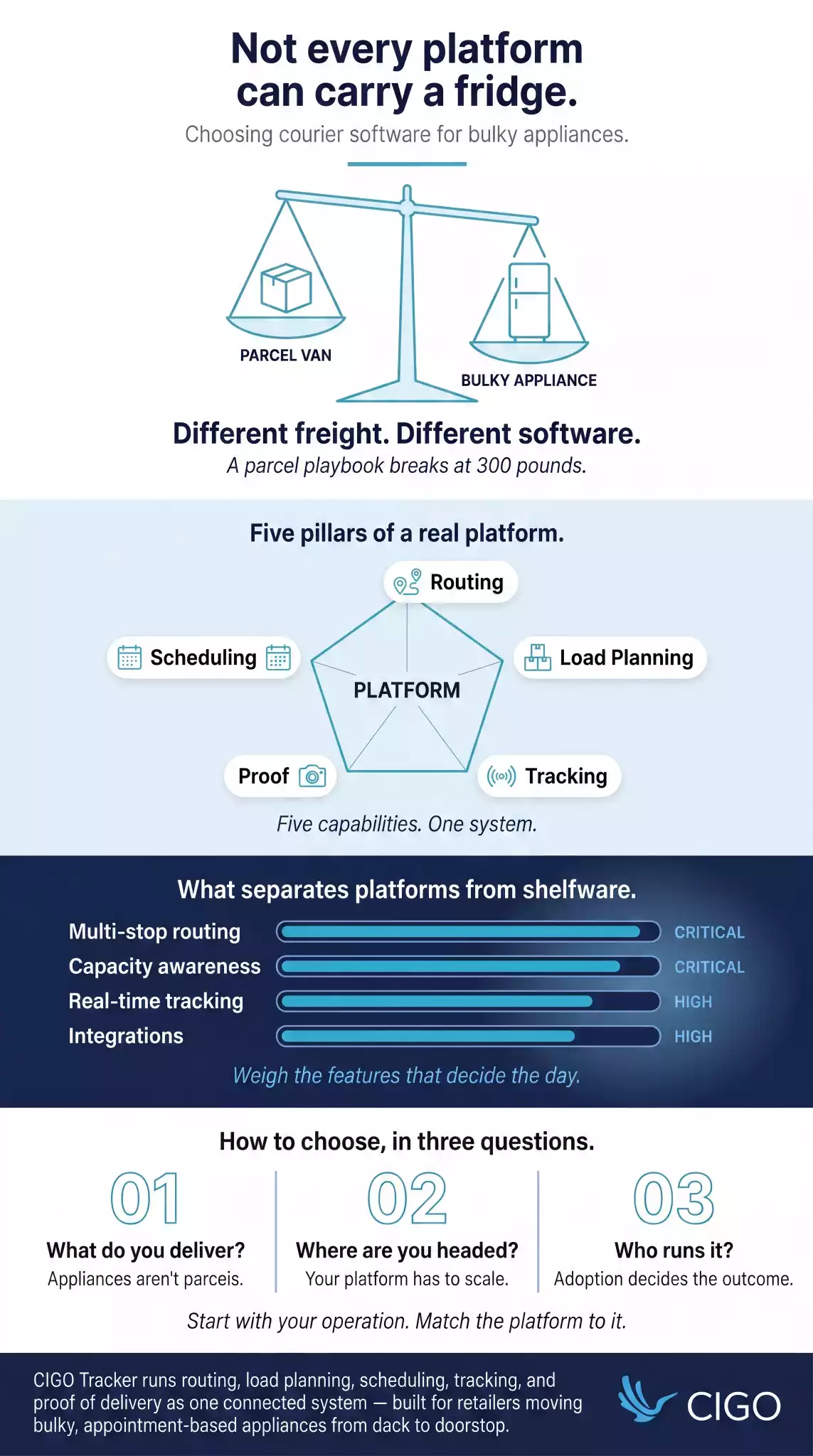
Courier delivery software for bulky items is a platform that plans, routes, dispatches, tracks, and documents the delivery of oversized, heavy, or high-value products. In simple terms, it’s the operational backbone for retailers whose freight doesn’t fit inside a parcel van.
Standard courier tools assume your driver can sprint up a porch, drop a box, and move on. That assumption breaks the moment your “parcel” is a 300-pound refrigerator needing a crew, an appointment window, and often an install.
Delivery management software for large items handles the extra layers that parcel systems skip:
- Vehicle capacity and space-aware load planning.
- Multi-stop routing built around realistic service times.
- Crew skill and equipment matching for installs.
- Structured proof of delivery with photos, signatures, and timestamps.
- Branded tracking designed for appointments, not drop-offs.
Your typical use cases share three traits: the product is large, the delivery is an appointment, and your brand is on the hook. That pattern shows up across appliances, furniture, mattresses, and HVAC units, where the right platform connects with furniture delivery workflows and applies the same discipline to appliance installs.
Benefits of Using Delivery Software for Appliance Businesses
The ROI on the right platform shows up in your first billing cycle, then compounds over time.
According to the U.S. Census Bureau retail trade data, e-commerce accounted for 16.1% of total retail sales in 2024, which means your appliance business cannot afford operational slack in its delivery layer.
The benefits of a strong last mile delivery software for appliances stack land in three places:
- Operational efficiency: Automated scheduling replaces manual calendars, dispatch assigns your crews based on skill and capacity, and drivers work from a clear plan that tightens routes and cuts dwell time.
- Cost reduction: A well-sequenced route burns less diesel, finishes earlier, and triggers fewer second truck rolls, reships, and damage claims.
- Customer experience: Accurate ETAs, branded notifications, and live tracking turn your appointment from a mystery into a professional experience your customers talk about afterward.
Compressing these three benefits at the same time is what makes the ROI math easy for your finance team to sign off on.
How Route Optimization Improves Bulky Item Deliveries
Route optimization is the single highest-leverage capability in bulky-goods delivery. Your stop sequence, vehicle matching, and time-window discipline all flow from a good routing engine.
Three gains land immediately: your travel time and fuel drop because the route stops zig-zagging across the metro, traffic delays get absorbed because the engine plans around them instead of reacting, and your delivery windows hold because the sequence respects the service time each install actually takes.
Strong route optimization software for delivery also models your truck, not just the map.
A route that looks clean on a parcel system can fail when the vehicle cannot handle the sequence. Retailers tracking their own numbers through delivery analytics and reporting see miles per stop drop, on-time rate rise, and cost per delivery fall over successive quarters.
Key Challenges in Delivering Bulky Appliances
Appliance delivery presents three structural challenges that every retailer in the category faces.
- Route planning: Your truck capacity, service time, and time windows must be respected simultaneously. Large appliances often fill space before they hit weight limits, so planning without a capacity-aware engine leaves your trucks over-committed or under-utilized.
- Damage and failed deliveries: A 300-pound refrigerator does not forgive mistakes. Retailers that run a full white-glove delivery workflow see claim rates drop because your crew, documentation, and customer communication work to one standard.
- Scheduling complexity: An appliance install is not a drop-off. It needs the right crew, tools, and service window. The U.S. Bureau of Labor Statistics projects 171,400 openings per year for delivery drivers, which means you cannot assume new hires will be available to paper over process gaps.
Must-Have Features in the Best Courier Delivery Software for Bulky Items
You already know where bulky-appliance delivery breaks down: route planning, damage, and scheduling.
The fix is a platform built to close all three. When evaluating the best courier delivery software for bulky items, five capabilities separate serious platforms from shelfware. Each one targets a specific failure mode that your appliance experiences in the field each week.
Advanced Route Optimization
Smart routing is the foundation your operation runs on.
Your system should handle traffic, service time, vehicle capacity, and time windows in one pass, then re-optimize mid-day when a stop cancels or a truck breaks down. True multi-stop routing weighs dependencies between stops, not just distances, so a 300-pound fridge on the second floor is sequenced before the 5 p.m. elevator reservation.
Retailers running dynamic route optimization see the gap between a routing tool and a true platform inside one week. The tool trims minutes. The platform saves you hours.
Real-Time Tracking and Visibility
That same routing system needs a live data layer to hold the plan together.
Your dispatcher sees where every truck is, how it is progressing, and where the day is slipping. Your customers see branded updates that match the promise the sale made.
The result is fewer missed deliveries because customers are ready when you arrive, and fewer inbound “where’s my truck?” calls because the information flows out automatically. Strong bulky item delivery tracking software turns live data into reliable service your team actually trusts.
Load Planning and Capacity Management
Visibility only helps when the truck was built right at the dock. Your platform should assign vehicles based on item size, weight, and fragility, then block overcommitments before the truck leaves the yard.
Inefficient trips cost you fuel and labor, and overloaded trips cost you safety and compliance. Strong load planning software prevents both outcomes by enforcing your constraints at the source, before a single stop gets sequenced.
Proof of Delivery (POD)
Once the truck unloads, your last operational question is how you close each delivery on record.
Digital signatures, photos, and timestamps give you the structured evidence that protects your margin from false damage claims.
When a dispute arises, your record speaks for itself. When the install is clean, that same photo becomes a quiet marketing asset inside the customer’s follow-up email. Strong proof of delivery software turns every completed stop into defensible evidence your team can pull up in seconds.
Scheduling and Dispatch Automation
Even a perfect route falls apart when the wrong crew shows up at the wrong time. A smart platform matches people to jobs based on availability, certification, and vehicle fit, preventing double-bookings before they turn into angry customers on Saturday morning.
The deeper win comes from unifying everything behind the scenes. When driver management software feeds directly into dispatch, you stop losing hours to scattered spreadsheets and mismatched shift calendars.
How Route Optimization Improves Bulky Item Deliveries
Route optimization continues to pay dividends after rollout. The real second-order gains show up once your fleet has been running on the platform for a quarter or two.
By then, three compounding shifts start to surface:
- Travel time keeps compressing: The system learns from your real dwell times and local traffic patterns, not a generic model.
- Fuel drops further: Consistent routing lets your drivers anticipate the day rather than react to it.
- Delays turn rare: The plan adapts to the exact geography your fleet serves, block by block.
The U.S. Department of Energy confirms the pattern: fleets using route optimization cut miles driven, signal stops, and time spent in traffic. Strong route optimization software for delivery turns that into an extra install or two per day without extending driver hours.
Why Proof of Delivery Is Critical for Bulky Items
Proof of delivery is the difference between a brand that absorbs damage claims and one that resolves them. For your high-value appliances, it is the operational backbone that protects your margin.
Four benefits reinforce each other:
- False damage claims drop: You hold dated, geo-tagged photos of the unit at install.
- Delivery confirmation stays unambiguous: This streamlines your billing and cuts support tickets.
- Real issues resolve faster: Your evidence lives in one structured record, not scattered across paper.
- Customer trust compounds: A clean photo inside the follow-up email turns every install into proof.
Strong electronic proof of delivery is what keeps your margin intact through peak season.
How to Choose the Best Courier Delivery Software for Bulky Items
You already know the features that matter. The harder question is matching them to your operation.
Start with your actual constraints, not a generic checklist. When evaluating the best courier delivery software for bulky items, the platform that fits your routes, your trucks, and your crew wins over the one with the longest feature list.
Understand Your Business Needs
Start with what you actually deliver.
Appliances, furniture, fitness equipment, and medical devices all share the challenges of bulky goods, but each differs in installation requirements, service windows, and regulatory constraints.
Match the platform to the categories you sell and the volume and service areas you actually serve. A platform built for dense urban parcel routes will buckle under rural appliance installations, and vice versa.
Look for Scalability
A good software decision protects your growth.
Your platform should handle today’s volume comfortably and three years of expected growth without a re-platform. That means room to expand across:
- Drivers and routes. More trucks, more stops per day.
- Markets and zones. New metros, new service areas, new distribution centers.
- Integrations. More systems feeding into your dispatch stack.
Delivery management software for large items that looks fine at 10 trucks can break at 50 if your vendor did not plan for scale. Ask for references at your expected future size.
Ease of Use
Adoption is the silent killer of enterprise software. If your dispatcher needs a week of training, your driver cannot run the app with gloves on, or your customer cannot read the tracking link on a phone, the platform will not earn its keep.
The best platforms feel faster than the paper process they replace, not slower. A simple dispatch dashboard and a clear driver app should be your baseline, not a stretch goal.
Integration Capabilities
A platform that does not connect to the rest of your stack creates silos.
Solid integration with your CRM, ERP, and e-commerce systems is how you:
- Avoid double entry. One source of truth across teams.
- Keep inventory accurate. Stock counts update in real time as deliveries close.
- See the full customer record next to your delivery plan.
Strong integration is also what makes your software a data asset, not just a point tool.
Why CIGO Tracker Is a Smart Choice for Bulky Appliance Deliveries
We built CIGO Tracker for retailers that move bulky, appointment-based goods. Every part of your operation runs from a single source of truth.
Three pillars do the heavy lifting:
- Advanced route optimization: Your trucks run plans that model capacity, service time, traffic, and time windows together.
- Real-time tracking and automated dispatch: Your drivers, dispatchers, and customers stay aligned as the day unfolds.
- Custom appliance workflows: COI requirements and install photos built in from day one.
This sits on top of our logistics optimization, fleet route management, and broader appliance delivery software stack, so your operation runs as one system, not a patchwork.
Ready to Turn Every Delivery Into a Competitive Edge?
Choosing the right platform is one of the highest-impact decisions your appliance operation makes. The best courier delivery software for bulky items protects your margin, your product, and the customer relationship your brand worked hard to build.
See what it looks like inside your own operation. Book a personalized CIGO Tracker demo, or start a free trial and run your next route through a platform built for bulky goods from day one.
FAQs
What is the best courier delivery software for bulky items?
The best courier delivery software for bulky items combines route optimization, load planning, real-time tracking, proof of delivery, and customer notifications into a single system designed for appliances, furniture, and oversized goods. It keeps your routes, crews, and installs coordinated from dock to doorstep.
How does delivery management software for large items differ from standard courier apps?
Delivery management software for large items models your vehicle capacity, crew skill, and install time, not a quick parcel drop. Standard courier apps treat every stop the same, while large-item software plans around your appointments, multi-person crews, and structured proof of delivery that protects you on every install.
Why do appliance retailers need last mile delivery software for appliances?
Last mile delivery software for appliances closes the gap between your warehouse and the customer’s home. It handles accurate ETAs, branded notifications, live tracking, and post-install documentation. For retailers selling high-value appliances, that final 100-feet visibility is what turns a logistics task into a brand experience.
How does route optimization software for delivery reduce bulky item costs?
Route optimization software for delivery cuts your miles driven, dwell time, and empty capacity across the fleet. For bulky items, it also respects space, weight, and crew constraints, so your trucks never take routes they cannot execute. On-time performance rises as cost per stop drops.
What should bulky item delivery tracking software include?
Strong bulky item delivery tracking software should give you real-time dispatcher visibility, branded customer tracking links, proactive notifications, and structured proof of delivery. For appliance retailers, it should also capture install-specific photos, signatures, and service notes, so your customer record stays complete from order to install.