Foresight AI
One mattress delivery contains more moving parts than ten parcel drops.
Your crew has a 45-minute window in your customer’s bedroom, an old mattress to wrap out, and a route where one slip-up puts three more behind.
Parcel playbooks can’t absorb that cascade. A van tossing 80 boxes can improvise, but a crew running six setups and six haul-aways can’t.
One mis-sequenced stop and the day tilts. That kind of coordination doesn’t come from a tracking app. It comes from delivery schedule software built for this exact job, which is why we built CIGO Tracker to sit inside your last mile delivery software stack and hold the day together.
Key Takeaways
- Mattress delivery is operationally heavier than parcel delivery the moment setup and haul-away enter the appointment, which is why generic last mile delivery software breaks down.
- Common scheduling failures like late arrivals, missed setups, and misrouted haul-away compounds into fuel waste, rework, and bad reviews.
- Delivery schedule software solves the coordination problem by tying orders, routes, crews, and customers into one live system.
- Must-have features include smart route optimization software, time-slot management, proof of delivery, customer notifications, and integration with inventory and CRM systems.
- Truck delivery scheduling software extends those gains across the fleet by matching loads, routes, and crews to the job in a single workflow.
Why Mattress Retailers Need Delivery Schedule Software
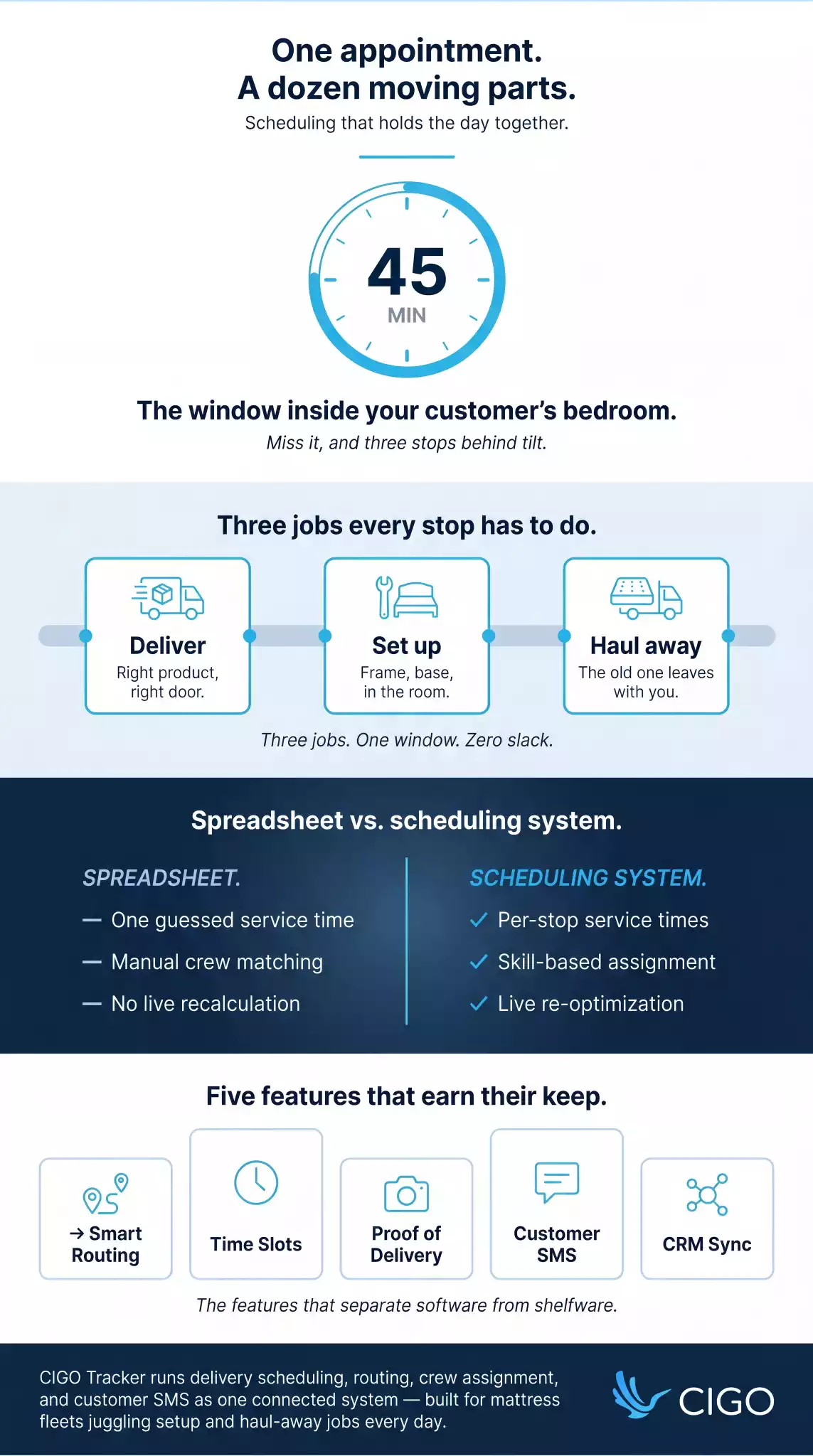
Mattress delivery runs on narrow margins for error. Your products are bulky, your crews are expensive, and your customers are waiting by the front window. Any slip compounds fast.
Three operational realities force the case:
- Bulky products with strict access requirements: A king that fits through a narrow stairwell is a planning problem, not a driver problem. Catch it before loading, and you avoid a three-hour reschedule.
- Tight time windows tied to customer schedules: Capgemini research found 73% of consumers rank convenient time slots above fast delivery. Mattress customers clear their morning, and they don’t forgive a missed window.
- Installation and haul-away coordination: Setup and removal need the right crew, tools, and sequence across mattress delivery operations running dozens of stops per day.
Strong delivery schedule software replaces tribal knowledge with structured plans. Your team sees the access constraints, service times, capacity, and route in one view, which is how a day full of setup-and-haul-away jobs actually holds together.
3 Key Challenges in Mattress Delivery Operations
Your fleet encounters the same failure modes as every mattress retailer, and most of them occur before the truck even leaves your yard. The patterns repeat across the category, which means you can name them, measure them, and plan around them.
Managing Setup and Installation Services
Setup is where your brand promise meets your customer’s living room, and it’s also where a small input gap costs you hours.
A strong install needs a trained two-person crew, the right tools for frames and adjustable bases, and enough service time for the product. Miss anyone, and the stop runs long, so the rest of your route pays for it.
Time estimation is where most fleets underperform. A spreadsheet that assumes “30 minutes per stop” ignores the reality that a king setup with an adjustable base can take 60 minutes, while a twin in a ground-floor apartment might take 15. Without per-stop service-time modeling, the plan looks clean and the day runs ragged.
That’s where delivery schedule software turns the guesswork into math, using crew skill, product type, and install scope to model every stop.
Handling Haul-Away and Disposal
Haul-away is one of the most underestimated costs in mattress retail.
Picking up an old mattress costs you plastic wrap, securement, truck space, and a disposal plan at day’s end, so mishandling any step can lead to cleanup, fines, or complaints.
The volume is bigger than most retailers realize. According to the Mattress Recycling Council, more than 1.56 million California mattresses were recycled in 2024, diverting 65 million pounds of material from landfills. If you operate in a state with mattress recycling laws, you carry reporting and routing obligations that other retailers don’t.
Separating delivery-only stops from setup-plus-haul-away stops is the job your delivery schedule software has to do, so your truck carries the right tools and your route respects the extra service time.
Route Inefficiencies and Delays
Poor routing is the most visible cause of failure, and the one your customers feel first. A route that zig-zags across a metro area burns fuel, eats driver hours, and ends with your phone ringing.
The math compounds fast. A mis-sequenced route adds miles, which raise your cost per stop, and it also compresses service windows, which pushes dwell times later into the day.
Modern route optimization software runs thousands of sequence permutations in the time your dispatcher takes to open a spreadsheet, and it weighs traffic, service time, time windows, and vehicle capacity on every pass.
For fleets running across multiple markets, logistics optimization tying routing and scheduling together, is how the day holds.
What is Delivery Schedule Software?

Delivery schedule software is the system that sits between your order book and your trucks. It takes your incoming orders, matches them to drivers and vehicles, sequences the stops, and runs your day with shared visibility for every stakeholder.
At its core, the software automates the decisions that used to live in your dispatcher’s head:
- Which driver and crew take which job?
- When should each stop be visited?
- How should stops sequence to minimize drive time and respect windows?
- Who gets notified and when, so your customer is present for the appointment?
The strongest platforms extend beyond routing into delivery management software territory, pushing live ETAs, capturing proof of delivery, and feeding tomorrow’s plan with today’s exception data.
How Delivery Schedule Software Works for Mattress Retailers
Order Assignment and Dispatch Automation
Your orders arrive from multiple channels: ecommerce, call center, showroom, and third-party retailers.
The software ingests each one, validates the address and service requirements, and assigns it to a crew with the right skills, tools, and geographic coverage. Instead of your dispatcher pattern-matching on memory, every assignment happens against rules your operation can audit.
That’s how you remove the common manual errors, like double-booking a crew, assigning a no-stair team to a fourth-floor walk-up, or sending a setup job to a route without install tools. A strong delivery dispatch software layer keeps those decisions consistent across shifts, which matters most when holiday volume surges.
Route Optimization for Large Deliveries
Mattress deliveries aren’t parcel deliveries, and your routing engine has to know that. The system models four constraints at the same time to produce a route that makes sense both geographically and operationally:
- Vehicle capacity: How much your truck can actually hold, not its spec-sheet maximum.
- Service time per stop: How long each install or haul-away really takes.
- Access constraints: Stairs, elevators, gate codes, and parking restrictions per address.
- Time windows: The promised arrival slots you can’t afford to miss.
Strong routing flattens three recurring problems: backtracking across zones, over-assignment to a single truck, and plans built on unrealistic dwell times. When you understand what route optimization actually involves, you build a measurable advantage in cost per stop, on-time rate, and customer satisfaction.
That advantage shows up fastest in fuel. Route optimization software saves it directly, because every mile avoided is fuel not burned and labor not paid, which lands on your P&L by quarter’s end.
Real-Time Tracking and Updates
Live tracking is where scheduling becomes a customer experience instead of an operational task.
Your dispatchers see every truck’s real-time position and updated ETA, your customers get branded tracking links with 30-minute-out alerts so they’re ready at the door, and your drivers get turn-by-turn directions that reflect the day’s optimized plan, not a generic consumer GPS route.
That’s how real-time visibility stops the “where is my mattress?” calls and turns every stop into a trust moment. Transparency cuts support volume, and it drives referrals too, because customers always talk about the delivery that actually went smoothly.
Must-Have Features in Delivery Schedule Software

Real-time tracking is one pillar, but it’s not the whole stack.
When you’re evaluating delivery schedule software for your mattress operation, these are the capabilities that separate useful tools from shelfware, and they’re the features that decide whether your investment actually runs your day or just sits in a tab.
Smart Route Optimization
AI-based routing weighs your traffic patterns, service time per stop, truck capacity, and time windows in a single pass, then recalculates the moment a condition breaks.
The strongest software optimizes twice: once before dispatch to build your cleanest daily plan, and again mid-route when a customer cancels, an install runs 20 minutes long, or a zone locks up in traffic.
Gartner research on last-mile delivery found 90% of supply chain leaders rank speed as a top-three priority and 85% rank reliability. Route optimization is how your fleet delivers both at mattress scale without relying on dispatcher instinct.
Time Slot Management
Your customer should pick the window, and your system should protect it.
Time slot management lets your shoppers choose their preferred delivery window at checkout, then locks the route around those commitments so your schedule doesn’t drift as the day runs.
When you offer flexible but realistic windows, you see materially fewer failed deliveries. The trick is letting your customers choose without overbooking your day, which only a structured scheduling system can enforce against live capacity.
Proof of Delivery (POD)
Proof of delivery captures signatures, photos, and timestamps at the moment of handoff. For your mattress operation, that’s high-value insurance, because three pieces of evidence protect your brand if a dispute surfaces later:
- A photo of the setup in the correct bedroom that proves the crew delivered to the right room, not just the right address.
- A customer signature on the completed install, confirming the work was finished to the customer’s satisfaction, not just started.
- A photo of the hauled-away mattress loaded into your truck, documenting that the old unit left the property in your possession, not the customer’s.
Electronic proof of delivery replaces your paper manifests with structured data that automatically flows back into your order and customer records. The operational benefit compounds, because patterns in exceptions (certain buildings, certain crews, certain products) only surface when every stop is captured the same way.
Customer Notifications
Automated SMS and email updates turn your delivery from a mystery into a scheduled appointment.
Your baseline cadence should include a confirmation the day before, an hour-out notice on the day, and a completion message after the stop. Two-way messaging goes further, because it lets your customers flag last-minute access issues before your crew arrives at a locked door.
So when you keep your customers informed, they call in less, rate the delivery higher, and are more likely to buy from you again.
Integration with Inventory and CRM
A scheduling tool that doesn’t talk to the rest of your stack creates duplicate work and silent errors. Integrations with your order management, warehouse systems, and CRM keep inventory counts, delivery status, and customer history in one consistent record.
So your sales team sees the delivery commitment, your warehouse sees the pick list, and dispatch sees live capacity.
That’s how strong integration turns delivery management software from a point tool into the backbone system your operation runs on.
How Truck Delivery Scheduling Software Enhances Fleet Management
Truck delivery scheduling software extends your scheduling layer to every large-vehicle demand your fleet faces: load capacity, weight distribution, driver hours, and vehicle-specific routing. For mattress retailers running box trucks, the gains are concrete:
- Load-aware assignment: Your system respects truck cube and weight limits, so you never discover on stop three that the king-size sets belonged on another vehicle.
- Sequencing that mirrors the load plan: Last-in, first-out loading means your driver doesn’t have to dig to the back of the truck at stop one.
- Driver productivity visibility: You see stops per hour, dwell time by stop type, and on-time rate per crew. Pair that with the top KPIs for last-mile performance, and your fleet has a real measurement layer.
- Fleet utilization: Empty miles drop, your trucks leave fuller, and the same fleet covers more jobs.
Last mile delivery software without truck-level constraints leaves your capacity stuck in a spreadsheet. Mature fleet route management turns scheduling into an ongoing advantage.
Why Cigo Tracker is the Ideal Delivery Schedule Software
CIGO Tracker is built for the last-mile workflows that bulky, appointment-driven products like mattresses demand, so scheduling, dispatch, routing, and customer communication run as one system on your team’s dashboard.
- Smart routing and live adjustments: Routes account for service time, capacity, and traffic, and your planner can resequence when conditions shift. That’s the difference between a plan and a living schedule.
- Real-time tracking for everyone in the loop: Your customers, drivers, and dispatchers see the same truth, which closes the communication gaps that cost you windows.
- Automation that cuts manual steps: Order assignment, notifications, proof of delivery, and exception handling run on rules you define once, not on tribal knowledge your team rebuilds every shift.
- Integrations with airtight platform security: Ecommerce, ERP, WMS, and CRM connections eliminate double entry.
For mattress retailers juggling setups and haul-aways, CIGO Tracker is the last mile delivery software built around your work.
Ready to Turn Your Delivery Chaos Into Predictable Growth?

Mattress retailers that run on strong delivery schedule software grow predictably, because setup and haul-away jobs need coordination, and generic shipping tools can’t deliver. The payoff compounds in tighter routes, fuller trucks, higher first-attempt success, and the kind of reviews that drive repeat purchases.
If you’re ready to see what stronger delivery scheduling looks like across your operation, book a personalized CIGO Tracker demo or start your free trial today.
FAQs
What is delivery schedule software for mattress retailers?
Delivery schedule software ingests your orders, assigns them to crews, optimizes routes, and runs your day with live visibility. For mattress retailers, it keeps setup, installation, and haul-away appointments coordinated across your fleet so your team hits every window without scrambling at dispatch.
How does truck delivery scheduling software improve fleet productivity?
Truck delivery scheduling software matches loads to routes, sequences stops against real service times, and tracks driver performance over time. Fewer empty miles, fewer reloads, and better on-time rates let your mattress fleet cover more jobs per truck without adding headcount.
What should I look for in delivery routing software for mattress deliveries?
Good delivery routing software handles capacity, time windows, access notes, and multi-stop sequencing in one engine. For mattresses, prioritize service-time modeling, setup and haul-away awareness, real-time re-optimization, and integration with customer notifications so your schedule holds under real conditions.
How does route optimization software reduce mattress delivery costs?
Route optimization software cuts miles, shortens dwell times, and prevents overassigned trucks. Fewer miles means lower fuel spend, shorter routes mean less overtime, and better sequencing means fewer failed stops, which together compress your cost per stop across a mattress fleet.
Why is last mile delivery software important for mattress retailers?
Last-mile delivery software unifies scheduling, routing, driver workflows, and customer communication into a single connected system. For mattress retailers, that unified layer is how setup and haul-away jobs stay on time, your crews stay productive, and your customers get a brand-reinforcing delivery experience.