Foresight AI
Every appliance store runs one version of the same bad day.
The morning schedule looks clean, but a gas range hookup runs 40 minutes, a moving van blocks your truck, and by 2:00, your phone is ringing with customers asking where the crew is.
By 4:00, three installs are pushed to next week, and overtime is already on the clock.
The right delivery schedule software for small business operations fixes the upstream planning gap before the truck leaves your yard, which is why stores using CIGO Tracker plan tight and install on time.
Key Takeaways
- Overbooked install days are a planning problem with a software fix, not a team problem.
- The root causes are predictable: manual assignment errors, weak routing, and missing customer updates.
- Delivery schedule software for small business operations brings automation, live tracking, and optimized routes into one workflow your small team can actually run.
- Smart route-optimization software and automated customer notifications eliminate the rework that turns a single late install into a lost afternoon.
- A connected delivery management system protects install quality, cost per stop, and customer satisfaction at the same time, making it the backbone of strong last mile delivery software.
Why Overbooked Install Days Are a Big Problem for Appliance Stores
Overbooking costs you more than the P&L shows. Every missed install compounds into three layers of expense your small shop can’t absorb.
- Bad reviews and lost trust: When your crew arrives at 3:00 for a 10:00 window, the review is written before the install is done. The J.D. Power 2025 U.S. Appliance Reliability & Service Study ranks ease of scheduling and timeliness among the top drivers of service satisfaction, so every missed slot directly erodes your reputation.
- Quality drops with crew load: A stressed crew skips hose clamps and level checks, which later show up as warranty calls and callbacks that eat margin. Tracking the true cost of missed deliveries exposes the quiet bill overbooking runs in the background.
- Driver shortage pressure: The ATA driver shortage report puts the industry 60,800 drivers short, so every hour you lose to bad routing is an hour you can’t backfill by hiring.
3 Common Reasons Appliance Stores Struggle with Delivery Scheduling
The costs above don’t appear because your team is careless. They show up because three root causes quietly break your schedule before the first truck rolls out. Name them, and you can fix them for good.
Manual Scheduling Mistakes
Manual scheduling is where most of your errors start. A dispatcher working from a whiteboard or a spreadsheet loses track of who’s already booked, which crew has install certifications, and which van has the dolly and straps for a top-load washer.
One double-booking is enough to blow your day.
The fault lies with the tool, not with your dispatcher. Without automation, there’s no single view of driver availability, crew skills, vehicle capacity, and service area. Give your field team one of the best apps for delivery drivers, and when your dispatch assigns the job, your driver sees it instantly, and status updates land without a phone call.
Delivery driver scheduling software removes those errors at the source by validating availability, skills, and capacity against each new assignment in real time.
Lack of Route Planning
Even a well-staffed day can collapse if your route is weak. A schedule that looks clean on paper often ignores traffic, real service times, and the physical reality of moving a 5-foot refrigerator up a three-story walk-up.
So inefficient routes show up as overlapping zones, long drives between stops, and installs that bleed into the next window. That’s where route optimization software earns its keep: it sequences your stops against real geography rather than the order tickets came in, saving you fuel, overtime, and the back-to-back U-turns that quietly burn both.
Poor Communication with Customers
Silence is your scheduling enemy. When your customer doesn’t know the crew is 30 minutes away, they step out, stop answering the phone, or assume the install was cancelled. So a tight window turns into a reschedule in minutes.
Two practices close the gap:
- Proactive notifications on the day of delivery, so your customer knows when to expect the crew.
- Two-way messaging, so your customer can flag access or scheduling issues before the truck arrives.
Both are standard in any modern delivery management system, yet they’re underused by small stores still running on legacy tools.
What Is Delivery Scheduling Software for Small Business?

Delivery scheduling software for small business is the system that plans your day and runs your day. It ingests your orders, assigns the right crew and vehicle, sequences the route, and keeps your customer, driver, and dispatcher in sync while the work happens.
So a good platform automates the high-volume decisions your small team waste hours on:
- Which driver takes which stop, based on availability, skills, and geography.
- What sequence the stops run in, based on service time, traffic, and time windows.
- Which customers need notifications, and when to send them.
- Which exceptions need your dispatcher, and which can be handled inside the driver app.
For your two-truck fleet, that automation matters more than it would for a national retailer. A Zoho Bookings survey found nearly half of small businesses spend over an hour finalizing a single appointment, because legacy tools drain the time lean teams can’t spare.
Key Features to Look for in Delivery Scheduling Software
You now know what delivery schedule software for small business operations does, so the next step is knowing what separates a working platform from a shelf-filler.
Not every vendor delivers the same value. When you evaluate your options, these are the capabilities that decide whether the software actually runs your operation or just adds another tab to your day.
Automated Scheduling
Automation assigns your jobs based on driver availability, crew skills, vehicle capacity, and geography, without your dispatcher having to touch the calendar. Your rules encode the store’s logic once, and the system applies them consistently across every new order.
The payoff is less manual work, fewer errors, and more consistent scheduling across shifts.
A dispatcher who used to spend three hours building your day can now do it in 20 minutes, then spend the rest of the shift handling the exceptions that need a human brain.
Route Optimization
Strong routing is the single highest-leverage feature in your scheduling software.
The system should weigh traffic, service time per stop, vehicle capacity, and your customer’s preferred window in a single pass, then re-optimize when conditions change throughout the day.
Understanding what route optimization actually involves separates retailers who buy a smart solution from those who buy shelfware. Good route optimization software doesn’t just shorten your route; it also smooths your day, protects the next stop’s window, and cuts the fuel spend that silently compounds over a quarter.
Real-Time Tracking
Live tracking gives your dispatcher a single view of every truck, its ETA, and in-progress installs. The same data powers your customer experience, because branded tracking links and automated ETAs keep your customer engaged right up to the appointment.
Real-time visibility turns your silent deliveries into transparent ones. For your customer, knowing the crew is 30 minutes out is the difference between being ready for the install and missing it
Entirely.
Customer Notifications
Automated SMS and email updates close your communication loop at every step: the day-before confirmation, the morning-of reminder, the 30-minute-out alert, and the completion message after the install.
Two-way messaging lets your customer confirm or reschedule without a phone call.
When you keep your customers informed, they call in less, show up more often ready, and rate the experience higher. The cumulative effect on your cost per install is not small.
How Delivery Driver Scheduling Software Prevents Overbooking
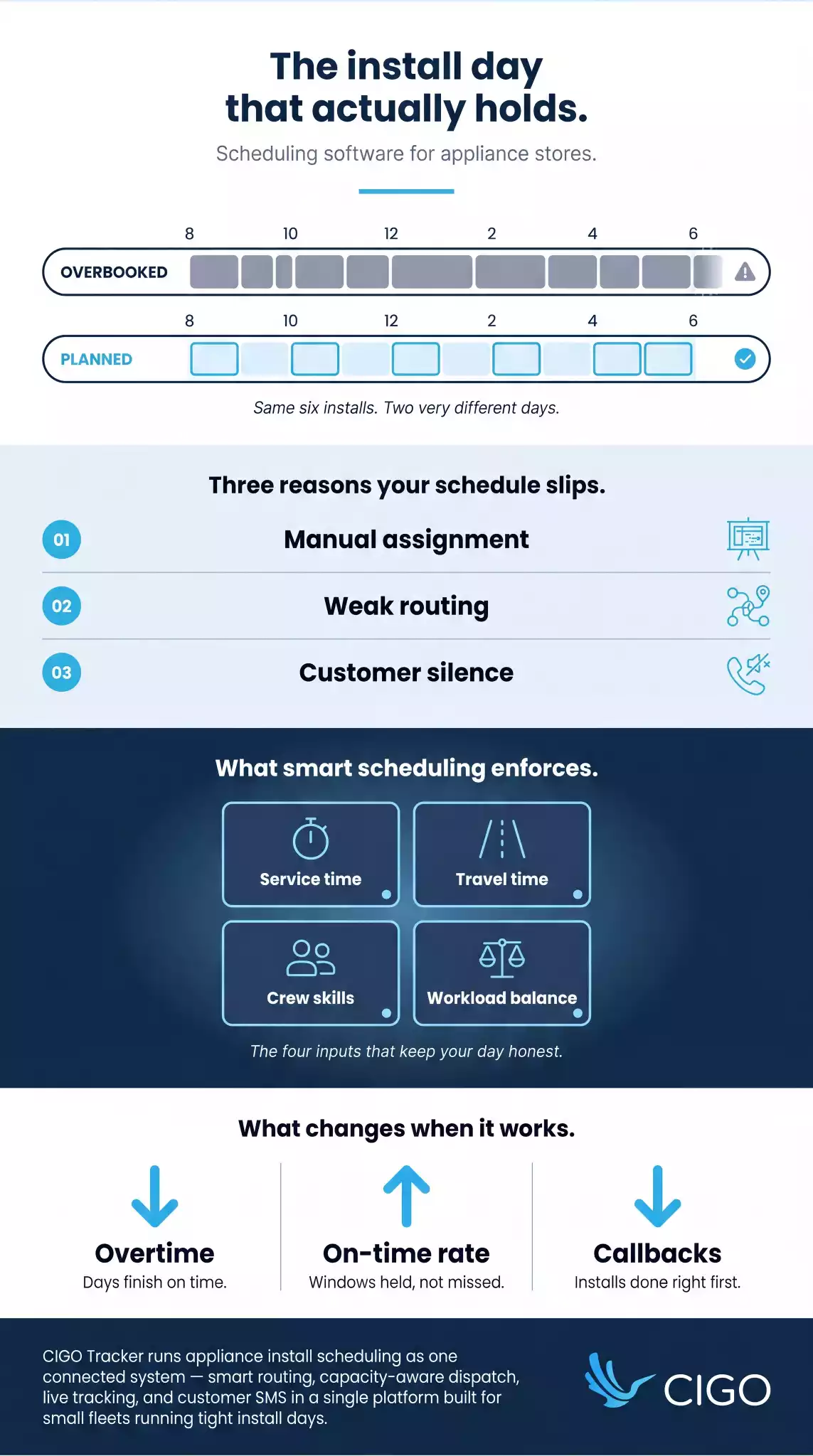
Smart scheduling is how you stop overbooking your install days at the source. Instead of relying on your dispatcher’s memory to determine when the day is full, the system enforces your capacity against real-world constraints.
That matters because ATRI’s 2025 trucking costs report found empty miles climbed to 16.7% in 2024, so every overcommitted day compounds into real cost.
Three capabilities do the heavy lifting:
- Service-time-aware capacity: A gas-range install is not the same job as a microwave swap. Delivery driver scheduling software that models service time per job type stops the calendar from assuming every stop is 30 minutes when reality looks very different.
- Travel time between stops: The system factors real driving time between addresses, not straight-line distance. A route that looks clean on a map can fall apart in city traffic, and your engine should know it.
- Balanced workload across crews: One crew should not finish at 2:00 p.m. while another runs until 7:00 p.m. Automatic load balancing spreads jobs across your roster, so nobody is burned out and nobody is underused.
These three inputs keep your day honest. The system tells you when your schedule is full, and it tells you before the day goes sideways, not after.
Role of Route Optimization in Managing Install Days
Route optimization is where your scheduling becomes execution. A clean plan on paper is worthless if your truck cannot run it, so strong routing ensures it can.
Three concrete outcomes shift with good routing:
- Reduced travel time between deliveries gives you more installs per day without adding hours or vehicles.
- More jobs can be done in a realistic day once backtracking and poor sequencing are removed from the equation.
- Improved on-time performance flows naturally from a route that respects your time windows and service-time constraints.
The pattern compounds across your week. Retailers that treat routing as the foundation of a resilient last-mile strategy see their scheduling slack grow as the day runs cleaner and exceptions shrink.
Strong logistics optimization is how appliance stores stop rebuilding the plan every morning and start refining a plan that already works.
Benefits of Using a Delivery Management System for Appliance Stores
Strong route optimization makes the day runnable, but it doesn’t stand alone. A connected delivery management system pulls your scheduling, routing, and customer updates into one operational lift across three layers that reinforce each other.
Better Time Management
Realistic schedules start with a system that knows your day’s real capacity.
When service time, travel time, and crew availability all sit in the plan together, your schedule stops over-promising and starts reflecting what your fleet can actually deliver. Last-minute chaos becomes a rare exception instead of your daily pattern.
For a small appliance store, better time management is also a sanity lift for you as the owner.
Your dispatcher stops firefighting, your drivers stop scrambling, and your schedule holds together on its own.
Improved Customer Experience
Your customers remember how the install day felt.
Accurate delivery windows, live updates, and a crew that arrives when it was supposed to arrive all reinforce the brand promise that sold the appliance in the first place. The reverse is also true, and one chaotic install can undo your marketing budget for three months.
That’s why reputation carries so much weight for appliance stores. BrightLocal’s 2024 Local Consumer Review Survey found 88% of consumers would use a business that responds to its reviews, compared to only 47% for businesses that don’t, which means your install day sits upstream of the reviews that decide your next sale.
Lower Operational Costs
Cost savings from a real scheduling platform stack up across every category:
- Fuel spend drops as your routes tighten.
- Overtime drops as your days finish inside the schedule.
- Failed attempts drop as your communication improves.
- Callback and warranty costs drop as installs happen under less pressure.
Each saving is small on a single day, but across a quarter they compound into growth capital.
Connecting the platform to the rest of your stack is how those savings compound consistently, and fleet route management built around real capacity turns that discipline into a daily habit.
How Cigo Tracker Helps Appliance Stores Avoid Overbooked Days
CIGO Tracker ties your scheduling, dispatch, routing, live tracking, and customer communication into one workflow your small team can actually run.
Four capabilities do most of the work:
- Automated scheduling keeps your day from exceeding its true capacity across drivers, vehicles, and crews.
- Advanced routing sequences install against traffic, service time, and windows so every truck runs a plan it can execute.
- Real-time tracking keeps dispatchers, drivers, and homeowners on the same page with the same information.
- A connected ecosystem with your appliance delivery software stack, so orders, inventory, and customer data stay consistent rather than scattered.
Over time, the combination tends to mean fewer overbooked days, cleaner reviews, and fewer calls you have to take.
Ready to Stop Firefighting Your Install Days?

Overbooked install days are the clearest sign your store has outgrown its scheduling tools.
The cost of letting that pattern continue, in reviews, margin, and team burnout, is higher than the cost of fixing it. Delivery schedule software for small businesses turns scheduling from a daily fire drill into a repeatable discipline, and CIGO Tracker ties it to the routing, tracking, and communication your appliance store already needs.
Book a demo to see CIGO Tracker inside your operation, or start a free trial and run it on your next install day.
FAQs
What is delivery schedule software for small business operations?
Delivery schedule software for small business operations is a platform that automates order assignment, route planning, and customer communication for small delivery teams. It replaces spreadsheets and whiteboards with a connected system that enforces realistic capacity, prevents overbooking, and gives your dispatcher real-time visibility across every install.
How does delivery driver scheduling software prevent overbooked install days?
Delivery driver scheduling software prevents overbooked days by modeling service time, travel time, and crew availability against every new job. The system flags when your capacity is full, balances workload across your roster, and produces a daily plan your crew can execute without overtime or failed appointments.
Can route optimization software help appliance stores save money?
Route optimization software saves money by reducing miles driven, shortening install-day hours, and cutting fuel spend per route. For appliance stores running on tight margins, the cumulative effect on your cost per install becomes meaningful within a quarter, especially when paired with automated scheduling and dispatcher visibility.
Why is real-time tracking important for last mile delivery software?
Real-time tracking turns last mile delivery software from an internal tool into a customer-facing experience. Your dispatcher sees live ETAs, your customer receives accurate delivery windows, and drivers work from up-to-date plans. The result is fewer missed installs, faster exception handling, and cleaner appointments.
What features should a delivery management system include for appliance installs?
A strong delivery management system for appliance installs should include automated scheduling, route optimization, real-time tracking, customer notifications, proof of delivery, and integrations with inventory and CRM. Together, these features give small appliance stores the visibility and control to run install days without chaos.